How to Implement Tempo Squats for Knee Joint Protection in Weightlifters
You should implement tempo squats with a 4-1-1 tempo to protect your knees, using a 4-second eccentric phase to reduce joint stress and build control. Keep your chest up, knees over toes, and core braced to maintain proper alignment. Perform them early in your workout with moderate loads, 3–4 sets of 6–8 reps, 2–3 times weekly. This boosts muscle activation and joint resilience without sacrificing strength. Compression sleeves can enhance feedback and warmth. Master the pattern here, and you’ll find how it smoothly integrates into heavier training later.
Notable Insights
- Use a 4-1-1 tempo to maximize eccentric control and reduce knee joint stress during squats.
- Maintain knee alignment over toes to prevent valgus collapse and minimize shear forces.
- Engage the core and keep a neutral spine to support proper hip and knee mechanics.
- Start with light or bodyweight loads to master tempo and ensure joint-safe movement patterns.
- Perform tempo squats 2–3 times weekly early in workouts to enhance joint resilience without fatigue.
Why Tempo Squats Protect Knees Without Losing Strength
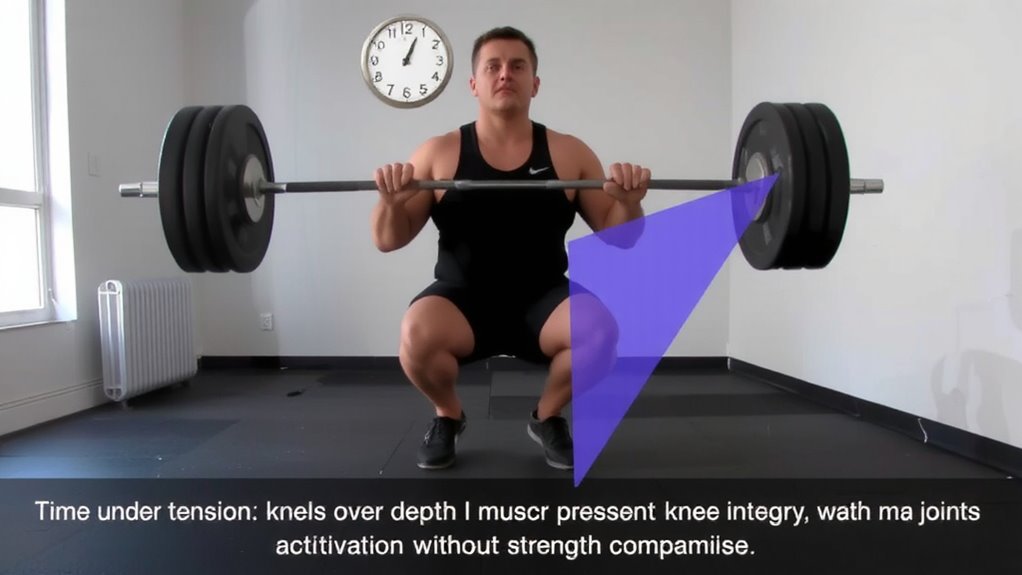
While traditional squats can place sudden stress on your knees, tempo squats reduce that risk by controlling the speed of each phase-especially the eccentric, or lowering, portion. You’re building eccentric control, which helps regulate joint loading and minimizes abrupt force spikes. That means less wear on connective tissues and a lower chance of overuse injuries. Studies show this method maintains, or even increases, strength gains despite lighter loads. The slowed descent increases time under tension, boosting muscle activation without taxing the joints. For weightlifters, this is essential-preserving knee health while still progressing. Training smart with tempo isn’t about backing off intensity; it’s about fine-tuning mechanics. Recovery improves, too, since controlled movement reduces microtrauma. Over time, consistent tempo work supports longevity, letting you train harder with fewer setbacks. The right approach balances load, movement precision, and joint preservation-making eccentric control a cornerstone of sustainable strength development.
How to Do Tempo Squats With Proper Form (Step by Step)
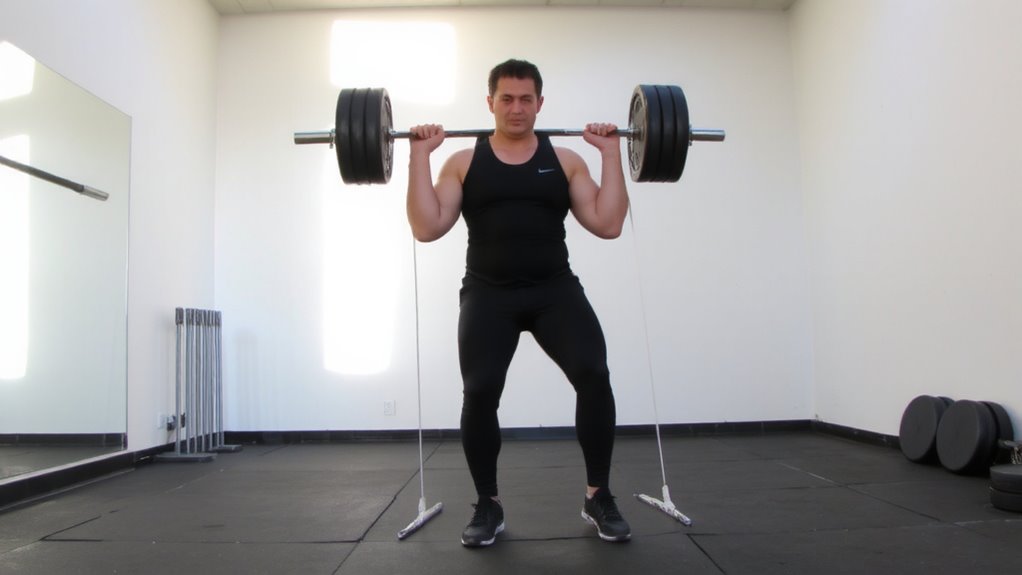
You’ll want to nail the basics before diving into tempo squats, since proper form guarantees you get the knee benefits without compromising technique. Start by standing with feet shoulder-width apart, chest up, and core engaged. Lower yourself over 3–4 seconds-this is where eccentric control matters most. By slowing the descent, you reduce compressive forces on the knee joint while boosting muscular activation. Keep your knees tracking over your toes throughout; maintaining proper knee alignment prevents valgus collapse and protects ligaments. Drive through your heels to stand, but don’t lock out completely. Use a timer or cue to stay consistent with tempo. Wear supportive shoes with a stable sole to enhance balance and joint feedback. A lifting belt isn’t necessary here-focus stays on control, not load. Perform 3–4 sets of 6–8 reps, using moderate weight until movement feels automatic. For added joint support during training, consider using best knee sleeves to help stabilize the knee and manage compressive forces.
Fix These 3 Squat Mistakes in Tempo Squats
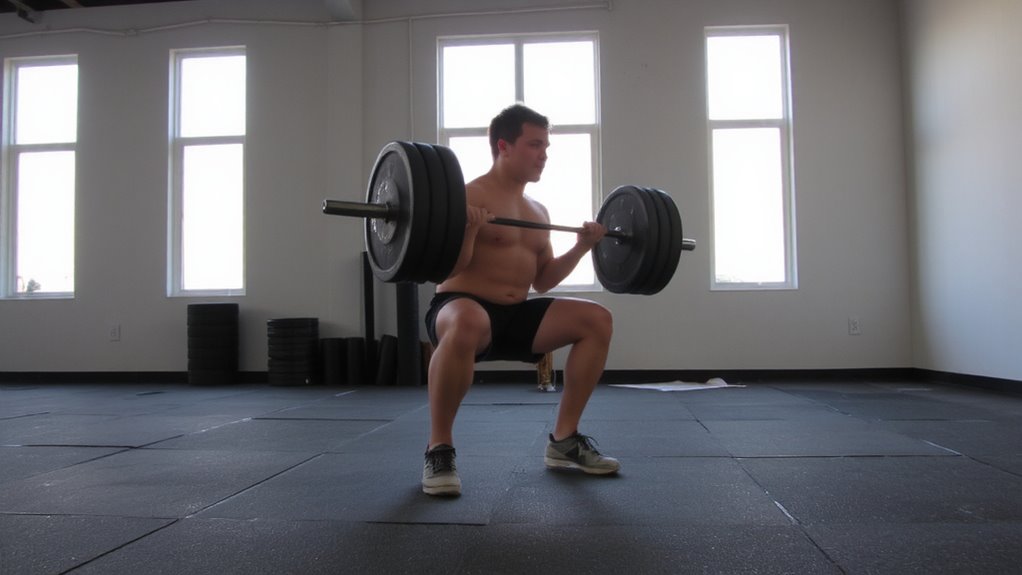
When you’re slowing down the eccentric phase of a squat to build knee resilience, it’s easy to let form slip and undo the very protection you’re aiming for. The first mistake is letting your knees cave inward-poor knee tracking increases shear stress and can lead to pain over time. Keep them aligned with your toes throughout. Second, rounding your lower back often occurs when you lose tension, compromising hip alignment and shifting load disproportionately to the knees. Maintain a neutral spine by bracing your core and hinging from the hips. Third, lifting your heels disrupts balance and reduces glute engagement, straining the knee joint. Keep your feet flat and weight in the midfoot to midheel. Correcting these errors guarantees tempo squats enhance joint integrity without introducing new risks. Proper execution supports long-term knee health and movement efficiency.
3-0-1 vs. 4-1-1: Which Tempo Should You Use?
Why do some programs prescribe a simple -1 tempo while others demand a full 4-1-1 count? It comes down to your goals and how you manage joint loading. A -1 tempo-explosive down, no pause-builds power and is great if you’re already strong and stable. But it offers less control, increasing stress on the knees under heavy loads. In contrast, 4-1-1 forces slow lowering, a solid pause, and controlled drive-this enhances time under tension and greatly reduces harmful joint loading. These tempo variations let you tailor training to knee health. For most lifters, especially those recovering or correcting imbalances, 4-1-1 provides safer stimulus. It improves muscle coordination and builds resilience. Though less flashy, it’s more effective for long-term joint protection. Choose based on your knee condition, not just strength.
Add Tempo Squats to Your Routine Safely
Though tempo squats offer clear benefits for knee protection and muscle control, integrating them safely means respecting both form and load from the start. Begin with bodyweight or light loads to master the rhythm-this isn’t just about moving slowly, but moving correctly. Proper program design places tempo squats early in your workout, after dynamic warm-ups but before heavy lifts, so fatigue doesn’t compromise technique. Use them 2–3 times weekly to support injury prevention, gradually increasing volume over 3–4 weeks. Focus on controlled eccentrics and full joint articulation without collapsing at the knees. Support your routine with recovery gear like compression sleeves to maintain joint warmth and proprioception. These tools don’t replace good form, but they complement it. Track your movement quality weekly-you’ll spot imbalances early and adjust accordingly. Safety hinges not on gear alone, but on intentional, well-structured program design that prioritizes long-term joint health over short-term gains. For added support during heavy sets, consider using best knee straps for squats to enhance stability and reduce strain on the knee joint.
Move From Tempo to Heavy Squats Safely
Since tempo squats build muscular endurance and joint awareness, you’re better prepared to handle heavier loads-but shifting too quickly can undo that progress. A well-structured squat progression guarantees your joints adapt without excessive strain. Start by gradually reducing the eccentric tempo-say, from 4 seconds down to 2-while maintaining control. This bridges the gap between tempo and maximal loads safely. Pay close attention to load management: increase weight no more than 5–10% weekly to monitor joint response. Your knee integrity depends on consistency, not sudden jumps in intensity. Track recovery markers-like morning stiffness or range of motion-to guide adjustments. Proper footwear and knee sleeves may support stability, but they can’t compensate for poor load management. Remember, durability comes from smart progression, not sheer volume. Let technique and joint feedback dictate the pace, guaranteeing long-term strength gains without compromising knee health.
On a final note
You’ll protect your knees without sacrificing strength by using tempo squats correctly. The controlled eccentric builds tendon resilience, while proper form reduces shear force. Evidence shows tempo variations like 3-0-1 enhance joint stability over time. When paired with quality knee sleeves that offer compression without restricting range, recovery improves. These tools, combined with progressive loading, make tempo squats a smart, sustainable choice for long-term knee health in lifters.