Sport-Specific Jump-Land-Cut Sequences for Soccer Players Clearing Return-to-Play Testing
You need sport-specific jump-land-cut drills to prove your body can handle soccer’s explosive demands post-injury. These sequences build core stability, improve neuromuscular control, and train soft, balanced landings to reduce re-injury risk. Mastering single-leg stability and knee alignment guarantees safe deceleration and sharp cuts. Progressing from double-leg to single-leg drills develops the proprioception and joint control essential for game-speed actions. Smart cueing locks in proper mechanics-keep going, and you’ll see how to integrate them effectively.
Notable Insights
- Jump-land-cut drills replicate soccer-specific movements, enhancing neuromuscular coordination for safe return-to-play.
- Single-leg stability and proper knee alignment reduce re-injury risk during high-demand directional changes.
- Progressive plyometric loading improves joint control, deceleration, and reacceleration mechanics post-injury.
- Real-time cueing (“soft knees”) reinforces safe landing techniques and builds athlete confidence.
- Sport-specific drills integrate core engagement and proprioception to optimize dynamic movement precision.
Why Soccer Players Can’t Skip Jump-Land-Cut Drills
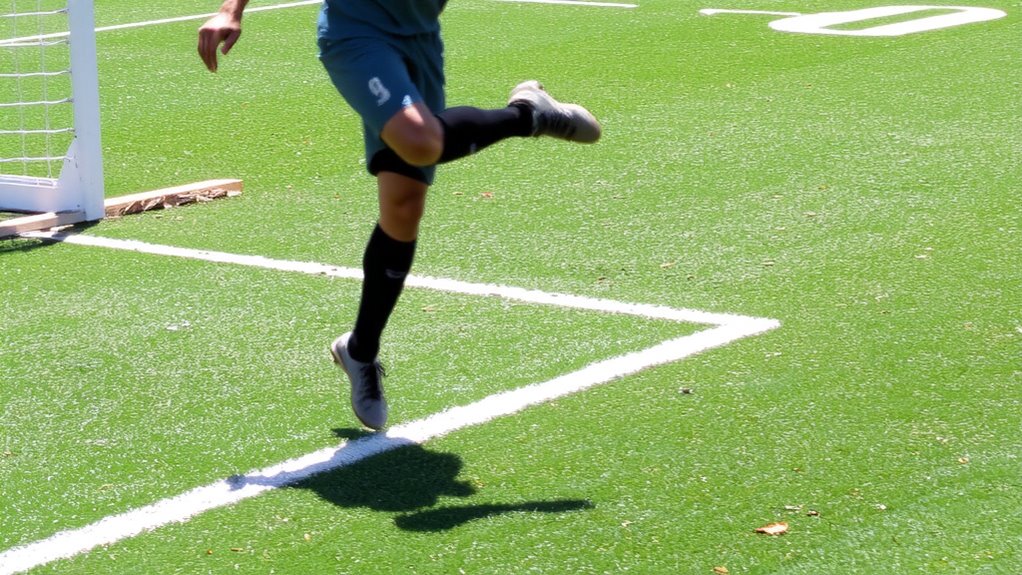
While you might prioritize ball work and endurance drills, neglecting jump-land-cut sequences puts you at a real disadvantage on the field. These movements mimic the explosive changes in direction you face during actual play, making them essential for sport-specific readiness. Proper core engagement stabilizes your torso on landing, reducing energy leaks and boosting power transfer. Without it, even strong legs can’t compensate for rotational instability. Plyometric timing-your ability to coordinate muscle activation between landing and cutting-is equally critical. It guarantees you decelerate efficiently and reaccelerate with precision. Drills that integrate both elements train your nervous system to react faster under fatigue, a key demand in late-game situations. Skipping them limits performance and increases fault movement patterns. Recovery tools like foam rollers or compression gear help maintain muscle quality post-drill, supporting consistent training. You can’t replicate this neuromuscular specificity with isolated exercises.
How Jump-Land-Cut Drills Lower Re-Injury Risk
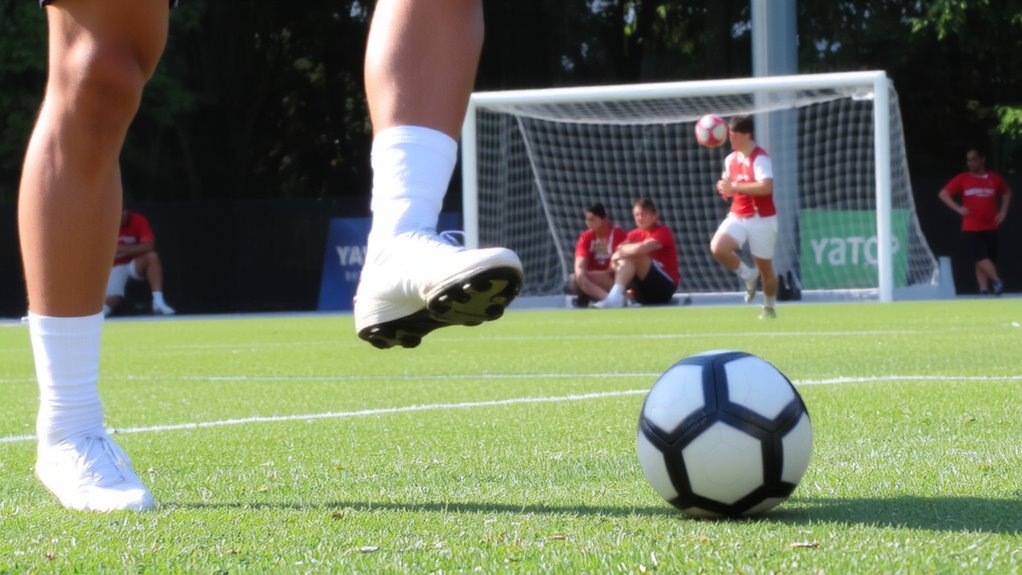
Your body’s ability to handle sudden shifts in direction hinges on muscle control and joint stability-both of which are directly improved by consistent jump-land-cut drill practice. These drills enhance load management by teaching your neuromuscular system to absorb impact efficiently, reducing stress on healing tissues. You’re less likely to overload vulnerable joints when movements become automatic and controlled. Equally important is psychological readiness-repetition builds confidence in your body’s ability to perform without reinjury. When you’ve practiced landing softly and cutting sharply under game-like conditions, uncertainty diminishes. This mental resilience is as critical as physical preparedness. Unlike generic rehab exercises, jump-land-cut sequences simulate real demands of soccer, preparing you not just to return, but to compete safely. Proper progression guarantees workload increases gradually, aligning physical adaptation with mental assurance-key for long-term success and injury-resistant performance on the field.
Master Single-Leg Stability, Knee Alignment, and Hip Control
A solid foundation in single-leg stability, knee alignment, and hip control isn’t just beneficial-it’s essential for soccer players returning to play after injury. You need precise neuromuscular control to handle the demands of cutting, pivoting, and sudden decelerations. Poor alignment increases re-injury risk, especially at the ACL. Training your balance reactions through targeted exercises improves dynamic joint positioning. Incorporating proprioceptive challenges-like foam surfaces or unstable platforms-sharpens your body’s ability to respond mid-movement. Proper hip control prevents excessive knee valgus, a common flaw during landing. You’ll notice better movement efficiency and reduced joint strain when form is prioritized over load. These skills aren’t just about strength; they reflect coordination and timing. Consistent practice develops reliable motor patterns, critical for high-speed play. Focus on quality reps, not volume, to build trust in the injured limb. This phase sets the standard before progressing to sport-specific drills.
Advance From Double-Leg to Single-Leg Jump-Land-Cut Drills
You’ve built single-leg stability, controlled knee alignment, and strengthened hip motor patterns-now it’s time to put those gains to work under more realistic demands. Shifting from double-leg to single-leg jump-land-cut drills marks a critical stage in plyometric progression, challenging your body to absorb force and redirect movement on one leg. This shift increases load on the musculoskeletal system, demanding greater neuromuscular adaptation to maintain proper mechanics under dynamic conditions. You’ll start with low-intensity jumps-like a single-leg landing from a small hop-focusing on soft, quiet touchdowns with the knee aligned over your toe. As control improves, add small cuts or direction changes. These drills bridge rehab and performance, priming your body for sport-specific actions. Consistent practice enhances proprioception, muscle timing, and joint stiffness regulation-key for injury resilience. Proper footwear and even surface use support safe execution.
Train Game-Like Moves With Sport-Specific Jump-Land-Cut Drills
With game-speed demands in mind, sport-specific jump-land-cut drills replicate the unpredictable movements soccer players face during competition-think quick cuts after landing, sudden stops off one leg, or directional shifts following a jump. These drills build dynamic control by challenging your neuromuscular system to stabilize under real-game loads. You don’t just jump and land-you respond, adjust, and change direction with purpose. Integrating plyometric progression guarantees you advance safely from controlled reps to explosive, complex sequences. Coaches use these drills not just for performance, but to assess readiness, knowing that mastering them reflects improved joint stiffness management, landing mechanics, and muscle coordination. Unlike generic jumps, these sequences demand precise foot placement, trunk control, and timing-skills directly tied to in-game resilience. They bridge the gap between rehab and return, sharpening your reactive ability while lowering re-injury risk. When programmed correctly, they’re a key metric in clearing return-to-play protocols.
Use Cues to Reinforce Safe Landings and Build Confidence
Every successful jump-land-cut sequence starts with a landing that’s quiet, balanced, and in control-so using targeted cues isn’t just helpful, it’s essential for building both safety and self-assurance. You benefit from verbal or visual prompts like “soft knees” or “land light” because they shape proper mechanics and reinforce neuromuscular control. Incorporating mental imagery-visualizing a stable, efficient landing before execution-sharpens focus and movement precision. Cues also support emotional regulation, especially post-injury, by replacing fear with actionable thoughts, helping you trust your body again. Over time, consistent cueing builds automaticity, making safe landings second nature during high-pressure moments. Coaches should pair cues with real-time feedback to fine-tune technique. Unlike passive recovery tools, cue-driven training actively rebuilds confidence and function. It’s not just about form-it’s about rewiring your response to dynamic demands on the field, ensuring you return not just fit, but fully prepared.
On a final note
You’ve put in the work to rehabilitate, and now jump-land-cut drills bridge recovery to performance. These sport-specific movements fine-tune knee alignment, hip control, and single-leg stability-critical for safe return to soccer. Progressing from double- to single-leg drills builds confidence and reduces re-injury risk. Used consistently, they reflect real-game demands, making them essential in any return-to-play plan.