Using Isokinetic Testing to Confirm Quadriceps Recovery Before Basketball Players Resume Jump Training
You rely on strong quads for jumps, cuts, and defense, but after injury, strength symmetry is critical-weakness or imbalance raises re-injury risk. Isokinetic testing measures peak torque and endurance at various speeds, revealing true quad recovery and neuromuscular efficiency. It detects imbalances your body might hide, ensuring both legs produce equal force. Without this data, returning to jump training could overload the recovering leg. Trusting these results means safer, smarter progression-there’s more to learn about optimizing your return.
Notable Insights
- Isokinetic testing objectively measures quadriceps peak torque to confirm sufficient strength for jump training.
- A strength symmetry index within 10% between legs reduces reinjury risk during explosive jumps.
- Testing at multiple angular velocities reveals functional deficits that single-speed assessments may miss.
- Quadriceps endurance is assessed through torque decline during repeated contractions at set speeds.
- Testing should occur after full range of motion and pain-free strength are achieved, typically 6–8 weeks post-injury.
Why Quadriceps Strength Matters for Basketball Players
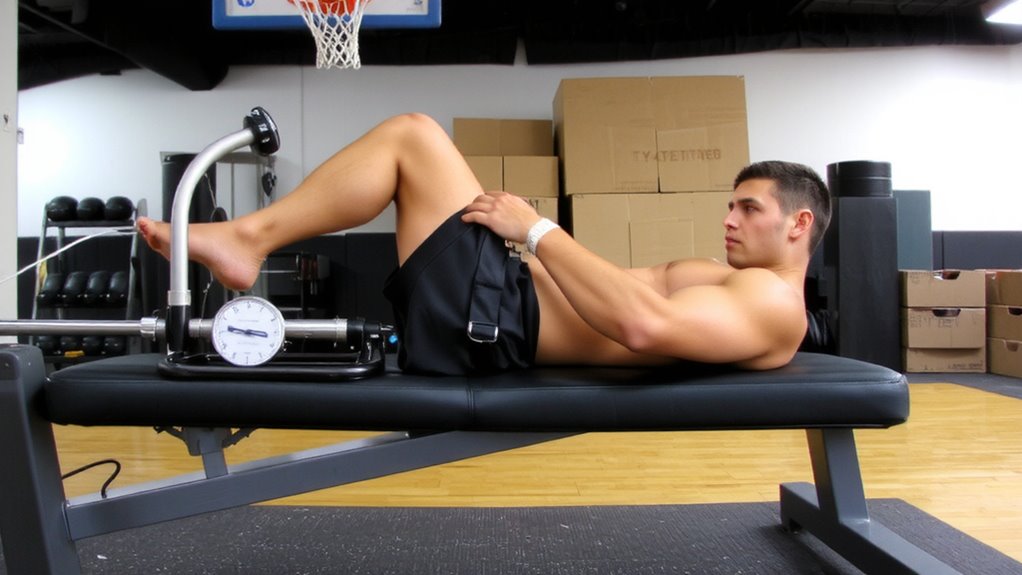
Strength isn’t just a measure of power-it’s the foundation of resilience, especially in the relentless rhythm of basketball. You rely on quad dominance for explosive jumps, sharp cuts, and sustained defensive stances. Without it, your performance dips and injury risk climbs. Strong quads absorb impact, stabilize your knees, and power your pushes down the court. But it’s not just about raw force-muscle endurance guarantees your legs keep performing through four quarters. When fatigue sets in, weak quads falter, disrupting your form and slowing reactions. That’s where isokinetic testing proves valuable: it objectively measures both peak torque and endurance across repetitions, revealing if your strength matches game demands. Fitness recovery tools like these don’t just track progress-they confirm readiness. You can’t afford guesswork when returning to jump training; precision keeps you effective and safe on the hardwood.
Why Strength Symmetry Matters After Quad Injury
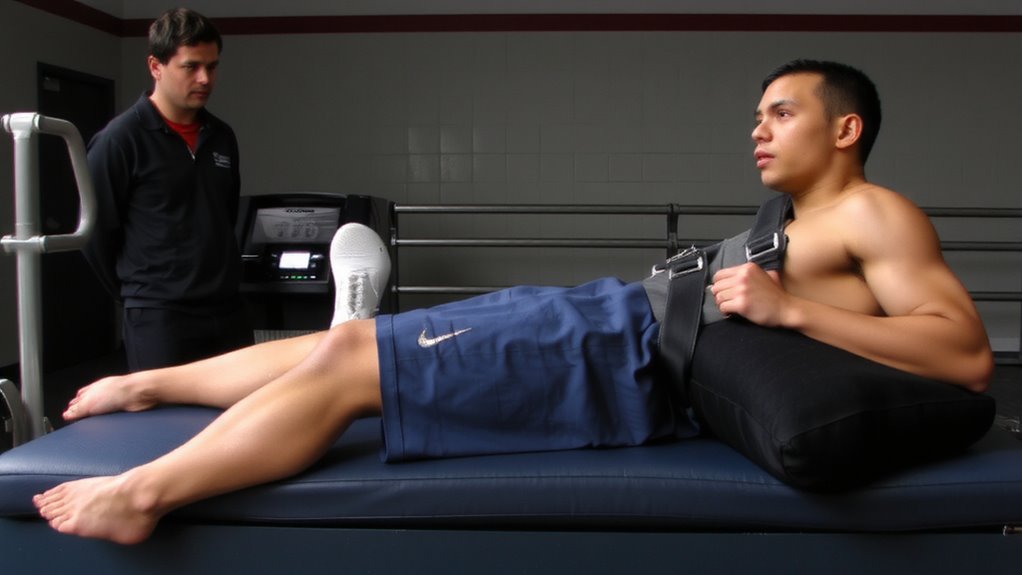
After a quadriceps injury, having even a 10–15% difference in strength between your legs isn’t just a minor imbalance-it’s a red flag that could undermine your return to play. That muscle imbalance increases stress on your recovered leg, raising reinjury risk during explosive movements like jumping or cutting. Your body compensates unevenly, disrupting coordination and reducing functional stability when you need it most. For basketball players, whose performance relies on symmetry in power and control, persistent asymmetry can degrade agility and increase joint strain. You might feel strong enough, but without balanced strength, your neuromuscular system can’t coordinate movements efficiently. Restoring symmetrical strength guarantees both legs contribute equally, supporting safer, more effective load distribution. Addressing these imbalances isn’t just about recovery-it’s about guaranteeing your body functions as a unified system, ready for the demands of competitive play.
How Isokinetic Testing Measures Leg Balance
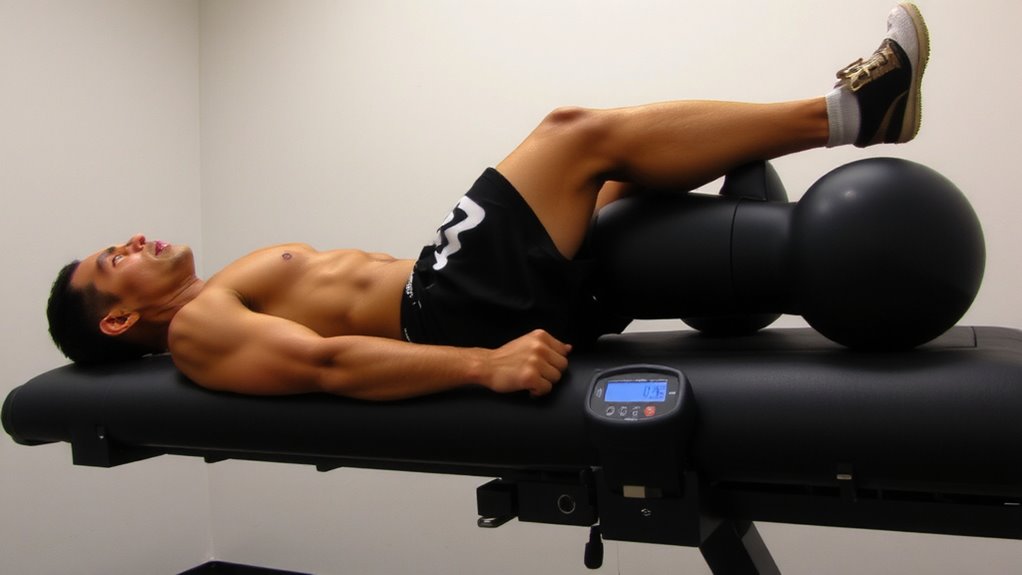
You’re not just rebuilding strength when you return from a quad injury-you’re rebuilding trust in your body’s ability to perform under pressure. Isokinetic testing gives you that confidence by precisely measuring force production in both legs through controlled, velocity-specific movements. It detects subtle imbalances others miss, especially those tied to leg dominance-your body’s natural favoring of one side-which can skew mechanics and increase reinjury risk. The test also tracks muscle fatigue by analyzing torque decline over repeated contractions, revealing how evenly each leg sustains performance. Unlike simple strength tests, isokinetic assessments expose asymmetries that persist even when you *feel* equal on both sides. This level of detail is critical for basketball players facing explosive jumps and cuts. Ignoring these imbalances means relying on guesswork, not data. Isokinetic testing turns recovery into a measurable, objective process-ensuring both legs contribute fairly, safely, and efficiently when it matters most.
What Torque Ratios Reveal at Different Speeds
Why do some athletes clear strength tests but still struggle with explosiveness or coordination on the court? The answer often lies in how torque ratios shift across angular velocities. At lower speeds, you might show balanced quad-to-hamstring strength, but as angular velocity increases, torque variability exposes functional deficits. High-speed movements-like jumping or cutting-demand consistent torque production under dynamic loads, and asymmetries become more apparent. If your torque ratios degrade at higher speeds, it suggests neural inhibition or incomplete muscle re-education. Isokinetic testing at multiple velocities reveals these hidden weaknesses, ensuring you’re not just strong, but also coordinated and explosive. Relying only on slow-speed data gives an incomplete picture. Evaluating torque across velocities provides a clearer, more functional insight into true readiness-especially for basketball, where speed and power are non-negotiable.
When to Test During Return-to-Play Rehab
Testing too early can give misleading results, while waiting too long might delay your return without reason-timing matters just as much as the metrics themselves. You should schedule your first isokinetic test when you’ve reached key recovery benchmarks, like pain-free full range of motion and solid strength during functional movements. Typical test timing falls around 6–8 weeks post-injury, but that varies based on individual healing and rehab adherence. Testing too soon may show false deficits because your quad isn’t ready for maximal effort. Conversely, delaying beyond clinical readiness doesn’t add value and may lead to unnecessary deconditioning. Using test timing aligned with functional milestones guarantees accurate data on strength symmetry and torque output. That way, you’re not just guessing-you’re confirming readiness with objective measures, which supports a smarter, safer progression into jump training and full play.
How Data Lowers Re-Injury Risk After Quad Recovery
Though objective metrics might seem like just another step in the rehab process, they actually play a critical role in reducing your risk of re-injury after quad recovery. Isokinetic testing gives you hard data on strength symmetry, muscle endurance, and fatigue resistance-key factors that aren’t easily judged by feel or observation. When your injured quad matches the uninjured side in peak torque and sustains performance across repeated contractions, you’re not just stronger-you’re safer. Without this data, you might return too soon, relying on guesswork instead of proof. Fatigue resistance, in particular, reveals how well your muscle handles load over time, mimicking game-like demands. Muscle endurance trends also help track progress accurately, guiding when to advance exercises. Using this tech isn’t overkill-it’s smart prevention. You wouldn’t drive without seatbelts; don’t return without data.
On a final note
You’ve seen how vital quad strength is for jumping and cutting, and now isokinetic testing gives you objective proof of recovery. It’s not just about strength-it’s symmetry and torque balance at game-like speeds. Without this data, returning to jump training risks re-injury. Using this tech isn’t optional gear; it’s smart, evidence-based rehab that keeps you competitive and durable long-term.