How to Build Lower Body Resilience in Sprinters Using Single-Leg Eccentric Loading
You build lower body resilience by using single-leg eccentric exercises like Nordic lowers and slow step-downs, which strengthen muscles and tendons under controlled lengthening. This boosts joint stability, corrects imbalances, and enhances hamstring activation-key for sprint deceleration. Perform these 2–3 times weekly on recovery days to improve force absorption and reduce injury risk. Proper form guarantees maximum benefit. There’s more to optimizing this approach for speed and recovery just ahead.
Notable Insights
- Perform eccentric single-leg squats with a 4-second descent to enhance knee stability and build joint resilience.
- Incorporate Nordic hamstring lowers to strengthen the posterior chain and reduce hamstring strain risk.
- Use single-leg Romanian deadlifts with slow eccentrics to improve hamstring activation and neuromuscular control.
- Train with lateral step-downs to increase frontal plane stability and correct limb imbalances.
- Integrate exercises 2–3 times weekly on recovery days to boost tendon resilience and sprint-specific strength.
How Single-Leg Eccentrics Prevent Sprint Injuries
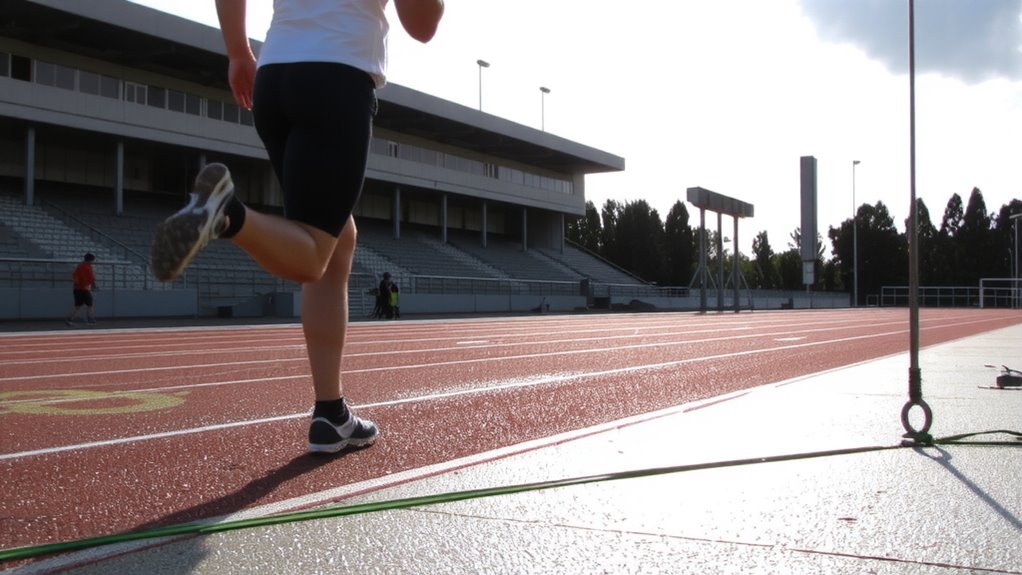
Why do so many sprinters still overlook the power of single-leg eccentrics when it comes to injury prevention? You’re asking for trouble if you skip these. Single-leg eccentric drills dramatically enhance knee stability by strengthening the muscles around the joint during lengthening contractions-exactly when injuries often occur. You’re not just building muscle; you’re training control. These movements also boost hamstring activation, critical for decelerating your leg during sprinting. Without proper hamstring strength and timing, you’re at higher risk for strains. Equipment like eccentric-dedicated sleds or resistance bands helps, but even bodyweight variations offer value when performed with intent. You don’t need flashy gear-just consistency and proper form. Coaches who integrate these into warm-ups or recovery sessions often see fewer lower-limb setbacks. It’s not magic; it’s mechanics. Smart runners use them. You should too.
4 Science-Backed Benefits for Speed and Resilience

You’re already seeing how single-leg eccentrics shore up weak points that lead to injury, but their real advantage shows up when you connect that resilience to performance. These exercises boost muscle symmetry and neuromuscular efficiency-two keys to explosive speed and consistent strides. When both legs contribute equally and your nervous system fires faster, your sprint mechanics improve dramatically. Research shows runners with balanced strength patterns generate more force per stride and recover quicker between sessions.
| Benefit | Mechanism | Performance Impact |
|---|---|---|
| Muscle symmetry | Reduces limb imbalances | Smoother stride, less drag |
| Neuromuscular efficiency | Faster motor unit recruitment | Quicker acceleration |
| Tendon resilience | Increased fascicle length | Greater energy return |
Over time, this translates to faster times and fewer breakdowns-especially under fatigue.
Top 5 Single-Leg Eccentric Exercises for Sprinters

While building raw speed matters, refining control under load is what truly shields sprinters from breakdowns, and single-leg eccentric drills excel here. You’ll boost knee stability and ankle mobility-both critical for force transmission and injury resistance. Start with eccentric single-leg squats on a 4-inch block, lowering over 4 seconds to improve hip and knee control. Try Nordic hamstring lowers-these build serious posterior chain resilience. Add single-leg Romanian deadlifts with a slow descent to challenge balance and loading mechanics. Include split squats with an emphasis on the rear leg’s eccentric phase to enhance unilateral strength. Finish with lateral step-downs, which refine frontal plane control. Each move reinforces joint integrity under deceleration, a key demand during sprinting. You’ll notice sharper shifts, reduced stiffness, and better ground contact precision-all signs your lower body is adapting smarter, not just stronger.
How to Add Eccentrics to Your Weekly Sprint Workouts
Since eccentric training places greater demand on the neuromuscular system, you’ll need to strategically integrate it into your sprint schedule to avoid overreaching. Aim to include eccentric work 2–3 times weekly, aligning with lower-intensity sprint sessions or recovery days to support fitness recovery. Exercise timing matters-perform eccentric drills before main sprint sets if focusing on activation, or after to prioritize fatigue management. For effective workout integration, pair single-leg eccentrics like Nordic curls or split squats with dynamic warm-ups or cool-downs, ensuring proper muscle engagement without compromising sprint quality. Begin with 2–3 sets of 6–8 reps per leg, emphasizing control. Avoid stacking intense eccentric work before maximal velocity sessions. Instead, use it to complement technical drills, enhancing tendon resilience and movement efficiency. Monitor soreness and adjust volume accordingly-consistency matters more than intensity. Proper recovery gear, like compression sleeves or best foam rollers, can aid tissue adaptation.
Fix These 3 Form Mistakes to Stay Safe and Strong
Eccentric training builds strength and resilience, but even the best programming can’t compensate for poor sprinting mechanics. Fix these three common form mistakes to protect your joints and maximize power. First, losing hip stability during single-leg loading shifts stress to the knee, increasing injury risk. Keep your pelvis level and core engaged. Second, collapsing inward at the knee during deceleration disrupts knee alignment-track your knee over the second toe. Third, overstriding alters force distribution, straining hamstrings and hips.
| Mistake | Fix |
|---|---|
| Hip drop during stance | Activate glutes, maintain hip stability |
| Knee valgus (inward collapse) | Cue knee alignment with toes |
| Excessive forward lean | Stay tall, control eccentric phase |
Master these fixes, and your form won’t just look better-it’ll function better, too.
On a final note
You’ve seen how single-leg eccentric loading builds stronger, more resilient sprinters by enhancing muscle control and reducing injury risk. When paired with proper recovery tools-like compression gear and foam rollers-eccentrics accelerate adaptation. The right fitness gear supports this process, but consistency in form and loading matters most. Used wisely, these methods improve sprint mechanics and durability, making them essential for any serious speed athlete’s routine.