Designing a Pre-Season Functional Strength Program for Rugby Forwards
You need a periodized pre-season program stacking hypertrophy, strength, and power phases to build resilient, functional force. Focus on compound lifts like front squats and cleans to train movement patterns under load, boosting neuromuscular efficiency. Integrate core stability with Pallof presses and loaded carries-this reduces energy leaks during scrums and rucks. Prioritize recovery with sleep, nutrition, and compression gear to support connective tissue repair. You’ll see how smart programming translates directly to impact dominance.
Notable Insights
- Focus on compound, multi-planar exercises that replicate rugby-specific movements like scrums and rucks.
- Prioritize core stability with anti-rotation exercises to enhance force transfer and reduce injury risk.
- Structure training in phases: hypertrophy, maximal strength, and power peak over 8 weeks.
- Use Olympic lifts and plyometrics to develop explosive power and neuromuscular efficiency.
- Incorporate posterior chain and loaded carry exercises to build resilience and on-field strength.
Build Functional Strength for Rugby Forwards
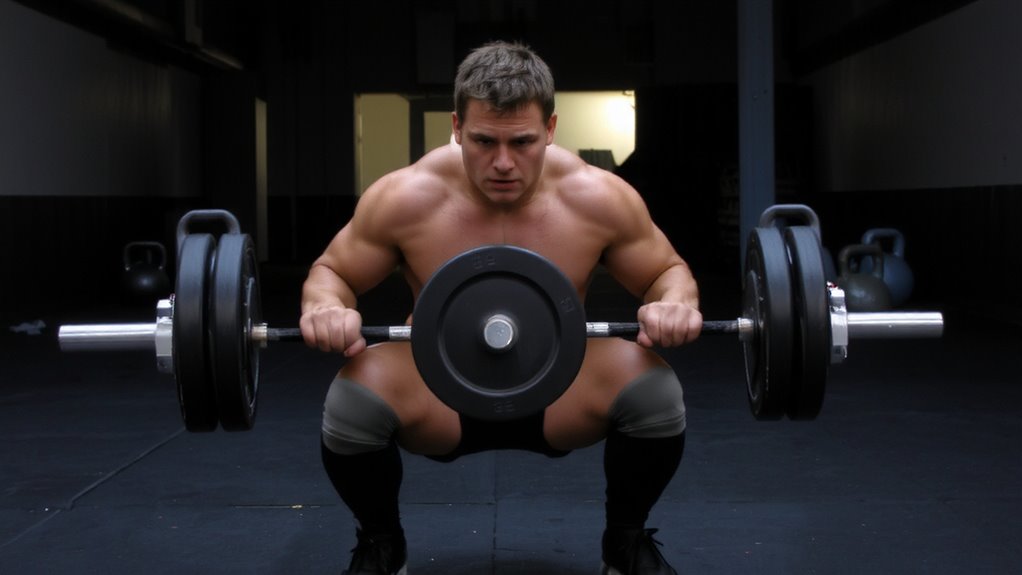
Strength-especially the kind that translates directly to the field-is non-negotiable for forwards, and that starts with building functional strength. You need movements that mirror real match demands, not just isolated lifts. Core stability isn’t just about six-packs; it’s the foundation for force transfer during scrums, rucks, and mauls. A strong, engaged core enhances balance and power output while reducing energy leaks. More importantly, it’s a cornerstone of injury prevention. Repetitive impacts and sudden directional changes stress joints and connective tissues-poor stability increases risk. Training should integrate compound, multi-planar exercises that condition joints and muscles under load. Your recovery matters just as much: quality sleep, nutrition, and proper use of compression gear support tissue repair. Well-designed functional strength programs don’t just build power-they create resilient athletes who withstand season-long demands and maintain performance consistency. Using supportive gear like knee straps for squats can help stabilize the joint during heavy lifts and reduce strain on tendons.
Choose the Best Exercises for Forward Performance

While compound movements lay the foundation, picking the right exercises is what fine-tunes your body for forward dominance. You need drills that boost core stability and support injury prevention without sacrificing power. Exercises like front squats, Romanian deadlifts, and weighted carries translate force efficiently, mimicking scrum drives and ruck engagements. Including Pallof presses and suitcase deadlifts challenges anti-rotation, reinforcing a rigid torso under load-critical when contesting in tight phases. Medicine ball slams enhance explosive output while conditioning your trunk to withstand impact. You’ll also benefit from glute-ham raises, which strengthen posterior chains often overworked during repeated tackling. These selections don’t just build muscle-they condition connective tissues and improve joint resilience. Prioritizing movements that demand balance, control, and full-system engagement guarantees you’re not just strong, but durable. Smart exercise choices now reduce breakdowns later, keeping you on the field where it matters.
Train Movement Patterns, Not Isolated Muscles
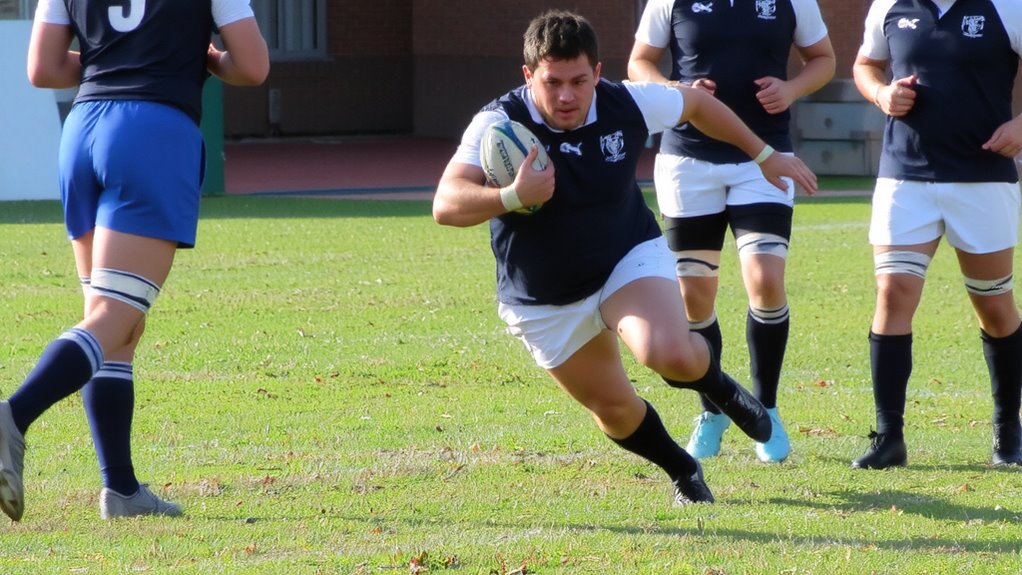
You’ll get more from your training when you focus on how your body moves, not just which muscles fire. Rugby forwards need functional strength that mimics on-field demands, meaning movement patterns like pushing, pulling, squatting, and rotating should drive your program. These actions build coordination, core stability, and joint mobility far better than isolated exercises. Training movements also improve neuromuscular efficiency, so your body reacts faster during tackles or scrums. Think of exercises like lunges with rotation or resisted sled pushes-they engage multiple systems at once. This approach guarantees your strength translates directly to performance. Isolating muscles might build size, but it doesn’t prepare your body for chaos. Prioritizing movement patterns conditions your entire system, boosts resilience, and supports injury prevention. With better core stability and joint mobility, you move efficiently and sustain heavy loads. It’s not just about power-it’s about control under pressure.
Use Compound Lifts to Build Power and Resilience
Power isn’t just about explosive starts or dominant tackles-it’s forged in the weight room through movements that demand total-body coordination and control. You need compound lifts because they integrate multiple muscle groups, building real strength that translates on the field. Olympic lifts like cleans and snatches are especially effective, training your body to generate explosive power from the ground up. These movements improve neuromuscular efficiency, helping you react faster and hit harder. Unlike isolation exercises, they condition joints, tendons, and connective tissues under load, boosting resilience. Yes, technique matters-poor form increases injury risk-but with proper coaching, the payoff is unmatched. You’re not just lifting weight; you’re refining force application. When done consistently, these lifts enhance both output and durability, preparing you for the physical demands of scrums, rucks, and sprints. They’re not flashy shortcuts-they’re foundational tools.
Structure Your Pre-Season Strength Program
Since building strength for rugby forwards demands both systematic progression and recovery management, your pre-season program should follow a periodized structure that aligns with on-field demands. Effective periodization planning guarantees steady gains while minimizing injury risk. Begin with a hypertrophy phase, then shift toward maximal strength, and peak with power development. Strength testing at the start and end of each phase lets you track progress objectively and tweak training loads accordingly. Use reliable benchmarks like 1RM squats or deadlifts to guide adjustments. Here’s a simplified weekly layout during the strength phase:
| Week | Focus | Key Lift Intensity |
|---|---|---|
| 1–3 | Hypertrophy | 3–4 sets × 8–10 reps @ 70% 1RM |
| 4–6 | Max Strength | 4–5 sets × 4–6 reps @ 85% 1RM |
| 7–8 | Strength-Power Peak | 5 sets × 3 reps @ 90% + jumps |
This phased approach maximizes adaptation.
Recover Strategically to Stay Match-Ready
Building strength through periodized training sets the foundation, but without smart recovery, gains can stall and injury risk climbs. You need to actively manage fatigue to stay match-ready. Incorporate active recovery-like light cycling or swimming-on rest days to boost circulation and clear metabolic waste. These low-intensity sessions aren’t just filler; they maintain joint mobility and support tissue repair. Combine this with foam rolling and dynamic stretching to enhance muscle resilience. Monitoring fatigue with wearable tech helps tailor recovery, ensuring you don’t overreach. Quality sleep and nutrition are non-negotiable; they directly influence adaptation. Compression gear may offer modest benefits in reducing soreness, though evidence is mixed. Still, when used with proven methods, it can complement your routine. Prioritizing injury prevention means balancing load with recovery. Smart recovery isn’t passive-it’s a strategic part of your program that keeps you strong, available, and ready to perform when it counts. For optimal results, choose a foam roller with appropriate density and texture, as the best option depends on your recovery needs and tolerance-consulting a comparison of the best foam rollers can guide your selection.
On a final note
You’ll need more than strength to dominate as a forward-recovery and gear matter just as much. Compression wear and foam rollers help manage soreness, letting you train harder, more consistently. Good recovery isn’t passive; it’s strategic, active, and essential. Pair smart programming with quality equipment-knee sleeves, lifting belts, durable mats-and you’ll sustain performance. Neglect recovery or use subpar gear, and gains erode. Prioritize both, and you’ll stay match-ready all pre-season.