Expiratory Pressure Builds Held During Rowing Finish Phase to Engage TA
You generate expiratory pressure at the finish by sharply exhaling against resistance, which boosts intra-abdominal pressure and engages your transverse abdominis. This core bracing stabilizes your spine, improving force transfer from legs to handle. A controlled “hiss” rather than passive breath release enhances timing and trunk stiffness. Proper timing locks your core just before full compression, turning your midsection into a stable power conduit-key for strength and back safety. Master this, and you’ll access more efficient, protected strokes.
Notable Insights
- Expiratory pressure during the rowing finish phase enhances transverse abdominis (TA) engagement through controlled forceful exhalation.
- A sharp, deliberate exhalation just before full compression increases intra-abdominal pressure, stabilizing the core at the stroke’s end.
- The “hiss-like” exhalation at the finish promotes diaphragmatic bracing, improving spinal support and TA activation.
- Proper timing of expiratory pressure with handle arrival at the finish optimizes core stiffness and power transfer.
- Maintaining expiratory pressure briefly at finish sustains TA engagement, enhancing postural control and stroke efficiency.
What Is Expiratory Pressure?

Breathing isn’t just about airflow-it’s about control, timing, and pressure, especially when you’re pushing hard on the rowing machine. Expiratory pressure is the force you generate when you breathe out against resistance, and you’re likely creating it without realizing. During intense strokes, you brace your core, engage your diaphragm, and build intra abdominal pressure-this stiffness stabilizes your spine. Proper diaphragmatic breathing lets you control this pressure deliberately, not just reactively. You’re not just moving air; you’re shaping internal force to support power output. Fitness recovery tools like breathing trainers claim to strengthen this response, but many lack evidence linking use to real rowing performance. Still, understanding expiratory pressure gives you an edge: it’s not just lungs at work, but a full-core effort where breath and stability intersect. Train it with purpose, not gadgets.
Why It Powers Your Rowing Stroke

You’re generating force with every stroke, but what you might not notice is how your breath shapes that power. Holding expiratory pressure at the finish engages your transverse abdominis, creating a stable core that improves power transfer from legs to handle. Without this tension, energy leaks, reducing stroke efficiency. Think of your torso as a conduit-only when braced can force move seamlessly through your body.
| Phase | Effect on Core Stability |
|---|---|
| Inhalation | Relaxes abdominal wall |
| Exhalation | Activates deep core |
| Pressure build | Enhances rigidity |
| Release | Reduces support |
This intra-abdominal pressure acts like an internal weight belt, supporting spine and pelvis. When timed right, it amplifies stroke efficiency and sharpens power transfer, making each pull stronger and more controlled. You’re not just moving water-you’re channeling force with purpose.
How to Build Expiratory Pressure at the Finish
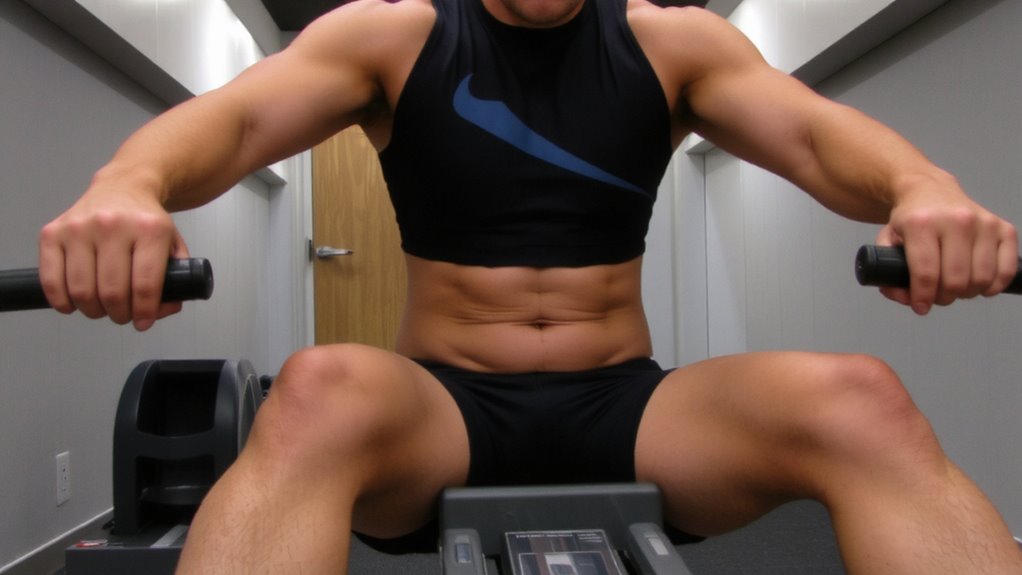
While driving through the finish, maintaining a sharp exhalation just before full compression helps lock your core in place. You’re not just exhaling-you’re creating diaphragmatic bracing by resisting the rebound of your breath, which enhances intra abdominal control precisely when stability matters most. Think of it as a controlled “hiss” rather than a passive release, letting your deep core engage without losing power. This technique works best when timed with the handle’s final pull, sustaining pressure as your body reaches peak compression. It’s not about breath volume, but precision-small, sharp exhalations increase trunk stiffness more effectively than forceful breathing. Rowers who master this report smoother finishes and less low-back strain. The mechanism relies less on muscular tension and more on neuromuscular coordination, making it energy efficient. With consistent practice, this method becomes automatic, improving stroke quality and promoting better force transfer through ideal intra abdominal control and diaphragmatic bracing at critical phases.
How Rowers Fire Their Deep Core at the Catch
As you approach the catch, engaging your deep core isn’t just about stiffness-it’s about timing and neuromuscular readiness. You need precise pelvic tilt and ideal spinal alignment to transfer power efficiently. Firing your transverse abdominis early stabilizes the lumbar spine, letting your limbs move freely without compromising form.
| Body Position | Muscle Engagement |
|---|---|
| Pre-catch flexion | Transverse abdominis activation |
| Pelvic tilt (posterior) | Internal obliques support |
| Neutral spine | Erector spinae maintains alignment |
A posterior pelvic tilt positions the hips correctly, preventing lumbar rounding. Maintaining spinal alignment under load reduces injury risk and improves stroke consistency. This isn’t just strength-it’s coordination. You’re not bracing like a plank; you’re pre-tensing like a coiled spring, ready to release force the moment the blade drops. Proper core engagement here sets the foundation for the entire drive phase, making every stroke more effective.
3 Drills to Master Breath-Linked Core Stability
How do you make your core work smarter, not harder, when each stroke demands both power and precision? Start with diaphragmatic breathing: inhale deeply into your belly, letting it rise, then breathe out slowly to activate your transverse abdominis. Pair this with gentle pelvic floor engagement-think of a subtle lift and squeeze, not tension. Try the 90/90 bridge: lie on your back, knees bent at 90 degrees, and press through your heels while maintaining breath-linked stability. Another effective drill is the dead bug, where controlled limb movement challenges your core without compromising alignment. These drills train your body to sync breath and stability, enhancing performance. Over time, consistent practice improves intra-abdominal pressure management, making your rowing stroke more efficient and protective of your spine. It’s not just strength-it’s smart neuromuscular coordination.
Common Breathing Mistakes (And How to Fix Them)
Most rowers, at some point in their training, fall into the trap of shallow chest breathing-gasping air rapidly instead of drawing deep, controlled breaths from the diaphragm. You likely do it too, especially under fatigue, which undermines core engagement and stroke efficiency. Another common error is holding breath during the drive, which spikes intra-abdominal pressure and can lead to overpressurization. This not only limits oxygen exchange but also strains your nervous system and reduces power output. Overpressurization often occurs when you brace too hard without coordinating exhalation, disrupting rhythm and stability. To fix this, practice rhythmic diaphragmatic breathing: inhale fully during recovery, and exhale steadily through the finish. Use breath cues in sync with your stroke-timing your exhale with the catch and drive phases. This enhances TA engagement without excessive strain, improving both performance and recovery. Avoid forcing tension; let controlled pressure support, not restrict, your movement.
Why This Saves Your Back and Boosts Drive
When you maintain steady expiratory pressure through the drive phase, you’re not just optimizing airflow-you’re reinforcing your core from the inside out. This intra-abdominal pressure acts like an internal brace, supporting spinal alignment and reducing shear forces on your lumbar spine. Proper engagement of the transverse abdominis (TA) enhances stability, which directly contributes to injury prevention. You’ll notice greater force transfer from legs to handle, meaning more efficient strokes and stronger drive. It’s not just about strength-it’s smart biomechanics.
| Benefit | Why It Matters |
|---|---|
| Improved spinal alignment | Reduces strain during repetitive motion |
| Enhanced TA engagement | Increases core stiffness for power transfer |
| Consistent expiratory pressure | Supports posture and stroke rhythm |
| Better force production | Boosts drive without added fatigue |
| Injury prevention | Minimizes back load over long sessions |
On a final note
You’ve learned how expiratory pressure stabilizes your core and amplifies drive during the finish. When you brace correctly, you protect your spine and transfer force more efficiently. This isn’t just technique-it’s functional strength built through breath control. Used consistently, these methods improve performance and reduce back strain. Pair them with well-maintained gear, like ergonomic handles and calibrated ergometers, and you extend both body and equipment longevity. Smart recovery and smart mechanics go hand in hand.