Rotary Medicine Ball Slams Integrated Into Tennis Serve Motion Patterns
You boost serve power by syncing rotary medicine ball slams with your kinetic chain-force flows from legs through hips, core, and arm. Using a 4–8 lb textured ball, you train precise sequencing: ground to hips to torso, just like your serve. Proper form guarantees core-driven rotation, not arm reliance. Perform 2–3 weekly sessions to sharpen timing and force transfer. Track velocity gains to see real serve speed improvements. There’s more to optimizing this drill for match-ready explosiveness.
Notable Insights
- Rotary medicine ball slams replicate the trunk rotation and kinetic sequencing of the tennis serve.
- They build explosive rotary strength in the core muscles critical for serve power.
- Slams train efficient energy transfer from legs through the core to the upper extremity.
- Proper slam form emphasizes core initiation, mirroring the serve’s biomechanical timing.
- Integrated training 2–3 times weekly enhances neuromuscular patterning for faster, more powerful serves.
Why Rotary Slams Boost Your Serve Power
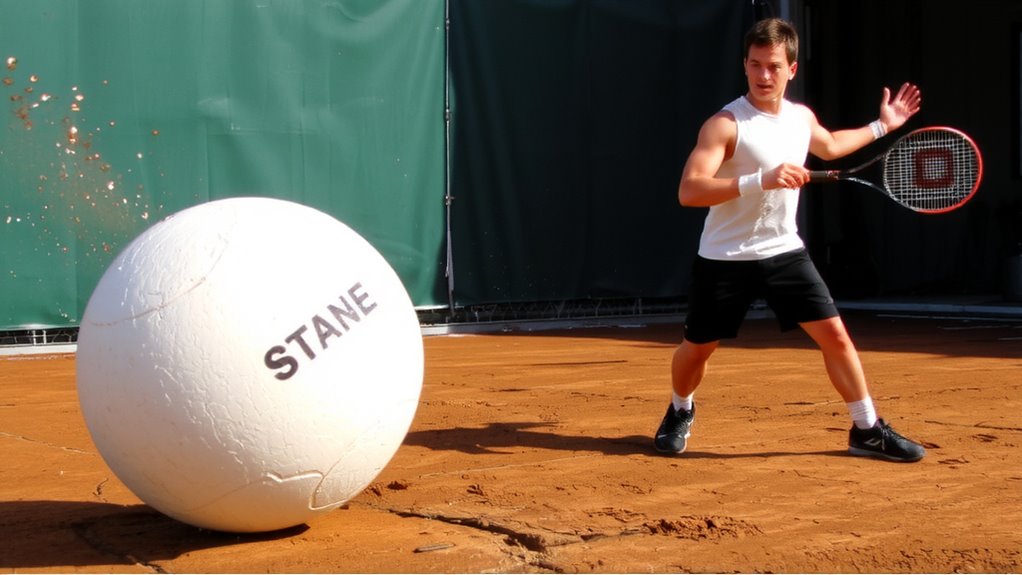
While you might not immediately link a slamming motion to serving a tennis ball, the rotational medicine ball slam directly targets the core mechanics behind a powerful serve. You develop rotary strength by forcefully rotating through your torso, mimicking the serve’s trunk rotation. This movement trains your obliques, transverse abdominals, and low back to work in unison, enhancing force production. Importantly, it reinforces proper kinetic sequencing-initiating motion from the ground up through the hips, then core, and finally into the upper body. Doing so conditions your nervous system to time muscle activation efficiently, translating into a faster, more explosive serve. High-density medicine balls with durable casings withstand repeated slams, making them reliable for consistent training. Over time, you’ll notice improved power output and reduced rotational lag. When integrated correctly, rotary slams aren’t just conditioning-they refine the very foundation of your serve’s energy transfer.
How Power Travels From Core to Racket
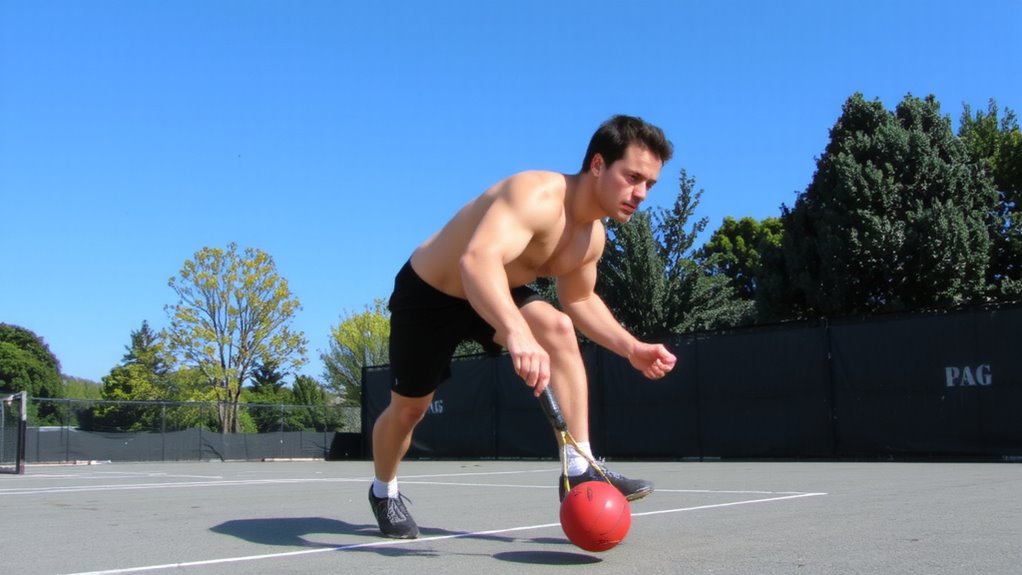
You’ve built rotational strength and refined your kinetic sequence with medicine ball slams, but that power only matters if it moves efficiently to where it counts-your racket. The secret lies in your kinetic chain: energy generated from your legs and core must flow seamlessly through your torso, shoulders, and arm. When timed right, this energy transfer multiplies force rather than leaking it. Think of your body as a whip-your core snaps first, then the motion accelerates upward, culminating in racket speed at contact. Medicine ball slams train this exact pattern, reinforcing how power should shift from deep muscles to extremities. Without a synced kinetic chain, even strong rotations won’t boost your serve. You’ll waste effort and risk strain. Efficiency isn’t optional-it’s what turns core power into clean, explosive serves. Every link must engage in order, ensuring maximum output at the final moment.
Perfect Your Slam Form for a Faster Serve
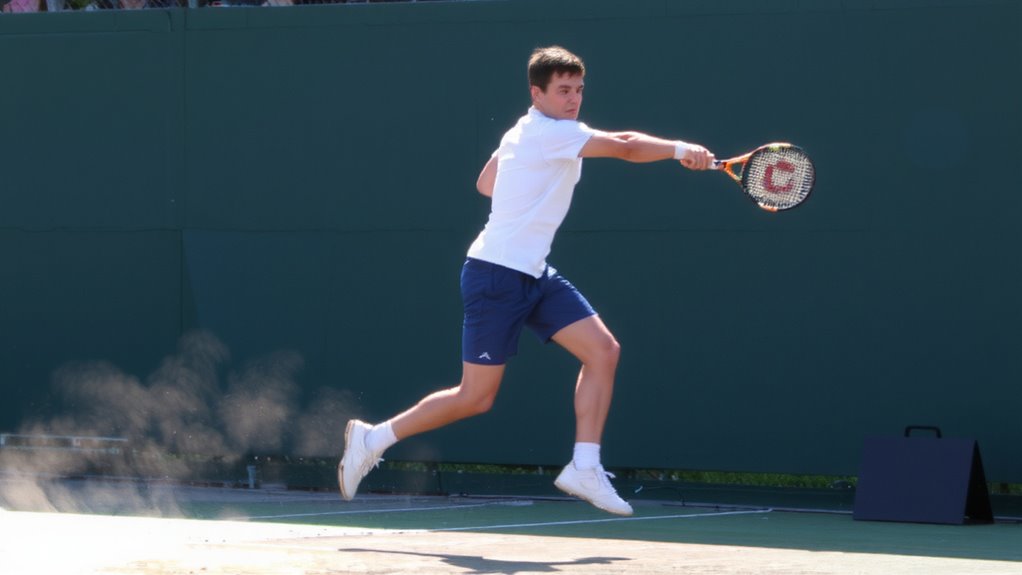
A well-executed rotary medicine ball slam isn’t just about power-it’s about precision in movement that mirrors the serve’s kinetic demands. You generate rotary tension by coiling your torso against your stable lower body, just like in a serve. This stored energy releases when you transfer force from the ground up, maintaining clean kinetic sequencing. Keep your feet shoulder-width apart, rotate sharply from the hips, and slam the ball diagonally across your body. Your arms aren’t driving-your core is. Misaligning the sequence disrupts timing and reduces output. Practice slowly at first to engrain correct form, then increase speed. The right medicine ball-between 4–8 lbs-offers enough resistance to strengthen without sacrificing speed. Textured surfaces improve grip, reducing slippage during sweaty sessions. Consistent form builds neural pathways that translate directly to a faster, more explosive serve.
Time Your Rotation Like Your Actual Serve
Since timing dictates power and accuracy in your serve, syncing your rotation with the same rhythm you use on the court guarantees the medicine ball slam translates effectively to match play. You’re not just building strength-you’re refining rotational timing, which is critical for a high-velocity serve. By mimicking your actual serve’s kinetic sequence, each slam reinforces the precise order of movement: feet, hips, torso, then arm. This neuromuscular patterning enhances efficiency, reducing wasted motion and injury risk. If your slam feels off, it likely means your trunk rotation leads too early or your weight shift lags-common flaws that disrupt the kinetic sequence. Use a weighted ball (4–8 lbs) with a textured grip for control, ensuring consistent feedback. Practicing with accurate tempo strengthens the neural pathways used in real serves, so the motion becomes reflexive under pressure. The right timing turns drills into real-world gains.
When (and How Often) to Slam for Gains
Typically, integrating medicine ball slams 2–3 times per week delivers maximum gains without overtaxing your recovery capacity, especially when you’re also training tennis-specific movements. Your ideal slam frequency balances stimulus and adaptation, ensuring powerful rotational development while respecting recovery timing. Too little, and you underachieve; too much, and you risk fatigue or asymmetry. Below outlines a practical weekly structure:
| Session | Purpose | Recovery Timing |
|---|---|---|
| Mon | Power development | 48 hours |
| Wed | Technique refinement | 24 hours |
| Fri | Max velocity emphasis | 72 hours |
| Sat | Light integration | 24 hours |
| Sun | Active recovery-no slamming | - |
This schedule supports neuromuscular coordination and joint resilience, especially when using dense, grip-stable medicine balls (6–10 lbs). Consistent slam frequency paired with intelligent recovery timing enhances serve speed and reduces connective tissue stress over time.
Avoid These Slam Mistakes for Better Serves
You’ve set up your weekly rhythm with medicine ball slams, spacing sessions to match recovery windows and training goals, but even the best schedule won’t fix flawed execution-especially when poor form sabotages the very power you’re trying to build. Improper alignment-like twisted hips or a slouched spine-reduces force transfer and increases injury risk, undermining tennis-specific power development. You need a stable base and coordinated trunk rotation to mimic serve mechanics effectively. Avoid excessive rebound-letting the ball bounce too high before the next slam-because it disrupts rhythm and shifts focus from power control to uncontrolled momentum. This defeats the purpose of training explosive, precise movement patterns. Quality matters more than quantity; each rep should reflect the serve’s kinetic chain. Use a grippy, appropriately weighted ball and slam on a responsive surface to maintain consistency. Proper form guarantees your recovery time is productive, not wasted on reinforcing bad habits that hinder performance gains in strength and coordination.
Track Slam Power to Improve Serve Speed
How do you know your medicine ball slams are actually translating to faster serves? You track them-specifically using slam velocity metrics and rotational force analysis. These tools give you objective data on power output and movement efficiency, linking off-court effort to on-court results. Slam velocity metrics measure how fast the ball hits the ground, reflecting explosive strength directly relevant to serve speed. Rotational force analysis breaks down torque and sequencing in your kinetic chain, showing whether you’re loading and transferring energy like you do in a serve. When combined, they help you fine-tune timing, force production, and coordination. Top-performing athletes don’t guess-they measure. Using a high-speed camera or sensor-enabled ball makes feedback reliable. Over weeks, improved metrics should correlate with faster, more powerful serves. It’s not just about slamming harder; it’s about training smarter with gear that reveals what the eye can’t see.
On a final note
You’ve seen how rotary medicine ball slams train the exact kinetic chain your serve relies on. When performed with proper timing and form, they boost rotational power, translating directly to racket speed. Used consistently-2–3 times weekly-they enhance neuromuscular coordination and core-to-limb energy transfer. Trackable power output helps gauge progress, while quality equipment guarantees durability and effective resistance. These slams aren’t just exercise; they’re a functional bridge between fitness and performance on the court.