Quad Set Activations With Biofeedback Monitoring for Postoperative Knee Patients
You’re losing quad strength fast after knee surgery, even if you’re doing your exercises-because without biofeedback, you can’t see if your muscle is truly activating. Quad sets with biofeedback help you maintain neural input and slow atrophy without joint movement. The device detects electrical signals in your quadriceps, showing real-time activation so you know if you’re firing correctly. It identifies underused muscles, corrects imbalances, and tracks progress in strength and endurance. You get accurate, visual proof of improvement, which guides recovery and enhances neuromuscular control. Seeing your muscle respond-even slightly-builds confidence and keeps rehab on track. Clear data means better decisions, and better decisions mean faster, more predictable recovery. Next, discover how proper setup makes all the difference.
Notable Insights
- Quad sets with biofeedback help preserve quadriceps strength during knee immobilization after surgery.
- Biofeedback provides real-time visual confirmation of proper quad activation when muscle contraction is not visible.
- Accurate sensor placement on the quadriceps ensures reliable detection of muscle activity and symmetry.
- Nerve inhibition from surgery can block quad activation, which biofeedback helps overcome through neural re-education.
- Patients perform 10–15 contractions, holding 5–10 seconds each, using biofeedback to track progress and correct errors.
Why Quad Sets Prevent Muscle Loss After Knee Surgery
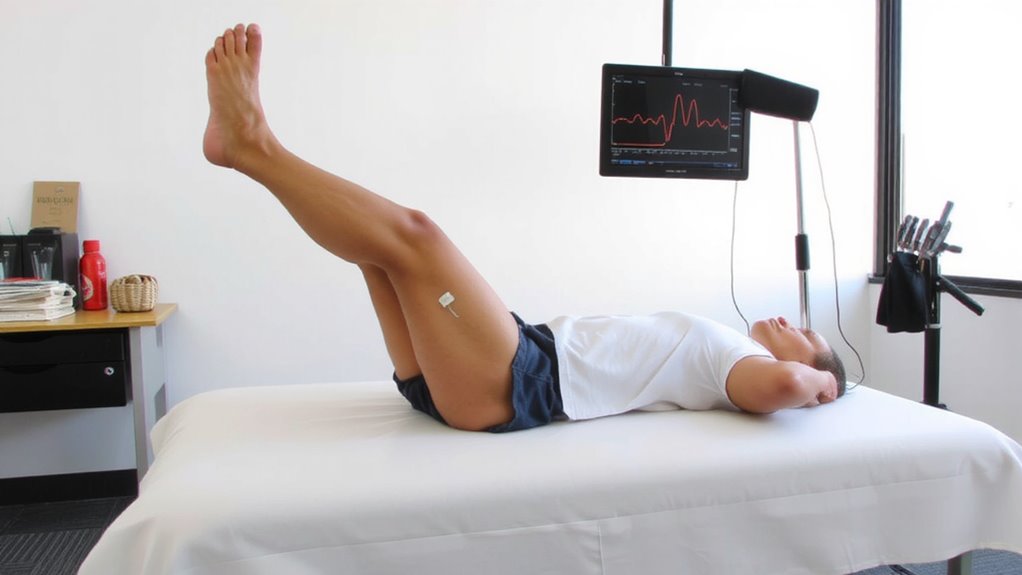
Although your knee might be immobilized after surgery, doing quad sets can make a real difference in preserving muscle strength. These simple contractions target your quadriceps, directly supporting muscle atrophy prevention during early recovery. When you activate the quads without joint movement, you maintain neural input, which slows degradation caused by inactivity. What’s more, quad sets act as neural re education techniques, helping your brain reconnect with muscles weakened by trauma or prolonged rest. Without this engagement, strength loss accelerates, delaying rehab progress. Fitness recovery isn’t just about intensity-it’s about timing and neuromuscular precision. Quad sets, though low-effort, deliver measurable benefits when performed consistently. They require no gear beyond your awareness, making them a practical, accessible tool in any recovery plan. Their effectiveness lies in repetition and proper form, laying the foundation for stronger movement later. You’re not just contracting muscle-you’re rebuilding communication, one activation at a time.
How Biofeedback Shows You’re Doing Quad Sets Right?
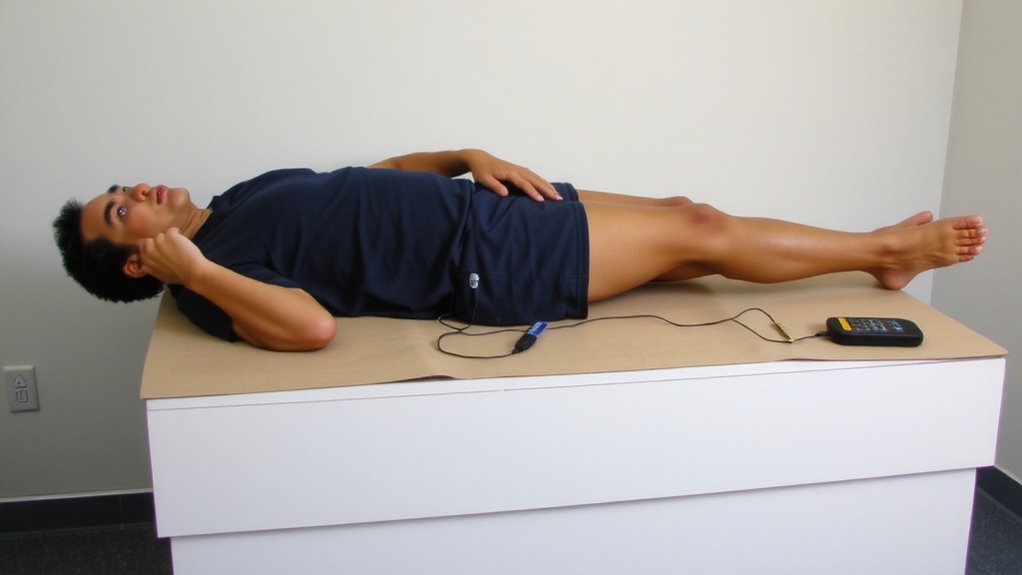
How do you know your quad sets are actually working when there’s no visible movement? Biofeedback gives you the answer by translating subtle electrical signals from your quadriceps into real-time data. You’re not guessing-you’re seeing confirmation. Proper activation shows balanced muscle symmetry between legs, which is vital for even recovery. Without it, one side might compensate, leading to imbalances. Here’s how biofeedback clarifies your effort:
| Signal Strength | Interpretation |
|---|---|
| Low | Under-activation |
| Moderate | Correct quad set |
| High | Possible overcompensation |
| Asymmetrical | Muscle symmetry imbalance |
| Steady | Sustained, effective hold |
Electrical signals should rise smoothly and match the unaffected leg’s output. This precision helps guarantee you’re rebuilding strength correctly, not just going through the motions. Biofeedback isn’t just helpful-it’s essential for accurate, measurable rehab progress.
How to Set Up Biofeedback at Home
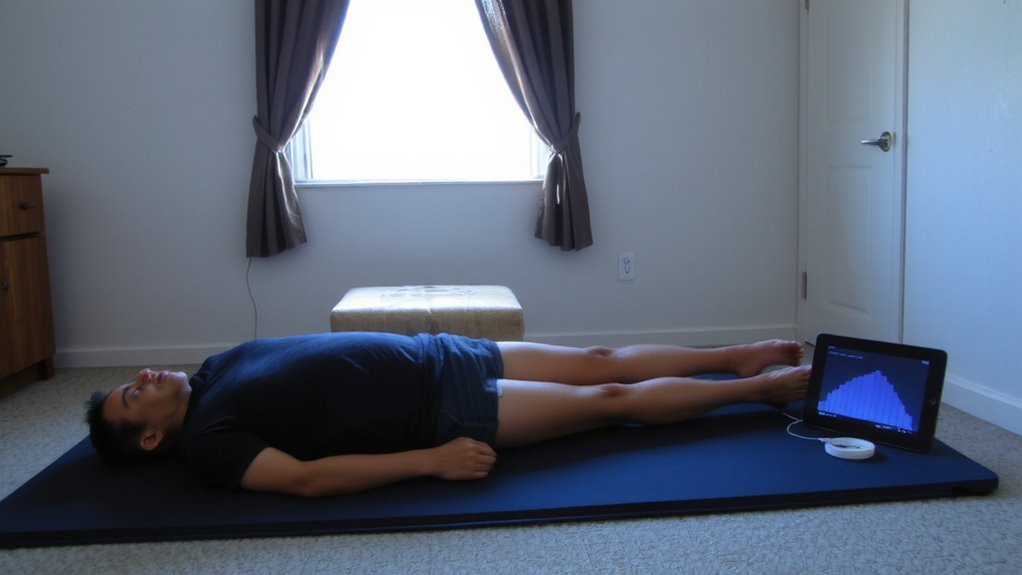
You’ve seen how biofeedback confirms proper quad activation, but making it work for your recovery means setting it up correctly at home. Start by placing the EMG sensors on your quadriceps as directed-usually above the knee and near the muscle belly-guaranteeing clean, dry skin for maximum contact. Proper equipment calibration is essential; follow the device’s guide to establish a baseline reading so the feedback accurately reflects your effort. Position the unit within clear line of sight, minimizing signal interference from nearby electronics or metal surfaces. Most home units use wireless transmission, so keep the receiver close to avoid disruptions. Secure leads with tape if needed to prevent shifting during exercises. A stable setup guarantees consistent data, making recovery tracking reliable. While consumer biofeedback gear varies in sensitivity, most perform well when used correctly, turning home sessions into measurable progress.
How to Do Quad Sets With Biofeedback
Once you’re set up with properly placed sensors and a calibrated bio游戏副本 unit, performing quad sets becomes a targeted exercise that bridges effort and measurable muscle response. Proper electrode placement guarantees the device captures true quadriceps activity, not signal interference. Sit or lie with your leg straight, then gently press the back of your knee into the surface while tightening your thigh-your goal is accurate muscle engagement, not visible movement. Watch the biofeedback screen: a steady rise in activity means you’re activating the right fibers. Hold for 5–10 seconds, then relax completely. Repeat 10–15 times, guided by real-time data. This method boosts neuromuscular re-education more effectively than unassisted exercises. Consistent use strengthens mind-muscle connection, vital in early recovery. Biofeedback units designed for home rehab deliver clinical-grade insights, making them practical investments. When used correctly, they transform passive recovery into active progress.
Why Your Quad Isn’t Firing (And How to Fix It)
Why does your quad remain silent when you need it most? After knee surgery, nerve inhibition often blocks the brain’s signal to your quadriceps, making activation nearly impossible-even if you’re trying hard. Swelling and joint trauma disrupt neural pathways, fundamentally “shutting off” the muscle. This isn’t laziness or weakness; it’s a neurological response. Overcoming it requires retraining muscle memory through repetition and precise feedback. Quad sets help reestablish that connection, but without accurate cueing, progress stalls. Biofeedback monitoring detects subtle contractions you can’t feel, providing visual proof of activation. That immediate feedback strengthens neural re-education, turning absent signals into consistent firing patterns. While basic exercises are accessible, pairing them with biofeedback devices enhances specificity and accelerates recovery. It’s not just about doing the work-it’s about knowing you’re doing it right. With consistent effort, nerve inhibition diminishes, and proper muscle memory gradually returns.
How to Track Quad Activation Progress With Biofeedback
How do you know if your quad is truly engaging during recovery? Biofeedback monitoring gives you real-time data on muscle activation, so you’re not just guessing. Electrodes placed on your thigh detect electrical activity, showing you when your quad fires and how strong the contraction is. Over time, you can track improvements in strength and endurance, ensuring progress isn’t stalled. A key benefit is evaluating muscle symmetry-comparing both legs reveals imbalances that could delay healing. Poor nerve conduction may show up as weak or delayed signals, alerting your therapist to underlying issues. Devices with reliable sensors and clear visual feedback make home use practical. Consistent monitoring helps fine-tune rehab, making biofeedback more than a gadget-it’s a precision tool. When used correctly, it supports smarter recovery by turning abstract effort into measurable results.
On a final note
You’re likely losing quad strength after knee surgery without realizing it. Biofeedback changes that by showing real-time muscle activity, so you know you’re doing quad sets correctly. It’s accurate, easy to use at home, and helps track progress objectively. While not a cure-all, pairing biofeedback with proper form boosts recovery. For fitness recovery gear, it’s among the most practical tools-affordable, evidence-based, and effective when used consistently.