Designing Isometric Wall Angels for Scapular Control in Overhead Athletes
You maintain proper wall contact by pressing your head, shoulders, and hips firmly against the wall, feet slightly forward. Keep arms at 90 degrees, elbows bent and pinned back to activate lower traps effectively. Engage your core to prevent rib flaring during each controlled, isometric slide. Foam rolling beforehand improves mobility, correcting common errors like tight lats or thoracic stiffness. This builds scapular control critical for overhead athletes-key for injury prevention, and even more effective when technique progresses strategically.
Notable Insights
- Position athletes with back flat against the wall, feet forward, maintaining head, shoulder, and hip contact for optimal scapular alignment.
- Initiate with arms at 90 degrees in a “W” shape to enhance lower trapezius activation and scapular control.
- Emphasize isometric holds at the top and bottom of the movement to improve neuromuscular precision and endurance.
- Incorporate foam rolling and mobility drills prior to exercise to address tight lats, pecs, or thoracic stiffness.
- Program 2–3 sets of 8–12 controlled reps with 30–60 seconds rest to support scapulothoracic stability and motor learning.
How to Do Wall Angels (With Perfect Form)
You’ll want to start with your back flat against the wall, feet slightly forward and shoulder-width apart, to get the most out of wall angels for scapular control. Press your head, shoulders, and hips firmly into the wall to establish proper alignment. Begin with arms bent at 90 degrees, forming a “W” shape. Slowly glide your arms up overhead, keeping contact points intact and elbows and wrists aligned throughout. Focus on a smooth motion-don’t jerk or cheat the movement. Engage your scapular stabilizers consciously, initiating movement from the mid-back, not the shoulders alone. Maintain slight tension in the core to support posture. Do three sets of 10 reps, pausing at the top for two seconds to enhance neuromuscular feedback. This exercise improves proprioception and builds foundational strength critical for overhead athletes. Done consistently, wall angels boost posture and joint integrity-no gear needed, just disciplined form and mindful execution.
What Goes Wrong (And How to Fix It)
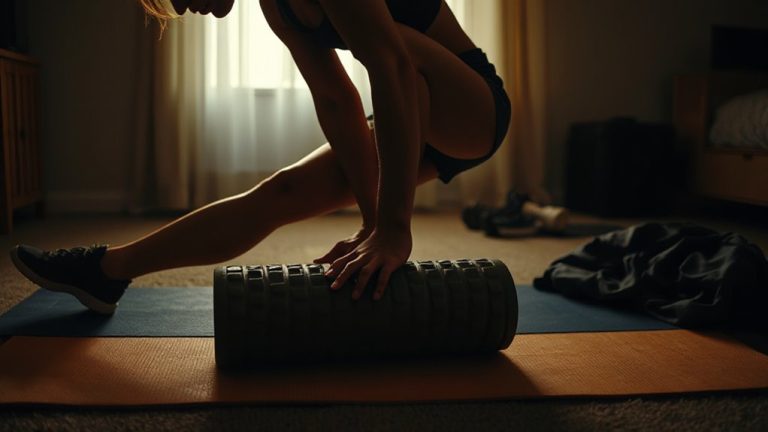
Why do so many people struggle to feel the right muscles working during wall angels, even when their form looks correct? You’re likely dealing with underlying muscle imbalances or joint restrictions. Tight lats, pecs, or anterior shoulder muscles pull your posture forward, making it hard to maintain proper scapular positioning. Even slight thoracic spine stiffness limits upward rotation, reducing lower trap engagement. These issues mean your body compensates, using the wrong muscles to complete the movement. You might think you’re training control, but you’re reinforcing faulty patterns. Address this by foam rolling tight areas and incorporating mobility drills for the thoracic spine and shoulders. Only then can you truly isolate and activate the correct muscles. Without correcting these imbalances and restrictions first, wall angels reinforce poor mechanics instead of building scapular control. Fix the foundation, and the movement will work as intended. A high-density foam roller can significantly improve myofascial release effectiveness when targeting stubborn lat and pec tension.
Change Arm Placement to Activate Lower Traps
Fixing mobility restrictions sets the stage, but getting the most out of wall angels means fine-tuning your arm positioning to directly target the lower trapezius-the key stabilizer for healthy scapular movement. You’ll activate it best when you slightly lower your arms from the classic “goal post” position to about 90 degrees or just below. This shift increases scapular retraction and shoulder depression, forcing the lower traps to work harder while reducing upper trapezius dominance. Keep your elbows bent at 90 degrees and push them back into the wall as you slide your arms up and down. Avoid flaring your ribs or losing contact with the wall-those mistakes reduce effectiveness. Studies show this modified angle enhances lower trap recruitment by up to 30% compared to standard positioning. It’s a small change with a big payoff, especially for overhead athletes needing precise scapular control.
Advance to Dynamic Shoulder Movements
Once mobility is established and scapular control refined through precise arm positioning, progressing to dynamic shoulder movements takes wall angels from a static activation drill to a functional stability exercise. You now add dynamic control by slowly sliding your arms up and down the wall with purposeful rhythm, maintaining full contact throughout. This movement progression challenges neuromuscular coordination while reinforcing scapulothoracic alignment under motion. Keep your core engaged and avoid flaring ribs or arching your lower back. The controlled tempo enhances motor learning and builds endurance in stabilizing muscles critical for overhead athletes. Unlike passive recovery tools, this active approach integrates strength and proprioception, offering superior carryover to sport-specific demands. Proper execution guarantees you’re not just moving through range but owning it. Over time, this dynamic control translates to more resilient shoulder function, reducing injury risk during explosive overhead actions.
Wall Angels for Shoulder Stability: Reps & Sets
Typically, you’ll want to perform wall angels in sets of 8 to 12 repetitions, repeating for 2 to 3 rounds as part of a shoulder stability routine. This range balances neuromuscular control and muscular endurance without compromising form. As you progress, you can adjust exercise intensity by slowing the movement or adding light resistance, though most athletes benefit most from strict, controlled reps against the wall. Rest intervals of 30 to 60 seconds between sets are sufficient, allowing partial recovery while maintaining activation in the scapular stabilizers. Shorter rests keep the work metabolic, while longer ones support better motor control in higher-intensity variations. Monitoring fatigue is key-excessive reps or sets may reduce scapular precision, defeating the exercise’s purpose. For long-term gains in shoulder resilience, consistency matters more than volume. Pairing appropriate rest intervals with manageable exercise intensity guarantees sustainable progress and reduces compensatory patterns.
Use Wall Angels in Warm-Ups and Rehab
You’ve probably already worked wall angels into your routine for building shoulder stability with controlled reps and smart recovery between sets. Now consider using them in warm-ups and rehab, where their isometric nature supports gradual activation without straining healing tissue. The movement demands consistent breathing coordination, helping you stay relaxed while maintaining tension-key for nervous system regulation during recovery. Your mental focus sharpens as you align each segment of the spine against the wall, correcting subtle form breakdowns before they become habits. Unlike dynamic exercises, wall angels allow you to cue proper scapular setting with precision, making them ideal when returning from injury. They don’t require resistance bands or sliders, just body control and attention-minimal gear, maximum feedback. Coaches often prefer them early in programming because they expose motor control deficits quietly but clearly. Used consistently, they bridge the gap between passive recovery and active preparation.
Why Scapular Control Prevents Shoulder Injuries
Scapular control isn’t just about muscle strength-it’s about movement integrity. When you move your arms overhead, poor neuromuscular control can lead to scapular dyskinesis, compromising shoulder stability and increasing injury risk. Proper scapular positioning guarantees efficient joint mechanics, reducing impingement and rotator cuff strain. Wall angels train your body to maintain this alignment through controlled, isometric contractions.
| Issue | Consequence |
|---|---|
| Scapular dyskinesis | Altered shoulder kinematics |
| Weak neuromuscular control | Delayed muscle response |
| Poor scapular upward rotation | Subacromial compression |
| Asymmetrical activation | Joint overload |
| Fatigue-induced drift | Increased injury likelihood |
On a final note
You’ll find wall angels highly effective for scapular control, especially when performed with precise form against a flat surface. They strengthen lower trapezius activation, critical for overhead athletes. When you add consistent reps-typically 2–3 sets of 10–12-you support shoulder stability and reduce injury risk. Used in warm-ups or rehab, they integrate well into routines. Quality foam rollers or resistance bands can enhance recovery, but nothing replaces proper movement patterning. Focus on progression, not speed.