Functional Single-Leg Squat Progression on BOSU for Neuromuscular Control
You start with double-leg BOSU squats to build foundational stability, then progress to assisted single-leg squats using light hand support for balance. Focusing on slow, controlled lowering strengthens your glutes and quads while sharpening neuromuscular coordination. Once you master eccentric control, attempt full single-leg squats on the dome to test proprioception and joint stability. This progression enhances functional strength, corrects imbalances, and prepares your body for dynamic movement challenges ahead.
Notable Insights
- Begin with double-leg BOSU squats to build foundational stability and neuromuscular coordination on an unstable surface.
- Progress to assisted single-leg squats using light hand support to maintain balance while increasing unilateral demand.
- Emphasize slow eccentric lowering (3–4 seconds) to enhance muscle control, joint stability, and time under tension.
- Advance to full single-leg squats on the BOSU dome, aiming for 90-degree knee flexion without wobbling or foot shifting.
- Correct form immediately using cues like “hips back, chest up” and regress to stable surfaces if control is lost.
Start With the Basics: Double-Leg BOSU Squats
While mastering advanced variations like the single-leg squat on a BOSU ball demands significant balance and strength, it’s essential to first build a solid foundation with double-leg BOSU squats. You’ll develop better neuromuscular control by focusing on proper foot positioning and knee alignment from the start. Place your feet shoulder-width apart, centered on the dome, toes slightly turned out-this setup supports natural hip and ankle mobility. As you squat, keep your knees tracking over your toes without caving inward; this maintains joint integrity and activates the correct muscles. The unstable surface challenges proprioception, enhancing lower-body coordination. It’s not just about strength-consistency in form shapes long-term performance. Double-leg squats condition your stabilizers, prepare connective tissues, and reduce injury risk. This phase isn’t optional; it’s a functional prerequisite. Use controlled reps, prioritize feedback from your body, and progress only when movement feels stable, fluid, and accurate.
Progress to Assisted Single-Leg Squats
Once you’ve built consistent control through double-leg BOSU squats, it’s time to shift into unilateral work with assisted single-leg squats, a critical bridge to full independence on the unstable surface. You’ll stand on one leg atop the dome while using light hand support on a stable surface to guide balance. This hand support reduces load without eliminating neuromuscular demand, letting you focus on alignment and hip stability. Rather than relying on assisted momentum from your arms, emphasize controlled movement initiation from the working glute and quad. The BOSU’s instability challenges proprioception, but the support helps maintain proper form during early repetitions. You’ll notice improved joint awareness and loading symmetry over time. This phase isn’t about power-it’s about precision. Assisted single-leg squats prepare your nervous system for full unilateral loading while minimizing compensatory patterns, making them a smart, measurable step in functional progression.
Master the Eccentric: Slow Single-Leg Lowering
You’ll often find that controlling the descent in a single-leg squat proves far tougher than pushing back up, and that’s exactly why slow, deliberate lowering matters. Focusing on a controlled descent enhances neuromuscular coordination and builds joint stability, especially on the unstable surface of the BOSU dome. As you lower, your glutes, quads, and calves engage through prolonged muscle activation, which strengthens the kinetic chain and improves landing mechanics. This phase, often overlooked, is where real motor control develops. By slowing the movement-think three to four seconds-you amplify time under tension, boosting both strength and proprioception. Keep your chest up, knee aligned, and heel driving down throughout. The BOSU’s curvature challenges balance without sacrificing feedback, making it ideal for refining form. You’re not just squatting-you’re learning precision. This emphasis on control isn’t just effective; it’s essential for injury prevention and long-term movement efficiency.
Test Your Balance: Full Single-Leg Squats on the Dome
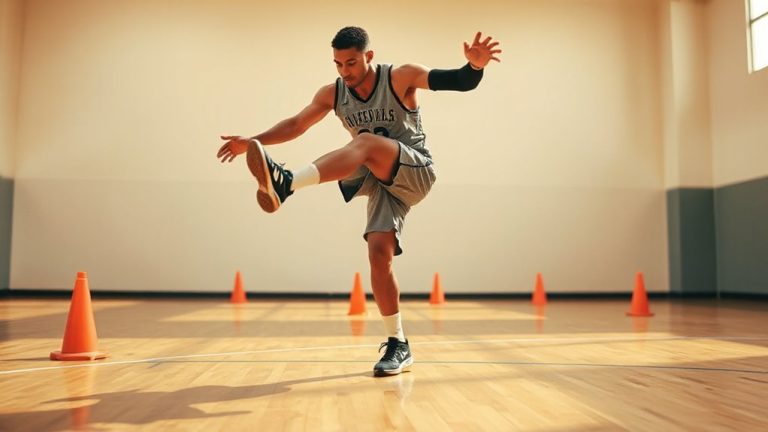
What does it take to truly master balance on an unstable surface? Now it’s time to test your control with full single-leg squats on the dome side of the BOSU. This move serves as both a balance assessment and a functional strength builder. You’re not just standing on an unstable surface-you’re driving into squat depth while maintaining alignment. The dome’s curvature challenges your ankle, knee, and hip stability, forcing your neuromuscular system to fire efficiently. When performed correctly, you’ll achieve a 90-degree knee bend without wobbling or shifting your stance foot. This level of control reflects solid proprioception and muscular endurance. Use this exercise not just as a workout, but as a diagnostic tool-your body’s response reveals weaknesses or asymmetries. Consistent practice improves joint stability and movement precision, making it a valuable addition to any functional training program focused on performance and injury resilience.
Fix These Form Breakdowns Early
Maintaining proper form during full single-leg squats on the BOSU’s dome isn’t just about hitting depth-it’s about doing so without compromising joint alignment or stability. You’ll often see knee alignment cave inward as fatigue sets in, which increases stress on the medial knee and reduces power transfer. That valgus collapse usually signals weak glute medius engagement and poor hip stability. Catch it early. If your standing hip drops or your pelvis wobbles, you’re losing control, and that compromises neuromuscular efficiency. These breakdowns aren’t just ineffective-they’re risky. Correcting them before they become habitual guarantees safer movement patterns and builds real functional strength. Stay attentive to your form each rep; small tweaks in foot placement or core bracing can make a big difference. Fixing these issues early enhances performance and protects joints, making the BOSU a smarter tool for balance and control, not just another fitness gimmick.
Use the Right Regression Cues
How do you know when to scale back instead of pushing through? You notice compromised form-knee caving, hip hiking, or wobbling at the ankle. That’s your cue to regress. Using the right regression cues helps maintain proper alignment and build joint stability without overloading the system. Tell yourself, “Hips back, chest up, weight in the heel,” to reinforce control. Shift to a stable surface or reduce range of motion instead of grinding through instability. These cues aren’t just verbal tricks-they guide neuromuscular coordination, guaranteeing each rep strengthens movement integrity. Without them, you risk reinforcing poor patterns that hinder progress. Proper alignment isn’t optional; it’s foundational. Joint stability develops only when challenges match current capacity. Regressing with purpose means you’re training smarter, not quitting. The BOSU adds instability, but mastering control on flat ground first guarantees safer, more effective progression. Use cues early, use them consistently, and you’ll build resilience progressively.
Program the Progression Into Your Routine
You’ve built control with the right regression cues, and now it’s time to structure that progress into your training. Mindful breathing should anchor each repetition, helping you maintain intra-abdominal pressure and joint stability during the single-leg squat on BOSU. Schedule the movement twice weekly, using consistent scheduling to track neuromuscular adaptation and minimize compensatory patterns. Start with 2 sets of 6 reps per leg, focusing on controlled descent and drive through the heel. As balance improves, progress to 3 sets of 8 with eyes closed or arms overhead. The BOSU’s unstable surface challenges proprioception, but only if used deliberately-rushing progression undermines motor learning. Pair this with low-impact recovery days to support connective tissue resilience. The gear’s durability supports long-term use, but effectiveness hinges on execution quality, not frequency. Integrate this progression methodically, and you’ll enhance functional strength with reduced injury risk.
On a final note
You’ve built strength and control through each phase of the BOSU single-leg progression, and now your neuromuscular coordination is sharper. This sequence delivers measurable gains in balance and joint stability, especially when performed consistently. The BOSU ball’s unstable surface challenges proprioception effectively, but only if form stays precise. Use regressions when fatigue sets in, and prioritize quality over depth. It’s functional, efficient training-no frills, just results.