Integrating Dynamic Postural Control Into Warm-Ups for Gymnasts
You build dynamic postural control from the start of your warm-up by activating deep core stabilizers and priming neural pathways with movement. Exercises like high knees and single-leg reaches boost coordination, balance, and body awareness. This approach sharpens performance on vault, bars, and beam by reinforcing proper alignment and reducing injury risk. Using wearable sensors helps track improvements in stability-seeing real progress keeps your training on point.
Notable Insights
- Activate deep core muscles early with dynamic movements to stabilize the spine during gymnastics routines.
- Incorporate single-leg reaches and wobble board stands to enhance balance and neuromuscular coordination.
- Use high knees and limb sweeps to prime neural pathways for faster, more accurate movement responses.
- Apply event-specific drills that mimic vault, bar, and beam demands to improve postural control.
- Track progress with video analysis and wearable sensors to refine warm-ups and reduce injury risk.
Why Dynamic Postural Control Powers Gymnasts
While many focus on strength and flexibility, it’s dynamic postural control that quietly drives your performance as a gymnast, fine-tuning how you stabilize and reposition during complex routines. You rely on it every time you dismount or shift between moves, where precision matters most. This control hinges on core strength-not just muscle size, but how well your deep abdominals fire to anchor your spine mid-movement. Without it, balance wavers and form breaks down. Joint stability, especially in the shoulders and ankles, works hand-in-hand, letting you absorb forces safely during landings and twists. Together, they reduce injury risk and sharpen execution. Training these elements isn’t flashy, but it’s foundational-like installing a responsive chassis in a race car. When your body aligns and reacts automatically, skills flow smoother, and recovery between sessions improves because strain stays where it belongs: not in overstretched ligaments, but in challenged, adaptive muscles. It’s not just preparation-it’s long-term resilience.
Warm Up With Movement to Ignite the Nervous System
Movement is your first real tool for waking up the nervous system before a gymnastics session-don’t underestimate it. You’re not just loosening muscles; you’re priming neural activation pathways that link your brain to motion. When you move with intent, you boost signal speed and coordination, which directly sharpens movement precision. Static stretching won’t do this-only dynamic actions like high knees, skipping, or controlled limb sweeps create the stimulus your nervous system needs. These movements mimic skills you’ll perform, so your body learns to respond faster and more accurately. Think of it as booting up a high-performance system: every rep fine-tunes the connection between thought and action. Without this prep, your responses lag, and precision drops-risk rises. Proper warm-up isn’t just routine; it’s strategic neural conditioning. You’re not just awake-you’re alert, calibrated, and ready to perform at your peak, where timing and control make all the difference on the mat.
5 Dynamic Drills for Balance and Body Awareness
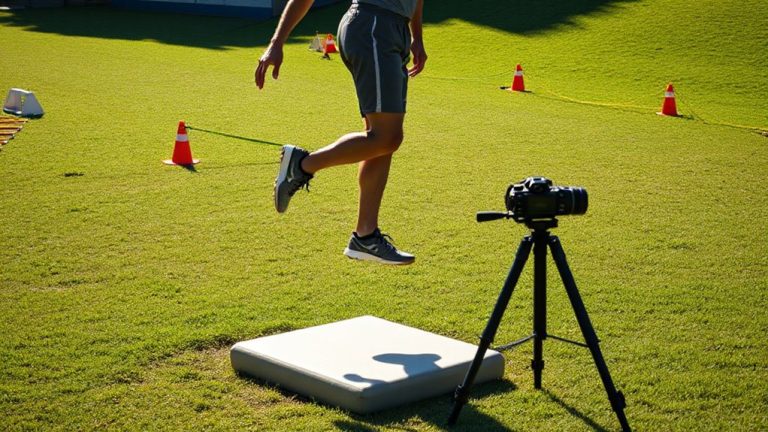
A well-designed set of dynamic drills sharpens both balance and body awareness, two non-negotiables for gymnasts who need to control their center of mass during complex, high-speed routines. You’ll improve proprioception training through movements like single-leg reaches, wobble board stands, and controlled leaps onto foam surfaces-each demanding focus and precision. These drills aren’t just about mobility; they require consistent core engagement to stabilize your spine and pelvis, mimicking the demands of actual skills. By integrating balance challenges with active motion, you condition your nervous system to respond faster and more accurately. Quality matters: perform each drill with control, avoiding momentum to maximize neuromuscular feedback. Over time, this enhances spatial orientation and joint positioning sense, reducing injury risk. Equipment like balance discs or agility cones can boost effectiveness, but technique always leads. Use these drills early in warm-ups to prime your body for higher-intensity work, laying the foundation for safer, sharper performance.
Apply Postural Control to Vault, Bars, and Beam
When you’re launching off the springboard toward the vaulting table, split-second control of your posture can mean the difference between a stuck landing and a costly deduction. Vault precision hinges on maintaining tight core engagement and proper body alignment from takeoff through rotation. On bars, controlled shifts and handstands rely on postural stability to minimize wobbles and maximize efficiency. A slight shift in shoulder angle or hip position can affect your rhythm and increase error risk. Beam alignment is equally critical-micro-adjustments in spinal position and foot placement keep you centered amid high-risk elements. Integrating dynamic postural control into routines guarantees your body moves as a unified system, not disjointed parts. This consistency boosts performance across events by reinforcing neuromuscular coordination. You’re not just rehearsing skills; you’re embedding precision. With focused practice, postural awareness becomes instinctive, elevating execution and reducing preventable mistakes during competition.
Track Progress: Better Stability, Better Performance
You’ve sharpened your postural control on vault, bars, and beam-now it’s time to measure how that precision translates into real performance gains. Tracking your progress isn’t just about scoring higher; it’s about recognizing improvements in stability, balance, and movement efficiency. Use postural feedback tools like wearable sensors or video analysis to spot subtle shifts in alignment during skills. This data helps you fine-tune technique and confirms that your warm-up routines are working. Consistent monitoring supports injury prevention by identifying muscular imbalances or faulty patterns before they lead to strain. Gymnasts who log their stability metrics over time often see stronger connections between controlled movement and cleaner execution. Better stability doesn’t just mean safer landings-it means greater power transfer, sharper form, and confidence in every routine. When you track progress objectively, you’re not guessing-you’re advancing.
On a final note
You’ve seen how dynamic postural control sharpens your readiness and reduces injury risk. When you integrate movement-based warm-ups, you prime your nervous system efficiently. These drills boost balance and spatial awareness critical for vault, bars, and beam. With consistent practice, your stability improves, directly enhancing performance. The right recovery gear-like compression sleeves and foam rollers-supports adaptation, speeding muscle recovery. Together, smart warm-ups and quality gear form a practical, effective foundation for sustained gymnastic excellence.