Why Elite Swimmers Use Pre-Sleep Visualization to Mentally Rehearse Recovery Phases
You’re not just resting when you visualize recovery-you’re training your brain to repair. Elite swimmers use pre-sleep visualization to activate neural plastic私服游戏, reinforce muscle memory, and boost tissue healing. By mentally rehearsing smooth strokes and calm physiology, they trigger parasympathetic activation, lower cortisol, and strengthen sleep quality. This quiet practice works like physical training, priming your body’s repair systems. It’s efficient, science-backed recovery that goes beyond gear-there’s more to how this reshapes performance overnight.
Notable Insights
- Pre-sleep visualization activates neural plasticity, reinforcing ideal stroke mechanics and muscle memory without physical exertion.
- Mental rehearsal of recovery triggers parasympathetic nervous system activity, lowering heart rate and cortisol for enhanced repair.
- Imagining blood flow and tissue repair boosts nutrient delivery and accelerates muscle regeneration during restorative sleep phases.
- Visualizing calm, symmetrical movement patterns prevents overcompensation, reducing injury risk and supporting long-term performance.
- Practicing visualization nightly before bed aligns with natural repair cycles, improving sleep quality and neural restoration.
Why Recovery Visualization Is Training
While most swimmers focus on laps and strength work, you might not realize that mental rehearsal counts as real training-especially during recovery. When you visualize your body repairing and restoring, you’re actually engaging neural plasticity, the brain’s ability to rewire itself based on repeated thought patterns. This isn’t just feel-good theory-studies show mental practice reinforces muscle memory, the same mechanism that makes technical strokes feel automatic. So when you mentally rehearse smooth flips or efficient pulls before sleep, you’re not daydreaming; you’re signaling your nervous system to maintain those patterns. Recovery isn’t downtime-it’s quiet training. Combined with proper fitness gear that supports circulation and alignment, visualization enhances physical repair. You’re not just resting, you’re refining. In elite circles, this blend of mental discipline and physical support is standard. You’re training smarter, even when you’re still.
What Swimmers Picture to Heal Faster
You’re not just replaying race footage when you close your eyes at night-elite swimmers use specific mental images to accelerate healing. They visualize blood flowing to fatigued muscles, delivering oxygen and nutrients vital for muscle regeneration. These mental rehearsals boost recovery by priming the nervous system to support repair processes. Swimmers also envision tissue repairing itself, joints moving smoothly, and balanced biomechanics-practices linked to injury prevention. Top athletes often pair these visions with breathwork and stillness, increasing parasympathetic activation.
| Visualization Focus | Purpose | Recovery Benefit |
|---|---|---|
| Blood flow to muscles | Enhance nutrient delivery | Accelerates muscle regeneration |
| Tissue repair in motion | Reinforce healing | Reduces inflammation |
| Ideal stroke mechanics | Prevent overcompensation | Supports injury prevention |
| Calm nervous system | Promote restfulness | Deepens sleep quality |
| Symmetrical body alignment | Optimize movement patterns | Lowers strain risk |
When and How to Practice Visualization
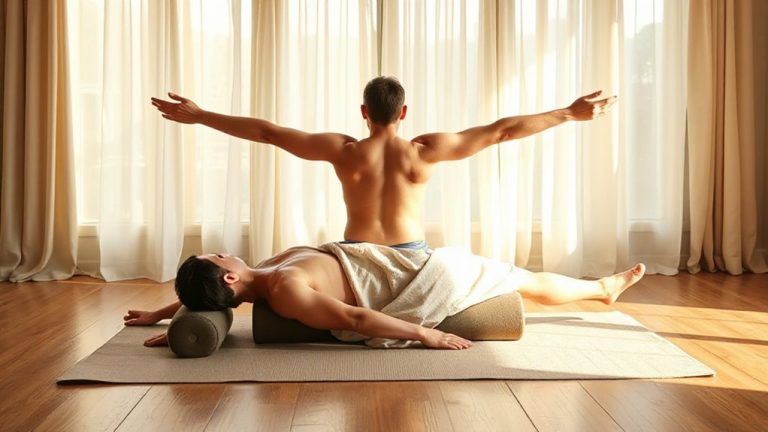
A consistent visualization practice can substantially enhance recovery, especially when timed to align with your body’s natural repair cycles. You’ll want to begin right before bed-ideally 15–20 minutes after winding down-when your nervous system shifts toward restorative states. Use timing cues like dimming lights or a set alarm to condition your mind for this routine. Practice in a quiet space, lying down with eyes closed, mimicking sleep posture. Pair visualization with guided scripts that walk you through muscle relaxation and envisioned recovery sequences, improving focus and depth. These scripts, especially audio-based ones, help maintain consistency and reduce mental drift. For best results, stick to the same time and environment nightly, reinforcing the habit. While no fitness gear is required, noise-canceling headphones or sleep masks can support the sensory isolation that deepens mental rehearsal. With regular use, you’ll likely notice improved sleep quality and sharper mental recall of recovery phases, amplifying physical restoration.
How Visualization Triggers Your Body’s Repair Mode
Since your brain can’t always distinguish between vividly pictured experiences and real ones, the mental rehearsal of recovery through visualization effectively signals your body to initiate restorative processes, much like actual physical rest does. This isn’t just theory-studies show that the mind body connection amplifies relaxation responses when you mentally simulate recovery. As you visualize, neural signaling activates the parasympathetic nervous system, slowing heart rate and lowering cortisol. These changes prime your muscles and tissues for repair. Elite swimmers use this nightly to boost overnight recovery without extra gear or supplements. Unlike passive rest, visualization actively directs your brain to simulate healing states, making it a cost-effective, portable recovery tool. While fitness gear like compression suits or cryotherapy chambers have their place, they can’t match the neurochemical efficiency of internally driven recovery. With consistent practice, neural signaling becomes more refined, deepening the body’s natural repair cycles.
How Mental Rehearsal Improves Sleep and Healing
When you mentally rehearse a calm, restful state before sleep, your brain begins to mirror the neural patterns of actual deep rest, easing the shift into high-quality sleep. This mental practice doesn’t just relax you-it boosts dream enhancement by increasing REM coherence, allowing your mind to process recovery more effectively. As you visualize slow breathing, muscle relaxation, and fluid movements, you prime the body for neural restoration, a critical phase where brain networks repair and consolidate physical training gains. Elite swimmers use this method because it complements recovery gear like compression suits and cooling vests, extending repair beyond physical tools. Unlike passive rest, mental rehearsal actively guides the nervous system toward peak restoration. It’s not a substitute for sleep, but a force multiplier-deepening rest quality, speeding recovery time, and improving next-day performance. When paired with proper recovery protocols, visualization becomes a quiet but powerful edge.
On a final note
You’re not just resting when you visualize recovery-you’re training. Elite swimmers use pre-sleep mental rehearsal to activate repair mechanisms, syncing imagery with physiological healing. By picturing relaxed muscles, proper breathing, and smooth strokes, they prime their nervous system for restoration. This practice enhances sleep quality and accelerates recovery, making it a smart, science-backed addition to any athlete’s routine. Like quality fitness gear, effective visualization supports peak performance through deliberate, consistent use.