Depth Drops Followed by Immediate Direction Changes for Advanced Neuromuscular Conditioning
You boost neuromuscular control by dropping from a box and immediately changing direction, training your body to absorb and redirect force rapidly. Proper form-bent knees, neutral spine, and soft landings-reduces joint stress while enhancing reactive strength. Use a 12- to 18-inch box to start, wear supportive shoes with good cushioning, and land on stable surfaces. Master basics before progressing; clean execution beats volume. Advancing builds sport-specific power and coordination-there’s more to fine-tuning this drill effectively.
Notable Insights
- Depth drops with immediate direction changes enhance neuromuscular control through rapid force absorption and redirection.
- Proper technique includes landing with bent knees and a neutral spine to ensure joint stability and safety.
- Explosive hip, knee, and ankle engagement post-landing improves reactive strength and sport-specific performance.
- Common errors like knee collapse or stiff landings increase injury risk and reduce training effectiveness.
- Progression to higher boxes and multidirectional drills should follow mastery of landing mechanics and adequate recovery.
Why Depth Drops Boost Neuromuscular Control
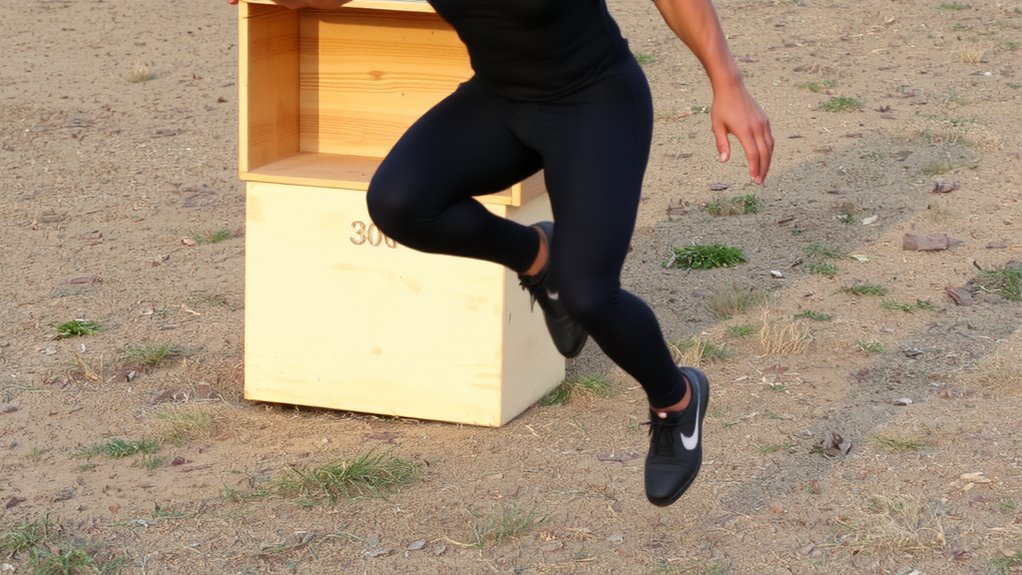
Landing mechanics matter-especially when you’re trying to build sharper neuromuscular control. Depth drops force your body to absorb impact quickly, triggering rapid neural adaptation that improves signal efficiency between your brain and muscles. You’re not just jumping-you’re training your nervous system to respond faster and more accurately under load. The sudden stretch upon landing enhances muscle elasticity, priming your tendons and connective tissues to store and return energy more effectively. This isn’t just about power; it’s about precision in movement shifts. Over time, you’ll notice better joint stability and reduced ground contact time. Quality footwear with responsive cushioning supports this process, but don’t rely on gear alone-technique drives results. Done right, depth drops condition your body to handle dynamic stress, laying the foundation for advanced drills without sacrificing joint health or recovery time.
What Are Depth Drops With Direction Changes?
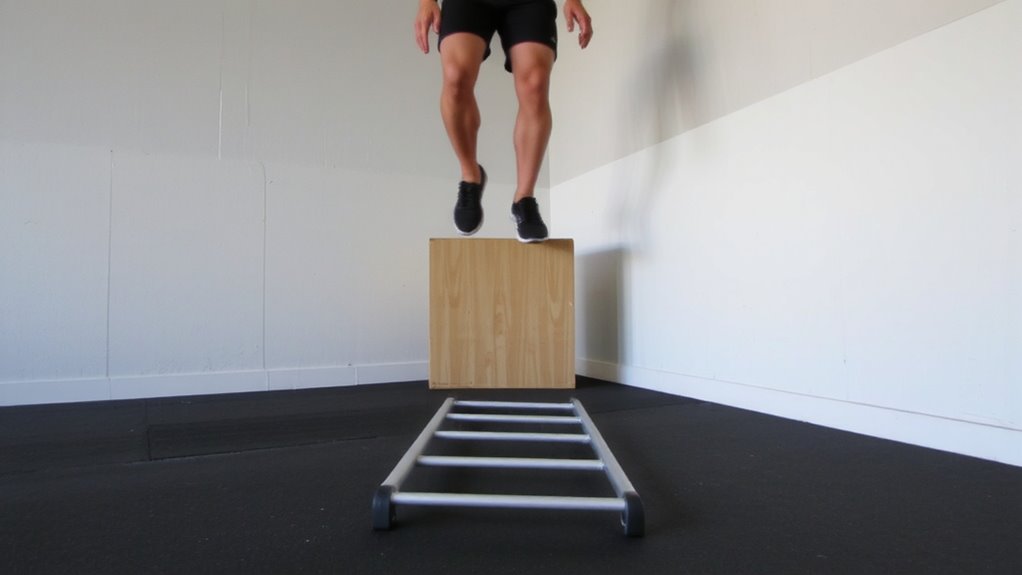
How do you take the benefits of depth drops further once your body adapts to straight-down landings? You introduce immediate direction changes. These advanced moves combine the plyometric benefits of explosive ground contact with rapid shifts in movement plane-like landing and sprinting forward, cutting laterally, or jumping vertically. This isn’t just about power; it forces your nervous system to manage force absorption and redirection simultaneously, driving greater neural adaptation. Your brain learns to recruit muscles faster and more efficiently under unpredictable demands. Unlike standard drops, directional variations closely mimic athletic scenarios, making them more transferable to sport. You’re not just jumping-you’re responding, adjusting, and accelerating in real time. This complexity increases neuromuscular coordination, but requires well-designed surfaces and supportive footwear to manage impact. The plyometric benefits extend beyond strength-they sharpen reaction, control, and agility while conditioning joints and connective tissues progressively.
Proper Form for Directional Depth Drops

While you’re likely familiar with basic depth drops, mastering directional variations demands far more than just dropping off a box and absorbing the impact-your entire kinetic chain must work in sync to handle the added complexity. You initiate the drop from a controlled height, landing with bent knees and a neutral spine to maximize landing stability. Instantly upon ground contact, you redirect force-laterally, forward, or backward-depending on the drill. This shift requires explosive engagement of the hip, knee, and ankle joints, enhancing reactive strength through rapid stretch-shortening cycles. Your arms should counterbalance the directional shift, maintaining equilibrium. Footwear with responsive cushioning and a firm outsole supports the maneuver, preserving joint integrity. Proper form isn’t just about execution-it’s about conditioning under controlled stress, building resilience, and improving neuromuscular coordination. Over time, you’ll notice quicker directional responses, tighter control, and sharper force absorption-all essential for high-level agility.
Avoiding Common Depth Drop Mistakes
You’ve just seen how controlled landings and precise redirection build strength and coordination, but even the most structured depth drop routines can backfire if common errors go unchecked. Letting your knees collapse inward or landing with stiff legs ruins your landing mechanics and spikes joint stress. You’re not just wasting reps-you’re inviting overuse injuries. Avoid bouncing out of the bottom; that elastic rebound might feel powerful, but it cheats the neuromuscular adaptation you’re after. Instead, absorb the impact smoothly, then drive off with intent. Poor landing mechanics also compromise injury prevention, especially in the Achilles and knees. Wearing minimalist training shoes can help-you’ll feel imbalances faster and adjust in real time. Don’t ignore feedback from your body or worn-out gear; frayed mats or degraded box surfaces reduce consistency and safety. Clean execution beats high volume every time. Master form, protect your joints, and let smart training compound over weeks. That’s how gains stick.
How High Should You Drop? Picking the Right Box
Where should you start when choosing the right box height for depth drops? Begin with box height safety-your drop shouldn’t compromise landing precision training. For most, a 12- to 18-inch box is ideal initially, especially if you’re building neuromuscular control. Dropping from too high too soon increases impact forces dramatically, raising injury risk and reducing reactive efficiency. Athletes with proven plyometric capacity can progress to 24 inches, but only if they demonstrate consistent soft, quiet landings. Focus on quality over quantity: a lower box emphasizing control reinforces proprioception and joint stability better than excessive height. Always assess your ability to absorb force without wobbling or stepping. Box material matters too-rubber-coated or foam-covered options reduce slippage and noise, supporting better repetition quality. Prioritize landing precision training with manageable heights; that’s where real neuromuscular adaptation happens.
Programming Depth Drops Into Your Routine
Because depth drops place significant demand on the nervous system and connective tissues, you’ll want to integrate them into your routine with careful attention to volume, frequency, and recovery. Start with a manageable training frequency-once or twice weekly-allowing at least 48 hours of recovery between sessions to maintain performance quality and reduce injury risk. Your equipment selection matters: use stable, adjustable plyometric boxes with nonslip surfaces to guarantee consistency and safety. Avoid flimsy or overly tall platforms that compromise form. Begin with lower drop heights and progress only when technique remains crisp. Limit sets to 3–5 with full rests (2–3 minutes) to preserve neuromuscular output. Overreaching too soon undermines connective tissue adaptation and delays recovery. Track your response closely-joint soreness or delayed fatigue means you’re outpacing recovery. Smart programming beats intensity when neuromuscular control is the goal.
Advanced Directional Progressions
Once you’ve mastered the basics of depth drops, advancing to multidirectional variations can greatly enhance neuromuscular coordination and tendon resilience. You’ll now integrate plyometric variations like lateral bounds, 180-degree rebounds, and diagonal hops immediately after landing. These drills challenge your body’s ability to decelerate and reaccelerate in new planes, promoting faster neural adaptation. Unlike linear movements, directional shifts demand greater proprioceptive control and hip stability, making them more transferable to dynamic sports. Start with low heights and controlled shifts to guarantee landing mechanics stay crisp. As you progress, increase speed and complexity, but never at the cost of form. Quality over quantity guarantees tendons adapt safely while minimizing overuse risk. Pairing these with recovery tools like compression gear and foam rolling helps maintain tissue quality, supporting consistent training. Advanced directional progressions aren’t just harder-they’re smarter, training your nervous system to respond with precision under load.
On a final note
You’ll find depth drops with direction changes sharpen neuromuscular control by demanding rapid stabilization and reactivity. When performed with proper form-knees aligned, soft landings, explosive shifts-they enhance proprioception and joint integrity. Avoid excessive box height; start low, progress gradually. Paired with quality recovery gear-compression sleeves, foam rollers-you’ll reduce soreness and maintain joint health. These drills, integrated wisely, build resilient, responsive movement patterns essential for advanced performance.