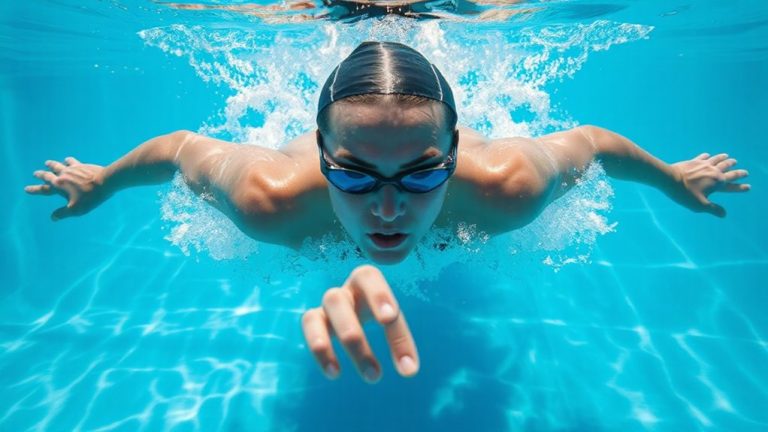
Core Stability Progression From Floor to Unstable Surface for Gymnasts
You start by mastering floor core activation to build intra-abdominal pressure and pelvic control on a stable surface. Then, you progress to quadruped anti-rotation drills, which sharpen neuromuscular coordination under load. Balance pads add mild instability, challenging your proprioception without sacrificing form. The BOSU ball increases demand with dynamic movements like throws and rebounds, bridging stability and sport-specific power. Combining unstable surfaces with dynamic actions-like medicine ball slams or lunges-mirrors real gymnastics demands, ensuring your core resists rotation and maintains alignment under unpredictable forces. Proper gear, like durable BOSUs and firm pads, enhances feedback and performance, while softer or low-quality equipment undermines progression. Training this way doesn’t just build strength-it builds smarter, more responsive movement patterns that transfer directly to routine execution. You’ll see how each stage layers new challenges, preparing your body for the next level of control.
Notable Insights
- Begin core stability training on a firm floor to master pelvic tilting and deep muscle activation with precise feedback.
- Progress to quadruped positions to develop anti-rotation control and support dynamic movement patterns.
- Introduce balance pads to challenge proprioception and enhance neuromuscular coordination through controlled instability.
- Utilize BOSU balls for greater dynamic demands, improving reflexive core control and impact stability.
- Integrate unstable surfaces with movement, such as medicine ball throws or jumps, to replicate gymnastics-specific stability demands.
Start With Floor Core Activation
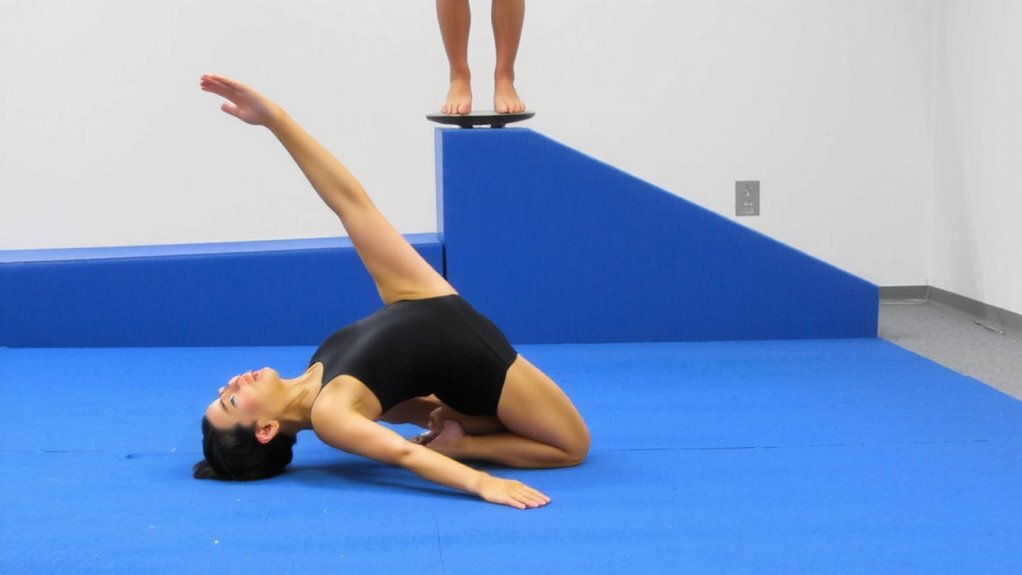
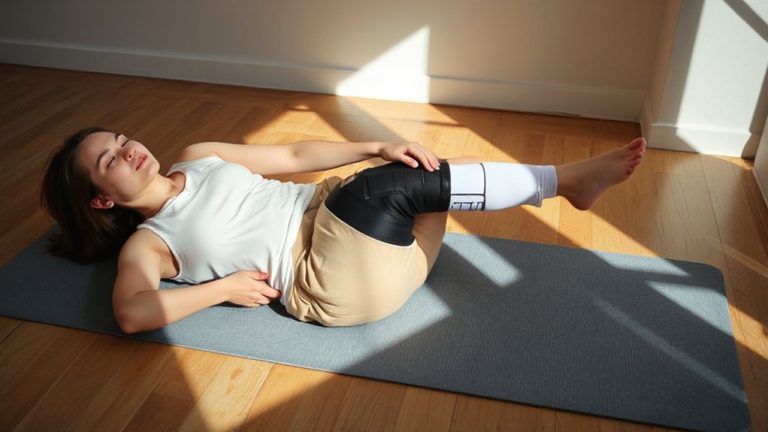
Why start your core training on the floor? Because it’s the most accessible way to build foundational control. On a firm surface, you can focus on precision-key for gymnasts who need exactness in movement. Lying flat, you initiate pelvic tilting to flatten the lower back against the floor, activating deep core muscles. It may seem simple, but mastering this teaches neuromuscular coordination. Pair pelvic tilting with muscle bracing-engaging transverse abdominis and obliques-and you create intra-abdominal pressure for spine support. This combo builds stability before adding motion. Floor work doesn’t require gear, making it cost-effective and easy to perform consistently. Though mats improve comfort, overly cushioned surfaces can reduce effectiveness by limiting feedback. The floor offers consistent resistance, allowing accurate self-assessment. For long-term development, starting here isn’t just practical-it’s essential.
Stabilize in Quadruped With Anti-Rotation
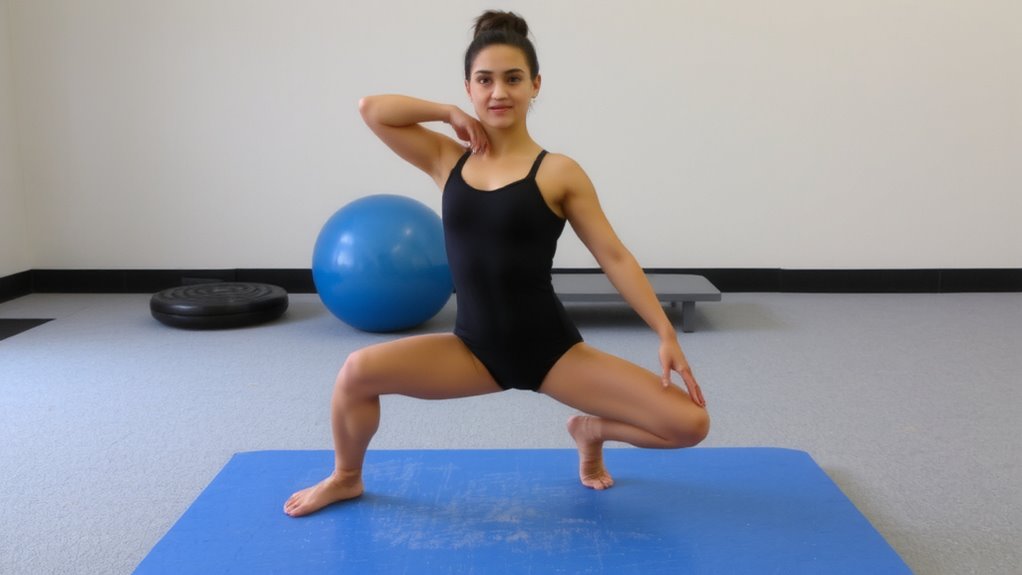
While you’re building awareness on the floor, shifting to quadruped opens a new challenge-one that demands real-time stabilization under load. You’ll need to maintain strict hip alignment while resisting rotation, which directly strengthens your anti-rotational core control-essential for gymnastic precision. Proper shoulder engagement is critical; keep your arms vertical and actively press into the floor to stabilize the trunk and protect the joints. This position mimics dynamic movement patterns in routines, making it more functional than static floor drills. Your core must work continuously to prevent pelvic sway or shoulder collapse, training coordination between deep stabilizers and global movers. Because the load is moderate yet neuromuscularly demanding, it’s ideal for building endurance without overloading connective tissues. Consistent practice improves control during skills requiring spatial awareness and balance. This progression bridges foundational activation with dynamic stability, setting the stage for more complex loading-without needing equipment, it remains efficient and accessible for daily training.
Add Instability Using Balance Pads
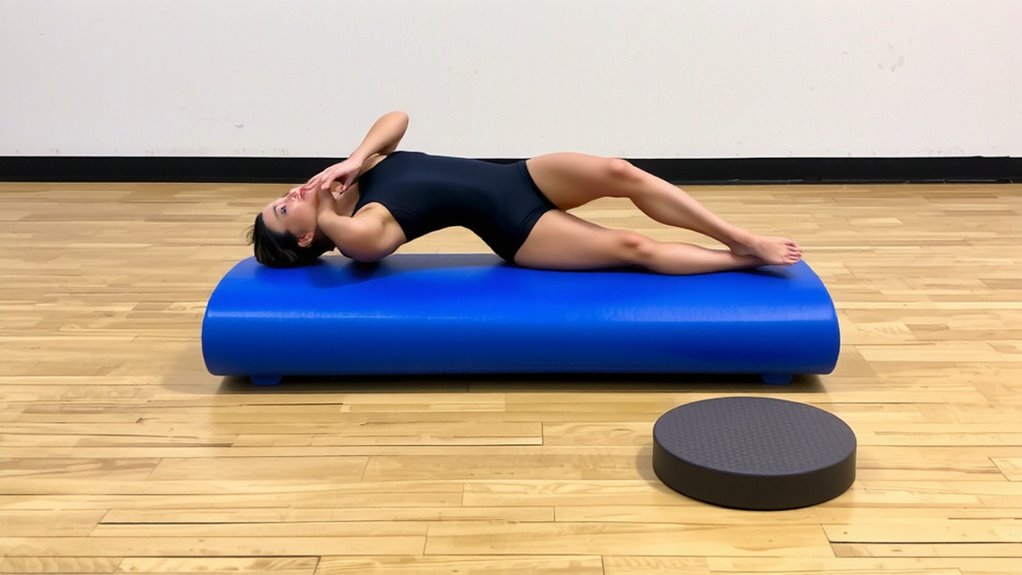
A balance pad isn’t just a soft surface to stand on-it’s a tool that amplifies neural demand by disrupting your base of support, forcing your core and stabilizing muscles to work harder in real time. You’ll notice immediate changes in muscle activation as the pad resilience responds to micro-shifts in weight, challenging proprioception with each rep. This level of instability enhances balance integration, training your body to maintain control during dynamic movements essential in gymnastics. Unlike rigid surfaces, the compressible material requires constant correction, improving neuromuscular efficiency. Most pads offer consistent rebound, allowing repeated use without loss of structural integrity. They’re lightweight and easy to clean-ideal for frequent training. When used correctly, balance pads bridge the gap between stable ground and advanced unstable tools, making them a smart, practical choice for progressive core development.
Train on the BOSU Ball for Dynamic Control
Since the BOSU ball introduces a greater degree of instability than a balance pad, you’ll find it challenges your core in more dynamic and sport-specific ways-especially when performing explosive or rhythm-based movements common in gymnastics. The curved, inflated side adds unpredictable motion, sharpening your reflexive control. Try plyometric rebounds: jump softly onto the dome from the floor, absorbing impact while keeping your torso steady-this builds resilience and trains neuromuscular coordination under load. Rotational throws with a medicine ball while standing on the flat side further enhance dynamic stability, mimicking twisting dismounts or tumbling entries. The BOSU’s design supports controlled aggression, unlike softer surfaces that dampen response. It’s durable, easy to clean, and versatile, though heavier than balance pads. Used consistently, it bridges floor-based control and high-intensity demand-ideal for refining gymnasts’ in-air awareness and landing precision.
Combine Movement and Unstable Surfaces
When movement meets instability, you’re not just working harder-you’re training smarter, especially as a gymnast who needs precise control during complex sequences. Combining dynamic actions with unstable surfaces challenges your core in ways that mimic real routines. Exercises like medicine ball throws from a wobble board integrate plyometric loading, forcing rapid force production while maintaining posture. As you jump or lunge off unstable platforms, your muscles endure sudden shifts, improving neuromuscular coordination. Rotational deceleration becomes critical when you twist mid-movement-your obliques and transverse abdominis must quickly stabilize to prevent collapse. Training this way reflects the demands of tumbling passes or dismounts, where balance and control are non-negotiable. Equipment like BOSU balls or foam pads must offer firm yet responsive resistance to be effective. Poor-quality gear collapses too easily, reducing training value. When designed well, these tools bridge floor-based stability to air-borne precision.
Challenge Reactivity With Limb Motion
How do you prepare your core for the chaos of flight and rotation when your limbs are flailing in different directions? You train reactivity under load, syncing your center with unpredictable limb motion. Incorporate plyometric bursts and rotational throws to mimic the dynamic demands of your routines. These movements force your core to stabilize mid-action, sharpening neuromuscular response when you need it most.
| Effort | Emotional Payoff |
|---|---|
| High | Confidence in control |
| Moderate | Frustration turning to focus |
| Maximal | Pride in resilience |
Plyometric bursts build explosive timing, while rotational throws enhance coordination between torso and extremities. Together, they condition your core to react, not just resist. You’re not just bracing-you’re adapting in real time, which is exactly what your body must do when momentum defies predictability. This reactivity is the bridge between stability and performance.
Transfer Core Stability to Gymnastics Skills
Control begins the moment you link core stability to actual gymnastics performance. You can’t just hold a plank and expect flips to improve-core integration is key. It’s about syncing trunk stiffness with limb movement so force transfers efficiently. When you jump or twist, your core must react instantly, stabilizing before motion starts. That’s where skill transfer happens: from drills on unstable surfaces to vault takeoffs or bar shifts. You’ll notice tighter hollow holds mid-back handspring or better posture during giants. Effective core work doesn’t end on the mat-it evolves in the air, under rotation, and through impact. Equipment like resistance bands or foam rollers helps maintain neuromuscular readiness, supporting recovery and performance. But no gear replaces proper technique. True progress shows when drills feel automatic, when stability becomes instinct. That’s when training sticks-and skills sharpen.
On a final note
You’ve built core stability from the floor up, progressing wisely through controlled, unstable environments. This method strengthens deep stabilizers while improving neuromuscular control-key for gymnastics performance. Equipment like balance pads and BOSU balls aren’t just accessories; they challenge proprioception and mimic dynamic skill demands. When used correctly, they enhance transfer to actual routines, fostering resilience and precision. Recovery isn’t passive; structured core progressions are active, purposeful, and essential.