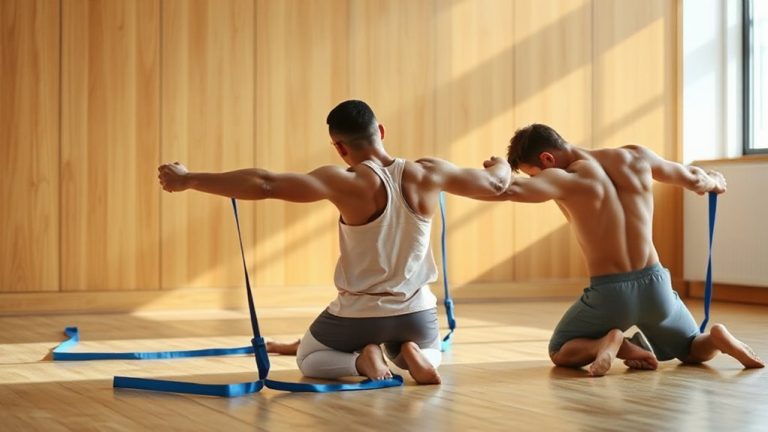
Dynamic Stretching for the Posterior Chain: Movements to Prep for Stretching
You’ll prime your posterior chain effectively with dynamic moves like leg swings to activate glutes and improve hip mobility. Straight-leg marches boost hamstring flexibility while building core control. Cat-cow to bird-dog flows enhance spinal motion and stability, and ankle mobilizations guarantee proper mechanics for power transfer. Combining lunges with hip extensions maximizes neuromuscular engagement. These movements prep your body better than static stretches-there’s more to optimizing your warm-up than just range of motion.
Notable Insights
- Dynamic leg swings prime glutes and improve hip mobility through controlled forward-backward motion.
- Straight-leg marches enhance hamstring flexibility and core engagement with deliberate, paused contractions.
- Cat-cow to bird-dog transitions boost spinal mobility and stabilize the lower back dynamically.
- Ankle mobilization restores dorsiflexion, optimizing posterior chain function during movement prep.
- Reverse lunges with hip extensions activate glutes, hamstrings, and lower back for full-chain recruitment.
Activate Your Glutes With Dynamic Leg Swings
Dynamic leg swings are a smart way to kick off your posterior chain warm-up, especially if your goal is to fire up the glutes before a workout. You’ll start by standing tall, hands on hips or a wall, and swing one leg forward and back in a controlled motion. This movement boosts hip mobility while encouraging glute isolation, ensuring the right muscles engage before heavier work. Unlike static stretches, dynamic swings prime the neuromuscular system, increasing blood flow and joint range. You’ll notice better activation and reduced compensatory patterns from the lower back or hamstrings. For peak performance, aim for 10–15 swings per leg, focusing on form over height. Quality movement here translates to safer, more effective lifts later. When paired with proper fitness gear-like supportive shoes and moisture-wicking apparel-you enhance stability and comfort, making each swing more effective. It’s a simple yet powerful activation strategy.
Loosen Hamstrings With Straight-Leg Marches
| Phase | Action | Focus Area |
|---|---|---|
| Lift | Raise leg to 90° | Hamstring activation |
| Hold | Pause briefly in mid-air | Core and leg isolation |
| Lower | Controlled return | Eccentric tension |
Perform 10–12 reps per leg in a slow, rhythmic pattern. This drill bridges mobility and control, making it ideal for warm-ups where precision matters. Unlike passive stretching, the straight-leg march primes connective tissue and improves ROM with minimal risk.
Mobilize Your Lower Back: Cat-Cow to Bird-Dog
You’ll want to start by flowing smoothly from cat-cow into bird-dog, as this combo gently warms the lower back while teaching spinal awareness and core engagement. Begin on all fours, moving through cat-cow with control-arching and rounding your spine to boost spinal mobility. Then, shift into bird-dog: extend one arm and the opposite leg while resisting rotation. This builds core coordination and stabilizes the lumbar spine. Keep your movements slow and deliberate, focusing on form over range. These dynamic shifts prep the posterior chain by enhancing neuromuscular control, not just flexibility. Unlike passive stretches, they activate muscles used in running, lifting, or jumping. For best results, perform 8–10 reps per side. No gear’s needed, making it practical for home or gym. This sequence isn’t flashy, but its functional design delivers measurable improvements in alignment and movement quality.
Free Your Ankles to Maximize Posterior Chain Engagement
How often do tight or stiff ankles silently sabotage your hinge mechanics and limit power transfer through the posterior chain? Poor ankle mobility restricts dorsiflexion, forcing compensations that dull glute and hamstring activation. When joint rotation is compromised, your entire kinetic chain suffers-especially during dynamic movements requiring deep hip hinges. Releasing ankle restrictions isn’t just about flexibility; it’s about restoring functional range so force can travel efficiently from the ground up. Limited mobility here often leads to excessive knee drift or heel lift, undermining stability and reducing power output. Tools like foam rollers and banded ankle mobilizations can enhance tissue quality and improve joint rotation. Consistent work pays off: better ankle mobility means cleaner movement patterns and fuller posterior engagement. Don’t overlook this foundational link-your deadlifts, hinges, and jumps depend on it. Prep your ankles, and you prep your entire posterior system for peak performance.
Combine Lunge and Hip Extension for Full Activation
While many trainees isolate lunges and hip extensions in separate phases of their routine, combining the two movements into a single, fluid exercise amplifies neuromuscular recruitment across the entire posterior chain. You’re not just warming up-you’re priming key muscles like the glutes, hamstrings, and lower back with purposeful tension and control. This integrated approach enhances hip mobility by linking dynamic stability with active range of motion, making it ideal before heavier lifts or mobility work. Using lunge variations-like the reverse lunge with a hip extension-helps correct muscular imbalances while improving coordination. You’ll notice better ground force transfer and joint alignment, especially when moving through compound patterns. The synergy between the lunge’s stride mechanics and the hip extension’s glute activation creates a more complete warm-up, one that prepares both structure and movement efficiency. It’s not just stretching; it’s functional readiness.
Avoid These 5 Common Form Errors
Performing a reverse lunge with hip extension correctly maximizes activation across the posterior chain, but poor execution can undermine its benefits and increase injury risk. You often create improper alignment by letting your front knee collapse inward or your torso lean too far forward, reducing glute and hamstring engagement. Overstriding momentum is another frequent error-stepping too far back generates uncontrolled movement, shifting focus from stability to sheer motion. This compromises muscle activation and stresses the knee joint. You might also fail to fully extend the hip at the top, limiting posterior chain involvement. Rounding your lower back during the movement further diminishes effectiveness and elevates strain risk. Keeping your core braced and movements controlled guarantees targeted activation. Avoid rushing through reps; quality matters more than quantity. Correct form guarantees you gain the full preparatory benefits without unnecessary joint or muscle strain.
Why Dynamic Warm-Ups Unlock Your Posterior Chain
Since your posterior chain-hamstrings, glutes, and lower back-often remains underactive in daily life, a dynamic warm-up wakes these muscles up more effectively than static stretching ever could. You’re not just increasing blood flow; you’re triggering neural priming, which sharpens the mind-muscle connection and prepares your body for explosive or controlled movements. Unlike passive stretches, dynamic motions like leg swings or walking lunges boost muscle elasticity gradually, reducing injury risk during lifts or sprints. You’ll notice your range of motion improves in real time, letting you move with greater efficiency. Fitness recovery isn’t just about rest-it starts with proper activation. When you consistently use dynamic warm-ups, you’re not only enhancing performance but also supporting long-term joint and muscle health. It’s smart prep, not flashy gear, that delivers real results. Your body responds better when primed correctly.
On a final note
You’ve primed your posterior chain effectively by activating glutes, loosening hamstrings, and mobilizing the lower back. These dynamic movements enhance neuromuscular readiness, improve joint range, and reduce injury risk. Unlike static stretching, this approach boosts blood flow and movement precision, making it ideal pre-workout. Pairing proper form with quality recovery gear-like compression sleeves or foam rollers-supports long-term tissue health. Done consistently, this routine optimizes performance and structural balance, laying the foundation for stronger, more resilient training sessions.