How Inertial Measurement Units (IMUs) in Wearables Assess Muscle Symmetry During Recovery
You’re relying on IMUs in wearables to detect subtle muscle imbalances during recovery by tracking motion symmetry through accelerometers and gyroscopes. These sensors capture real-time data on limb movement, gait, and alignment, revealing differences in strength and coordination between sides. Rehab teams use this objective feedback to adjust your therapy, ensuring balanced progress. Devices like those from Catapult and dorsaVi offer clinical-grade insights that traditional methods miss-keep exploring to see how they outperform conventional tools.
Notable Insights
- IMUs detect motion asymmetries by measuring linear acceleration and angular velocity during movement.
- Wearable sensors capture real-time gait and limb synchronization differences between left and right body sides.
- Continuous data reveals subtle muscle activation imbalances during dynamic rehabilitation exercises.
- Clinicians use IMU-derived metrics like step length and pelvic rotation to quantify symmetry progress.
- High-fidelity IMUs in wearables provide objective, continuous feedback outside clinical lab settings.
Muscle Symmetry in Recovery
While you’re rebuilding strength after an injury, muscle symmetry often becomes a key indicator of how well your recovery is progressing. You rely on muscle balance not just for performance, but to prevent re-injury and guarantee both sides of your body contribute equally. Traditional recovery tracking methods often miss subtle imbalances, leading to uneven strain and compensatory movements. Wearable fitness gear equipped with IMUs helps detect these discrepancies by measuring movement patterns across limbs. This data offers objective insight into whether your weaker side is catching up, making recovery tracking more accurate and actionable. Unlike subjective assessments, IMUs provide consistent feedback on symmetry during daily activities and rehab exercises. When used consistently, they support smarter adjustments to training loads and therapy routines. Ultimately, prioritizing muscle balance through precise monitoring improves long-term outcomes, making these tools valuable for anyone serious about full, sustainable recovery.
How IMU Sensors Capture Motion
Because they combine accelerometers, gyroscopes, and sometimes magnetometers, IMU sensors can capture motion with impressive detail, giving you a clear picture of how your body moves in three-dimensional space. These sensors detect linear acceleration, angular velocity, and orientation changes, letting you monitor subtle movements during rehabilitation exercises. For accurate readings, proper sensor calibration is essential-without it, even small errors can distort data and misrepresent movement patterns. You’ll also face challenges like motion artifacts, which happen when external vibrations or improper placement interfere with sensor performance. High-quality wearables minimize these issues through secure fitting and advanced signal processing. While IMUs aren’t perfect, their ability to deliver consistent, real-world movement data makes them valuable tools in fitness recovery. With the right setup, you get reliable feedback that helps guide smarter, more effective rehab strategies over time.
Detecting Real-Time Movement Asymmetry
When you’re working to rebuild strength and coordination after an injury, spotting imbalances between left and right muscle groups quickly can make a real difference in recovery outcomes. Wearable IMUs offer real-time feedback on movement asymmetry, letting you adjust before bad habits set in. Through continuous gait analysis, these sensors detect subtle differences in stride length, timing, and force distribution. They also monitor limb synchronization during dynamic exercises, flagging delays or misalignments that may hinder progress. This isn’t just data-it’s actionable insight, delivered the moment it matters.
| Parameter | IMU Detection Capability |
|---|---|
| Gait asymmetry | High precision across步行 cycles |
| Limb synchronization | Real-time phase matching alerts |
| Balance deviation | Instant feedback during weight shifts |
These capabilities make IMUs more than fitness gear-they’re recovery allies, accurate and always on.
How Rehab Teams Use IMU Insights
If you’re part of a rehab team, you already know that subjective observation only goes so far-IMU insights fill in the gaps with quantifiable, movement-based evidence. You use biomechanical feedback from wearable sensors to identify subtle imbalances in muscle activation and joint motion, allowing for earlier, more precise interventions. These metrics let you track symmetry improvements objectively across sessions, replacing guesswork with data. You rely on real-time reports to adjust exercises on the fly, fine-tuning resistance or range to match each patient’s needs. Gait optimization becomes measurable, not anecdotal-step length, cadence, and pelvic rotation are all assessable down to milliseconds. This level of specificity improves decision-making during rehab, ensuring protocols adapt to actual performance, not just perceived progress. While IMU wearables require proper calibration and interpretation, their clinical value in monitoring recovery dynamics is increasingly clear, making them a practical upgrade from traditional observational methods.
IMU Wearables in Post-Surgery Recovery
Post-surgery recovery hinges on precision, and IMU wearables deliver just that-giving you immediate, actionable data on movement quality during critical healing phases. You’re able to monitor asymmetries in gait or joint motion that could otherwise prolong recovery or worsen surgical inflammation. These devices track subtle deviations in acceleration and rotation, alerting your care team to irregular movement patterns before complications arise. Because they’re non-invasive and worn daily, you get continuous feedback without disrupting incision healing. Unlike periodic clinical visits, IMUs offer a consistent window into how your body adapts during rehabilitation. Their compact sensors integrate seamlessly into recovery gear, ensuring reliable performance without bulk. For you, this means fewer setbacks and a clearer path to balanced muscle reactivation. By catching imbalances early, IMUs support smarter progression, minimizing strain on healing tissues and improving long-term outcomes in post-surgical rehabilitation.
Why IMU Wearables Beat Traditional Methods
While traditional assessment tools like visual gait analysis or force plates have long served rehabilitation, they often miss the dynamic, three-dimensional movement patterns that IMU wearables capture with ease. You get real-time, continuous data during natural movement, not just snapshots in controlled environments. That’s where IMUs shine-offering superior data accuracy through synchronized accelerometers, gyroscopes, and magnetometers. Unlike bulky setups requiring lab visits, these wearables are lightweight and unobtrusive, ensuring high user comfort during daily activities. You can wear them over extended periods, enabling clinicians to track progress objectively without disrupting recovery routines. Traditional methods can’t match this blend of precision and practicality. With IMUs, you’re not guessing symmetry improvement-you’re measuring it accurately, wherever rehab happens. That’s a game-changer for personalized, evidence-based recovery.
Best IMU Wearables for Recovery
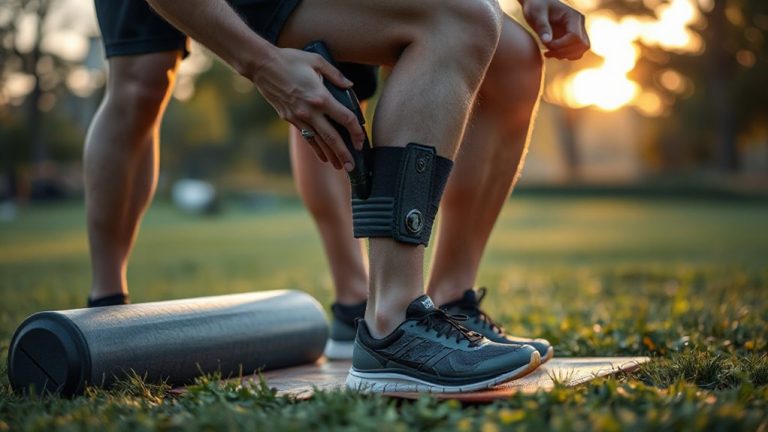
Since accuracy and comfort matter most when tracking recovery, the best IMU wearables strike a balance between sensor fidelity and wearability. You’ll want devices that offer high data accuracy without compromising on daily use. Look for models with calibrated accelerometers, gyroscopes, and magnetometers-these guarantee reliable movement tracking. Sensor placement is critical; wearables that secure firmly near key muscle groups, like the quadriceps or glutes, capture symmetry more effectively. Straps with adjustable bands or integrated smart clothing help maintain consistent positioning. Brands like Catapult and dorsaVi deliver strong performance in clinical and athletic settings, combining robust analytics with user-friendly apps. They’re durable, wireless, and let you monitor asymmetry trends over time. While they cost more, the insights into muscle balance and recovery load are worth it. Choose systems that sync seamlessly with recovery platforms so you can act on data quickly.
On a final note
You’re seeing how IMU wearables deliver precise, real-time motion data during recovery, capturing subtle asymmetries traditional methods miss. These devices track acceleration and rotation with high fidelity, letting rehab teams adjust protocols based on objective metrics. Compared to observational assessments, IMUs offer consistent, quantifiable feedback, especially post-surgery. While not flawless, their portability and accuracy make them essential tools-transforming how you monitor muscle symmetry and optimize fitness recovery with smarter, data-driven insights.