The Science Behind Tendinopathy Rehabilitation Programs: Why Specificity Matters
You won’t fix tendinopathy with rest alone-your tendon needs specific, progressive loading to reorganize collagen and regain strength. Generic exercises fail because they don’t match your tendon’s real-world demands. Instead, targeted movements like eccentrics and isometrics rebuild tissue by applying controlled stress where it’s needed most. This approach not only reduces pain but enhances load tolerance. The right program evolves with your healing, ensuring long-term resilience. There’s more to how this works exactly when you look at the phases of recovery.
Notable Insights
- Tendinopathy requires mechanical loading to stimulate collagen realignment and fibroblast activity for structural repair.
- Eccentric and isometric exercises reduce pain and build load tolerance by modulating neural responses and promoting tendon adaptation.
- Progressive loading must match the tendon’s capacity to avoid flare-ups while driving remodeling.
- Exercise specificity ensures tendons adapt to functional demands by replicating energy absorption and release patterns.
- Non-specific or passive treatments fail to restore tendon resilience and limit functional recovery.
Why Rest Isn’t Enough for Tendinopathy Rehab
Why keep avoiding movement when your tendon isn’t healing no matter how long you rest? Prolonged inactivity might reduce strain, but it doesn’t address the real issues-poor collagen organization and weakened load tolerance. You need strategies that support both inflammation management and pain modulation, which rest alone can’t provide. Without targeted input, tendons stagnate, losing elasticity and strength. Think of inflammation not just as swelling to suppress, but as a signal to guide recovery. Passive modalities like ice or NSAIDs may briefly ease discomfort, but they don’t rebuild tissue. You’re better off using controlled stimuli-gradual, specific movement-that recalibrate pain thresholds and encourage structural adaptation. Recovery isn’t about waiting it out; it’s about smart engagement. Tools like compression sleeves or biofeedback wearables aren’t magic fixes, but they help monitor and support dynamic rehab. You need performance-aware recovery-adaptive, responsive, and integrated into a larger plan focused on long-term tendon health. A well-designed compression sleeve can enhance proprioception and support optimal loading during rehabilitative exercise.
How Loading Repairs Damaged Tendons
You’ve likely heard that rest slows further injury, but it doesn’t rebuild what’s already compromised-your tendon’s structure needs more than stillness, it needs direction. Specific loading guides repair by stimulating cellular activity that promotes collagen alignment, essential for restoring tensile strength. Eccentric contractions, in particular, apply tension while lengthening the muscle-tendon unit, creating micro-stresses that signal fibroblasts to reorganize damaged fibers.
| Phase | Stimulus | Result |
|---|---|---|
| Early Load | Controlled stretch | Fiber realignment |
| Mid Load | Eccentric contractions | Collagen synthesis |
| Late Load | Increased resistance | Dense, aligned matrix |
This mechanotransduction process turns mechanical input into biological repair. Without it, tendons remain disorganized and weak. You’re not just healing-you’re rebuilding with precision.
Use Progressive Loading to Rebuild Strength
While your tendon begins to reorganize under controlled load, true strength returns only when that stimulus steadily increases-progressive loading isn’t just logical, it’s necessary for bridging the gap between healing and function. You need to gradually bump up exercise intensity so your tendon adapts without flaring symptoms. It’s not about pushing through pain; it’s smart load management-tracking reps, resistance, and frequency to match your current tolerance. Think of it like strength training with a purpose: each phase builds on the last, ensuring your tendon handles more stress over time. Research shows tendons respond best to slow, structured increases in demand. Jumping too fast leads to setbacks, while moving too slow stalls progress. You’re not just recovering-you’re rebuilding resilience. Progressive loading turns repair into real-world strength, but only if you respect the balance between challenge and capacity. Get this right, and you reclaim function without compromising healing.
Match Exercises to Your Tendon’s Job
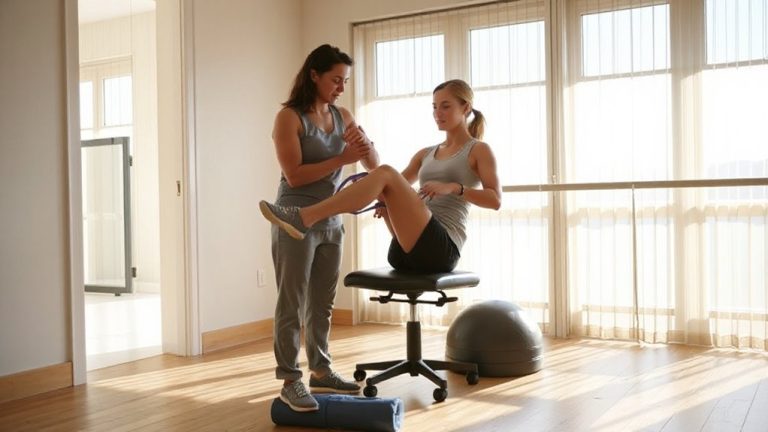
Building on the idea that strength comes from smartly increasing load, it’s just as important to make sure you’re loading the right way. Your tendon isn’t just a passive strap-it has a specific job, and your rehab must reflect that. If you’re dealing with Achilles tendinopathy, for example, you need exercises that mimic how the tendon functions during movement. That’s where eccentric contractions shine: lowering slowly under load trains the tendon to handle real-world forces. Isometric holds help too, reducing pain while building early-stage tolerance. These aren’t filler exercises-they’re targeted tools. Generic strength moves don’t cut it because they skip the tendon’s actual role. You wouldn’t test a car’s brakes by only revving the engine. Likewise, your rehab should match the tendon’s job: absorbing, storing, and releasing energy with precision. Specificity isn’t optional-it’s essential. For deeper tissue work between sessions, incorporating a best trigger point tool can help maintain muscle-tendon junction mobility.
Stop Generic Programs: They Don’t Work
Most generic rehab programs fail because they treat all tendons the same, ignoring the unique demands placed on each one. You need specificity-your Achilles handles load differently than your patellar or rotator cuff tendons, and your rehab should reflect that. Inadequate programming often relies on cookie-cutter exercises like endless leg lifts or shoulder circles, which don’t replicate real tendon function. These one-size-fits-all routines lead to failed outcomes because they skip progressive, load-specific stimuli necessary for tendon remodeling. Without tailoring volume, intensity, and movement patterns to your tendon’s role, you’re not rebuilding resilience-you’re just going through the motions. Equipment choices matter too; using standard fitness gear without adjusting resistance or tempo limits effectiveness. Generic protocols might feel familiar, but they rarely address the actual pathology. If your rehab isn’t matching your tendon’s job-and your daily or athletic demands-it’s probably not working. Stop wasting time on routines that promise recovery but deliver little.
Tendinopathy Rehab by Stage: What to Do When
You’ve likely tried generic rehab programs and seen they don’t deliver lasting results-too often, they ignore what your tendon actually does in daily life or sport. Effective recovery hinges on matching exercise load to tendon biomechanics at each stage. Rehabilitation psychology also plays a key role-your belief in progress influences adherence and outcomes. Here’s how to adapt:
| Stage | What to Do |
|---|---|
| Acute Pain | Isometric holds, low-load; reduces pain via neural modulation |
| Early Load Tolerance | Slow isotonic exercises; builds collagen alignment |
| Load Capacity | Heavy slow resistance; optimizes tendon stiffness |
| Return to Sport | Energy-storage drills; mimics sport-specific demands |
Progression depends on pain response and functional goals. You must respect tissue healing timelines while staying mentally engaged. Specificity in loading-and mindset-drives structural and psychological resilience. Generic programs fail because they’re one-size-fits-all. Your rehab should reflect your movement demands, not just textbook templates.
Signs Your Tendon Is Healing
How do you know your tendon is truly healing-not just quieting down temporarily? You’ll notice consistent pain reduction during and after movement, not just at rest. That sharp ache during stair climbing or lifting fades, replaced by mild discomfort that subsides quickly. Improved mobility becomes obvious-your range of motion expands without stiffness, and daily tasks feel smoother. You’re likely progressing if load tolerance increases gradually with targeted exercises. Unlike temporary relief from passive treatments, real healing shows when function returns under stress. Specific rehab protocols that match your tendon’s stage reinforce this. Tools like resistance bands or controlled eccentric devices help track progress objectively. Don’t rely solely on how it feels today; look for trends over weeks. True recovery isn’t the absence of pain alone-it’s sustainable movement, improved mobility, and the confidence to load your tendon without setbacks.
On a final note
You now know rest alone won’t fix tendinopathy-specific, progressive loading is essential. Tailoring exercises to your tendon’s function speeds recovery and builds resilience. Generic programs lack the precision needed for effective rehab, often leading to setbacks. By matching load to stage and purpose, you support structural healing and long-term strength. Proper technique and consistency matter more than gear, though supportive, well-designed recovery tools can aid performance when used correctly.