Volleyball Approach Jumps With Restricted Arm Swing to Isolate Leg Power
You limit arm swing during volleyball approach jumps to isolate leg power and uncover true lower-body strength. By folding your arms across your chest, you remove upper-body momentum, making it easier to assess takeoff mechanics and force production. Expect lower jump heights at first-this is normal. Restricted jumps expose weaknesses in knee drive, triple extension, and landing control, helping refine technique. Use them 1–2 times weekly alongside recovery gear like compression sleeves to support consistent training. You’ll gain clarity on how your legs truly perform under demand.
Notable Insights
- Restricting arm swing during approach jumps isolates leg power and enhances lower-body force production.
- Fold arms across the chest to eliminate upper-body momentum and emphasize proper triple extension.
- Expect reduced jump height initially, as arm drive normally contributes significantly to lift.
- Focus on soft, controlled landings to improve impact absorption and reduce injury risk.
- Use weekly jump height tracking to monitor leg power gains over 4–6 weeks of training.
Why Limit Arm Swing in Volleyball Jumps?
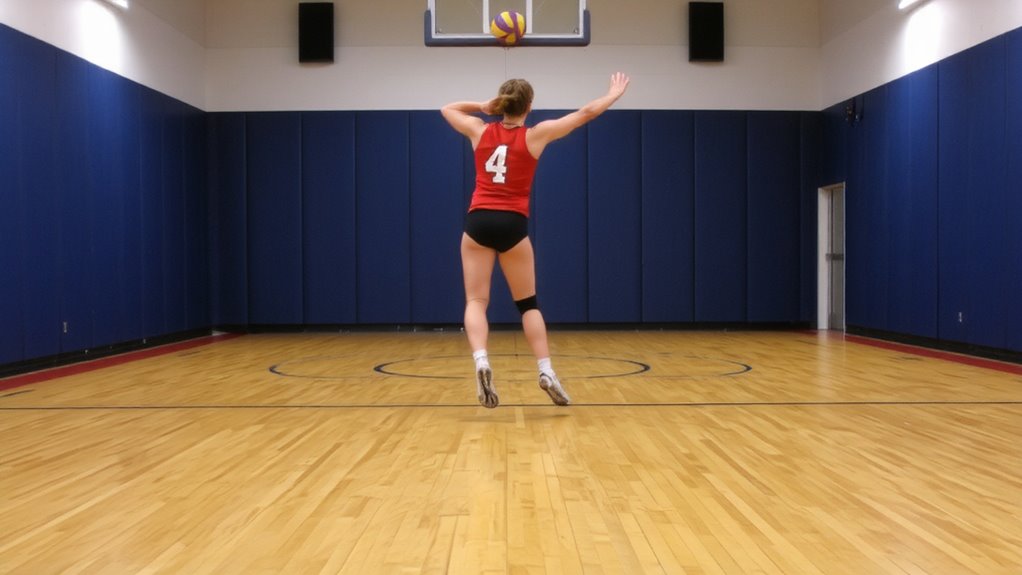
Why would anyone limit arm swing during a volleyball approach jump when it seems to go against everything you’ve been taught? Because doing so reveals how much power your legs truly contribute. Biomechanical analysis shows that arm swing enhances jump height, but restricting it forces your lower body to compensate, exposing weaknesses. You’re not eliminating arm use forever-you’re isolating variables to build a stronger foundation. This kind of training drives neuromuscular adaptation, teaching your legs to generate force more efficiently without relying on upper-body momentum. Think of it like using resistance bands or weighted vests: temporary constraints create long-term gains. These drills don’t replace full jumps but refine them. Over time, you’ll likely see improved take-off power even with normal arm swing. It’s not about discarding technique-it’s about deepening control, ensuring your legs aren’t just following the arms’ lead.
How to Do Arm-Restricted Approach Jumps
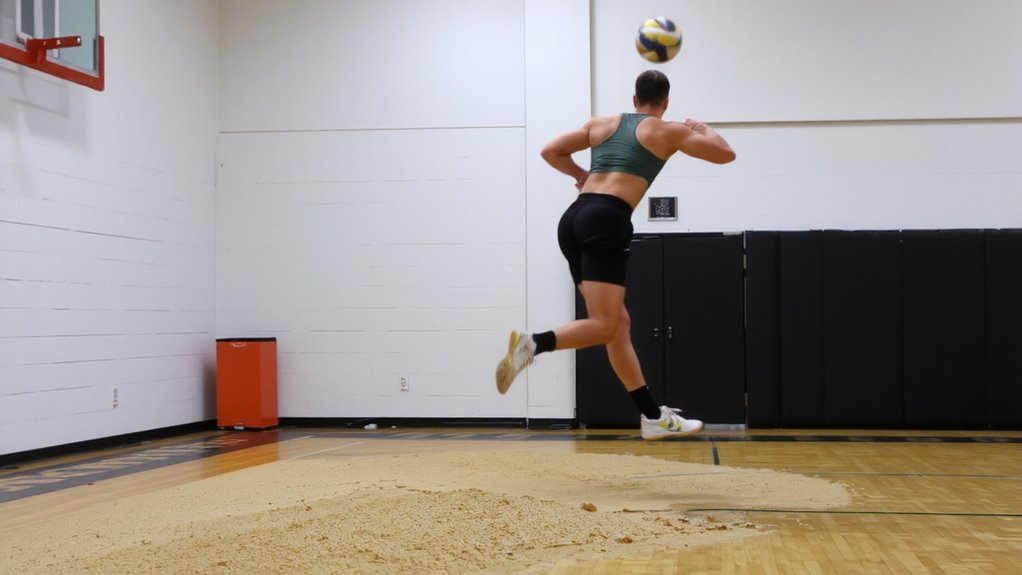
How do you train your legs to explode off the ground without relying on your arms to lead the way? Start with arm-restricted approach jumps by keeping your arms folded across your chest or held tightly at your sides-this arm positioning eliminates upper-body momentum, forcing your legs to generate all the power. Use a standard three- or four-step approach, focusing on precise foot placement and explosive knee drive. Proper jump mechanics are essential: emphasize a quick, low-to-high arm swing replacement through strong hip extension and coordinated triple extension at the ankle, knee, and hip. You’ll notice reduced jump height initially, but over time, neural and muscular adaptations enhance leg strength and efficiency. These drills sharpen takeoff precision and improve overall vertical performance when full arm swing returns. It’s not just about power-it’s about control, timing, and isolating what truly drives your jump.
Common Mistakes in Restricted Jump Drills

You’ve likely felt the awkwardness of launching into the air with your arms pinned to your sides, forced to rely solely on your lower body to generate lift. A common mistake in restricted jump drills is improper landing mechanics-letting your knees cave inward or landing with stiff legs increases injury risk and reduces training effectiveness. You might also catch yourself using excessive trunk rotation to cheat height, which shifts focus from leg power to momentum. This defeats the drill’s purpose and promotes inefficient movement patterns. Maintaining a neutral spine and engaging your core helps you stay balanced and aligned. Land softly, with knees tracking over toes, absorbing impact through hips and quads. Control matters more than height here. Consistent form guarantees you build strength safely and transfer it effectively to full approach jumps.
Tracking Leg Power Gains From Restricted Jumps
A well-structured training log is essential when measuring leg power improvements from restricted arm swing jumps, since eliminating upper body contribution isolates lower limb strength and neuromuscular efficiency. You’ll notice gains by tracking jump height weekly using a tape measure or motion sensor. Consistent increases mean your leg strength is adapting well. Use the same starting stance and countermovement depth each time to keep data accurate. Over 4–6 weeks, most athletes see a 10–15% rise in jump height with proper loading and recovery. Monitor performance trends, not just single sessions, to account for daily fatigue. This method gives you reliable feedback on how effectively your legs produce force. Don’t ignore rest days-recovery lets muscles rebuild stronger. Wear supportive footwear to maintain joint alignment and maximize force transfer. When logged correctly, jump height becomes a direct reflection of your leg strength development. Consider adding best insoles for higher jumps to enhance force transfer and support during training.
Progressions to Boost Explosiveness
Once consistent gains in jump height are established through restricted arm swing drills, the next step is to build on that foundational power with targeted progressions. You can now introduce plyometric variations-like depth jumps, single-leg bounds, and approach-specific hops-to further stimulate fast-twitch muscle fibers. These drills challenge your nervous system and mimic game-like takeoffs, bridging the gap between isolated strength and functional power. Monitor improvements closely using jump height metrics gathered via force plates or wearable sensors, ensuring progress aligns with performance goals. Not all plyometric variations yield equal results; focus on quality over volume to reduce injury risk and maximize output. Overloading too soon can impair recovery, so balance intensity with adequate rest and proper recovery gear, like compression sleeves and foam rollers, to maintain training consistency. For added versatility and durability during these drills, consider using a high-quality Top Plyo Boxes.
How to Add Restricted Jumps to Training
How do you effectively integrate restricted jumps into your training without undermining recovery or technique? Start with low volume and focus on precision-this helps refine jump timing and foot coordination while minimizing fatigue. Use restricted jumps 1–2 times per week, pairing them with technical drills rather than max-effort sets. Below is a simple weekly integration model:
| Day | Exercise | Sets x Reps | Focus Area |
|---|---|---|---|
| Monday | 3-Step Restricted Jump | 3 x 4 | Foot coordination |
| Wednesday | Approach Drill (No Arm) | 2 x 5 | Jump timing |
| Friday | 2-Step Explosive Jump | 3 x 3 | Leg drive |
| Saturday | Full Approach (Arms Free) | 2 x 3 | Integration |
| Sunday | Active Recovery | – | Fitness recovery |
This structure balances stimulus and recovery, ensuring quality technique. Proper footwear with responsive cushioning supports joint safety during repetitive landings. Consider selecting insoles designed for high-impact sports to enhance energy return and reduce fatigue, such as those with optimized arch support.
When to Use Restricted vs. Full Approach Jumps
You’re already using restricted jumps to sharpen timing and coordination, but knowing when to apply them versus full approach jumps makes all the difference in building transferable power. Your training focus should shift based on phase and goal: use restricted jumps early in a cycle to isolate leg drive and refine takeoff mechanics without arm compensation. They’re ideal for correcting imbalances and boosting rate of force development. Once leg strength and timing stabilize, integrate full approach jumps to replicate game-speed kinetics and engage the total kinetic chain. This progression supports long-term athletic development by guaranteeing power isn’t just generated-but efficiently transferred. Restricted jumps aren’t a replacement; they’re a diagnostic and developmental tool. Pair them strategically with full approaches to maximize vertical output, maintain movement specificity, and reduce injury risk. Balance guarantees each jump type serves a clear purpose in your growth as a dynamic, resilient athlete.
On a final note
You’ll find restricted arm-swing jumps sharpen your leg power focus, cutting reliance on upper-body momentum. These drills reveal weaknesses in lower-body explosiveness, making them a smart addition to volleyball training. When used alongside full approach jumps, they offer a balanced measure of athletic progress. Paired with proper recovery and quality gear-like supportive footwear and compression wear-they reduce injury risk while boosting performance, proving most effective when strategically programmed into your weekly routine.