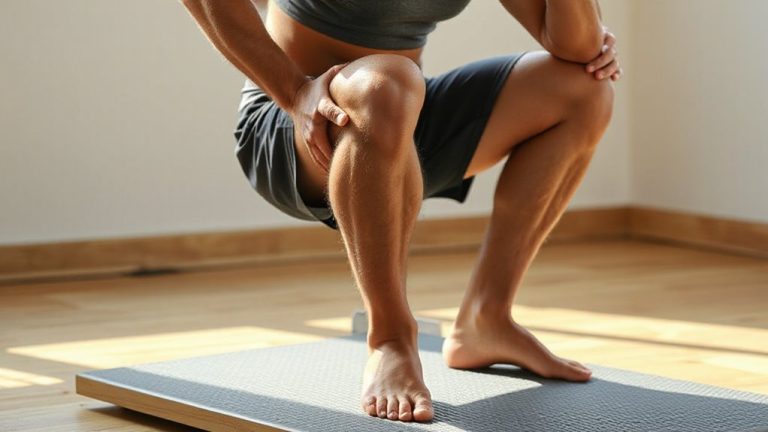
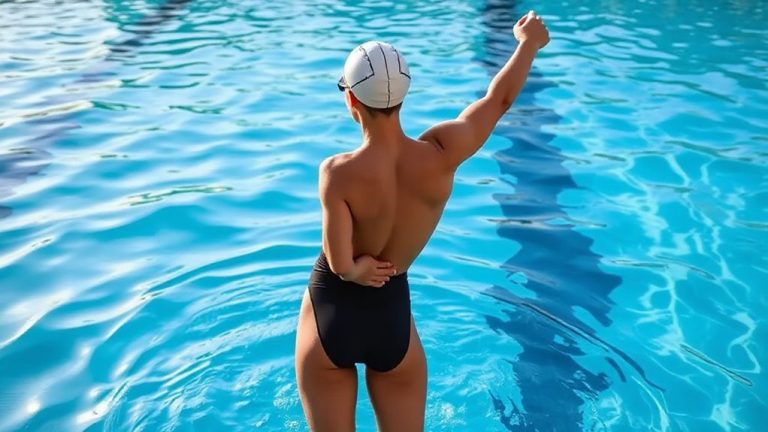
Vertical Deep-Water Kickboard Challenges to Strengthen Transverse Abdominis
You’re standing tall in deep water, kickboard held vertically at your chest, core engaged to stay balanced. This position forces your transverse abdominis to fire constantly, fighting water’s instability. Flutter kicks ramp up the challenge-start small, then go faster and deeper. Add scissor kicks once you’re steady. Avoid arching or holding your breath; they kill effectiveness. Keep movements precise, and you’ll build serious deep-core strength-and there’s a smarter way to progress than you might think.
Notable Insights
- Hold a kickboard vertically against the chest to increase core demand through water instability.
- Engage the transverse abdominis by maintaining a neutral spine and centered hips in deep water.
- Perform flutter kicks progressively, starting small and increasing tempo to amplify core activation.
- Transition to scissor kicks after mastering flutter to challenge obliques and hip stabilizers.
- Avoid arching the back or over-gripping the board to ensure proper transverse abdominis engagement.
How to Do the Vertical Kickboard Hold (With Perfect Form)
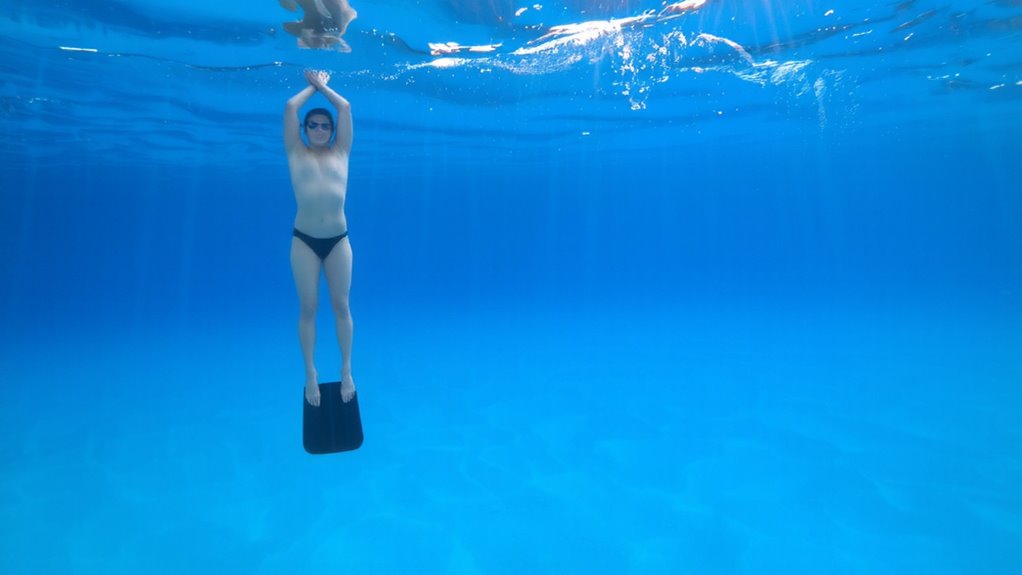
Start by grabbing a standard foam kickboard and positioning it vertically in front of your chest, with your hands gripping the top edge and your elbows locked. You’ll float in deep water, so keep your spine straight and hips centered-perfect body alignment begins here. Engage your core gently but firmly, avoiding tension in the shoulders. Breath control is essential; inhale deeply through your nose, exhale slowly through your mouth to stabilize intra-abdominal pressure. Maintain a neutral neck, eyes forward, and distribute buoyancy evenly across your torso. A high-density foam kickboard performs best-light enough to float yet firm enough to resist compression. You’ll notice subtle shifts if alignment falters. Consistent use improves water confidence and muscular endurance. The gear’s simple design belies its effectiveness: no moving parts, minimal maintenance, just reliable feedback. Perfect form isn’t flashy, but it’s functional-and this exercise proves it.
Why This Move Activates Your Deepest Core Muscles
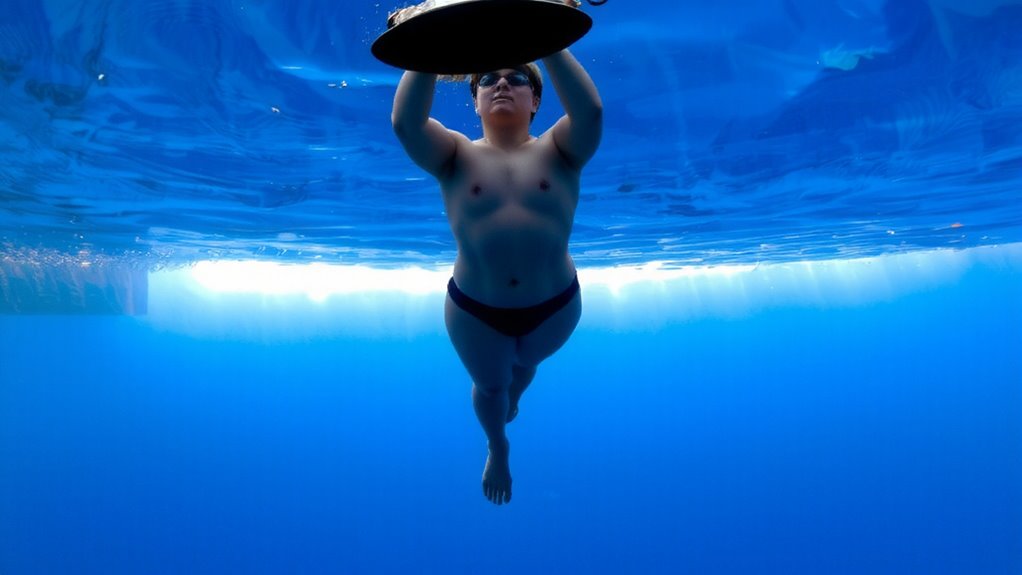
You’re already floating in deep water with the kickboard held vertically, your body aligned and core engaged-now consider how this seemingly simple hold actually forces your deepest core muscles to do the real work. The lack of stable ground demands continuous muscular engagement, especially from the transverse abdominis, which stabilizes your spine. Maintaining anatomical alignment prevents compensatory swaying, guaranteeing the workload stays deep within the core rather than shifting to larger, superficial muscles. Water’s resistance amplifies subtle movements, turning even small adjustments into core challenges. Below is how key factors interact during the exercise:
| Factor | Role | Benefit |
|---|---|---|
| Anatomical Alignment | Maintains neutral spine | Enhances deep core activation |
| Water Instability | Creates constant micro-adjustments | Increases muscular engagement |
| Vertical Position | Challenges balance without impact | Strengthens transverse abdominis efficiently |
This move’s design guarantees effective, low-impact core strengthening essential for functional fitness.
Master the Flutter Kick: 3 Progression Levels
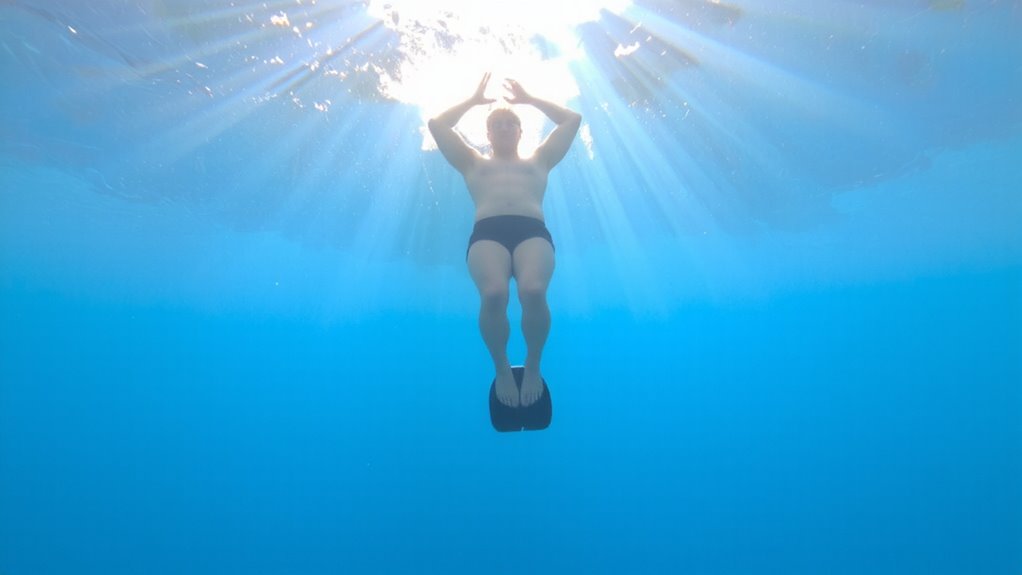
A well-structured flutter kick progression can transform your deep-water core workout from static endurance to dynamic control, especially when using a vertical kickboard. Start with Level 1: small kicks just below the surface-this builds transverse abdominis engagement while improving ankle flexibility. In Level 2, increase kick tempo and amplitude slightly; you’ll notice greater core demand and hip stabilizer activation. By Level 3, you’re driving rapid, controlled kicks with feet staying deep-this enhances neuromuscular coordination and cardiovascular load. Each level requires disciplined form: keep your spine neutral and avoid arching. Greater ankle flexibility allows smoother water displacement, reducing drag and boosting efficiency. A consistent kick tempo guarantees rhythmic core recruitment, preventing fatigue from erratic motion. These progressions aren’t just harder-they’re smarter, demanding precision over power. When performed correctly, they optimize core training specificity and minimize strain, making them a reliable advancement model in aquatic fitness programming.
Add Scissor Kicks for Greater Core Challenge
One effective way to escalate the intensity of your vertical deep-water workout is by incorporating scissor kicks after mastering the flutter progression-this shift not only challenges your core in a new plane of motion but also increases demand on the hip flexors and obliques. By alternating legs in a controlled, vertical plane, you engage in advanced core integration, forcing the transverse abdominis to stabilize against dynamic movement. Scissor kick variations, like slower pulses or wider arcs, allow you to modulate resistance without added equipment. These adjustments enhance muscular endurance while minimizing joint strain, making them ideal for low-impact training. The kickboard’s buoyancy supports proper alignment, letting you focus on contraction quality. Performance improves when you maintain a tight core and avoid hip sagging. Unlike land-based versions, the water’s resistance amplifies time-under-tension, boosting effectiveness. Consistent use sharpens neuromuscular control and builds functional strength. When executed with intent, scissor kicks become a valuable tool for developing resilient, integrated core performance.
Fix These 5 Form Mistakes (And Feel the Burn)
Why does your deep-water kickboard session leave you sore in the wrong places? You’re likely making one of these five form mistakes. Arching your back or letting your hips drop shifts effort from your transverse abdominis to larger, unrelated muscles, causing unnecessary muscle fatigue. You should maintain a tall, stacked posture-like balancing a book on your head. Another common error? Holding your breath. Proper breathing techniques-slow inhales through the nose, controlled exhales through the mouth-keep oxygen flowing and stabilize your core. Kicking from the hips, not the knees, guarantees targeted engagement. Also, avoid over-gripping the kickboard; it tenses your shoulders and disrupts alignment. Finally, wobbling means you’re not bracing properly-tighten your abs like you’re about to be punched. Fix these, and you’ll feel the burn where it counts-deep in your core.
Build a 4-Week Kickboard Core Routine
How do you turn a simple kickboard into a core-transforming tool? By using vertical deep-water kicks with consistent form and progressive intensity. Start Week 1 with 3 sets of 30-second holds, focusing on controlled breathing and bracing your transverse abdominis. Weeks 2–3 increase duration to build kickboard endurance, aiming for 45–60 seconds per set. By Week 4, incorporate subtle arm presses into the water to amplify resistance. The water resistance naturally challenges your core while reducing joint strain, making it ideal for active recovery and sustained engagement. Use a durable, foam kickboard that maintains buoyancy under pressure-this guarantees consistent performance. Monitor fatigue; if your form slips, shorten intervals. This routine enhances core stability and endurance efficiently, blending functional resistance with aquatic recovery principles. It’s practical, scalable, and effective across fitness levels.
On a final note
You’ve learned how the vertical kickboard hold targets your transverse abdominis with precision. This move, when done right, builds real core stability, not just surface strength. Using proper gear-like a firm, textured kickboard-ensures better grip and performance. Over four weeks, consistent form and progression turn effort into measurable control. Maintenance matters: rinse gear after use, check for wear. Done well, this routine supports long-term core resilience, making it a smart, science-backed addition to any swim or recovery program.