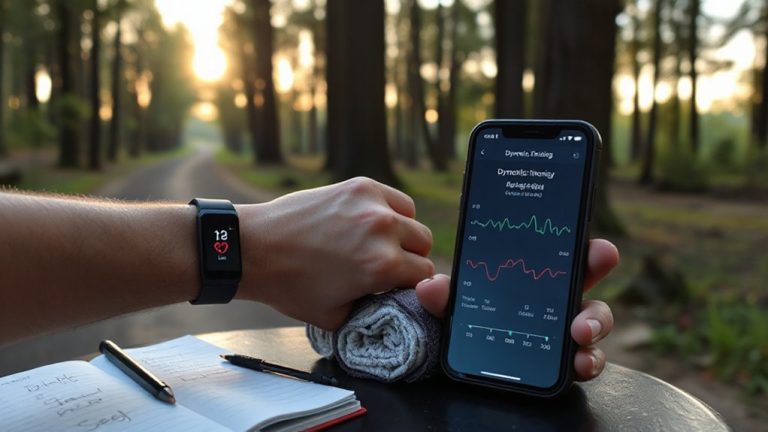
Using Wearable EMG Sensors to Detect Neuromuscular Fatigue After Resistance Training
You’re seeing real-time neuromuscular fatigue with wearable EMG sensors that detect electrical changes in muscles after resistance training. These devices track increased amplitude and slowed conduction velocity-key signs of fatigue-through high-fidelity signal processing. Clinical-grade wearables like Delsys Trigno and Myontec MBody offer accurate, sweat-resistant monitoring during dynamic movement. They help you adjust effort, prevent overtraining, and optimize recovery-smart feedback that keeps performance progressing safely. There’s more to how athletes use this data effectively.
Notable Insights
- Wearable EMG sensors detect increased muscle electrical activity as a sign of neuromuscular fatigue post-resistance training.
- Slowing muscle conduction velocity during fatigue is captured by high-sampling-rate EMG for accurate fatigue assessment.
- Real-time EMG feedback helps identify when motor unit recruitment patterns indicate declining muscle performance.
- Advanced signal processing in wearables filters noise to ensure reliable fatigue detection during post-exercise recovery.
- Clinically validated devices like Delsys Trigno provide precise EMG data to monitor fatigue and guide recovery decisions.
What Is Neuromuscular Fatigue and Why It Matters?
While you might think muscle tiredness is just about feeling sore or out of breath, neuromuscular fatigue goes deeper-it’s a temporary decline in your muscle’s ability to generate force due to prolonged or intense activity. This isn’t just physical strain; it involves your nervous system too, as signal transmission to muscles slows down. Poor neural efficiency means your brain’s commands don’t fire as effectively, weakening performance. Over time, without proper recovery, this fatigue hampers muscle adaptation, limiting strength gains and endurance. Fitness recovery isn’t just about rest-it’s about how well your body restores neuromuscular function. Smart fitness gear that monitors these signals helps athletes train smarter, avoiding overwork. Ignoring neuromuscular fatigue risks injury and stalls progress. Recognizing its role allows for better training design, optimized loads, and improved neural efficiency, supporting long-term muscle adaptation. It’s a vital factor in high-performance fitness.
How EMG Sensors Detect Fatigue in Real Time
As your muscles work harder during intense training, you’ll notice fatigue creeping in, and that’s exactly what wearable EMG sensors are designed to catch in real time. These devices pick up electrical activity from your muscle fibers, but raw data means nothing without signal processing and noise reduction. Advanced algorithms filter out interference from movement or external sources, ensuring only relevant muscle signals are analyzed. This allows the sensor to deliver accurate, real-time feedback on neuromuscular strain.
| Feature | Benefit |
|---|---|
| High sampling rate | Captures rapid muscle changes |
| Onboard signal processing | Reduces data lag |
| Adaptive noise reduction | Improves signal clarity |
| Wireless integration | Enables continuous monitoring |
You’ll find these features essential for reliable recovery tracking. Wearables that prioritize signal fidelity help you make smarter training decisions, avoiding overuse while maximizing performance gains.
How EMG Signals Change When Muscles Fatigue
You’re already seeing how wearable EMG sensors capture muscle activity and filter out noise to deliver clean, real-time data-but now consider what those signals actually look like as your muscles start to tire. As fatigue sets in, you’ll notice the EMG amplitude increases because your body recruits more motor units to maintain force. At the same time, muscle conduction velocity slows-ion channels in fatigued fibers work less efficiently, delaying signal transmission. This drop in speed is a reliable fatigue marker. Fiber recruitment patterns also shift: fast-twitch fibers, usually reserved for power, activate earlier and remain active longer. The EMG signal grows denser, more chaotic. These changes are measurable, consistent, and highly useful for tracking recovery. While not all wearables interpret these shifts accurately, high-quality EMG devices detect them with clinical-grade precision, making them practical tools for serious training and recovery planning.
Top EMG Wearables for Tracking Training Fatigue
Because accurate fatigue tracking depends on both signal fidelity and real-time analysis, not all EMG wearables perform equally-some stand out by combining clinical-grade sensors with intuitive feedback. You’ll want high sensor accuracy to detect subtle shifts in muscle activity post-exercise, especially during resistance training. Devices like the Delsys Trigno and Myontec MBody offer reliable EMG data with minimal noise, making them top picks among researchers and pros. Their wireless design stays secure during movement, and sweat-resistant materials mean they endure intense sessions. When you’re logging repetitive workouts, brand reliability matters-consistent firmware updates and durable construction prevent dropouts. Though pricier, these tools reduce guesswork in recovery planning. Cheaper alternatives often sacrifice signal clarity or app integration, undermining fatigue insights. Choosing the right wearable means balancing upfront cost with long-term performance. Focus on proven sensor accuracy and trusted brand reliability to get meaningful, repeatable data from every session.
How Real-Time EMG Feedback Improves Training
Choosing the right EMG wearable isn’t just about capturing clean signals-it’s about using that data to make smarter decisions during training. You’re able to monitor muscle activation in real time, which lets you adjust form, intensity, or rest periods instantly. When you see underactive muscles, you can correct your technique before fatigue sets in, reducing injury risk and boosting effectiveness. This immediate feedback supports performance optimization by highlighting imbalances and ensuring targeted muscles are working as intended. You don’t waste effort on inefficient reps-instead, you train with greater precision. Devices that offer low-latency transmission and intuitive apps make this process seamless, turning raw EMG data into actionable insight. Over time, consistent use helps you fine-tune workouts to match physiological responses, maximizing gains. Real-time EMG isn’t just a monitoring tool-it’s a strategic advantage for smarter strength training.
How Athletes Use EMG Data to Speed Recovery
While muscle recovery is often seen as passive downtime, athletes who track EMG data turn it into an active, measurable process. You use the sensors post-workout to monitor neuromuscular fatigue, spotting imbalances in muscle symmetry that could lead to injury if ignored. When one side fires harder or longer than the other, you adjust rehab or recovery protocols immediately. EMG helps refine recovery timing-instead of guessing when to resume training, you rely on declining RMS or MPF trends to signal readiness. Coaches combine this data with subjective feedback, ensuring recovery isn’t rushed. Devices like Delsys Trigno or Myontec offer reliable signal fidelity, making field use feasible. Though setup needs skin prep and baseline readings, consistent use pays off. Over time, you learn your body’s fatigue signatures, optimizing rest windows. EMG gear isn’t flashy, but its precision in tracking physiological recovery makes it a smart investment for serious training cycles.
On a final note
You’re seeing real benefits when using EMG wearables to track neuromuscular fatigue-they detect subtle shifts in muscle signal frequency and amplitude post-training, giving you objective recovery insights. Devices like TheraBand EMG or MyoWare simplify monitoring, though accuracy depends on proper sensor placement and skin prep. Real-time feedback helps prevent overtraining, but don’t rely on it alone. Pair EMG data with perceived exertion and sleep metrics for smarter, more effective recovery decisions.