Lumbar Mobility Drills With Supine Knee Drops for Segmental Rotation
You improve lumbar mobility with supine knee drops by guiding your knees side-to-side in a controlled, gravity-assisted motion that encourages segmental rotation. This drill enhances spinal articulation while keeping your pelvis neutral and core engaged. It reduces stiffness from sitting and primes your spine for twisting movements. Avoid arching your back or forcing the range-let gravity do the work. Proper form guarantees safer, more effective results, especially if you modify with bent knees or a pillow for support. You’ll find timing matters too-morning or pre-workout sessions boost daily function, and there’s more to optimizing this drill where technique meets individual needs.
Notable Insights
- Supine knee drops enhance lumbar mobility by promoting segmental rotation of vertebrae in a gravity-assisted position.
- Maintain neutral pelvis and engage deep core muscles to ensure controlled, independent spinal segment movement.
- Keep shoulders grounded and knees aligned over ankles to maximize rotational accuracy and reduce strain.
- Move slowly with mindful breathing to improve nervous system control and prevent over-rotation.
- Modify with pillows or bent legs to accommodate tight hips and optimize accessibility during recovery.
Why Knee Drops Improve Lumbar Mobility for Daily Movement
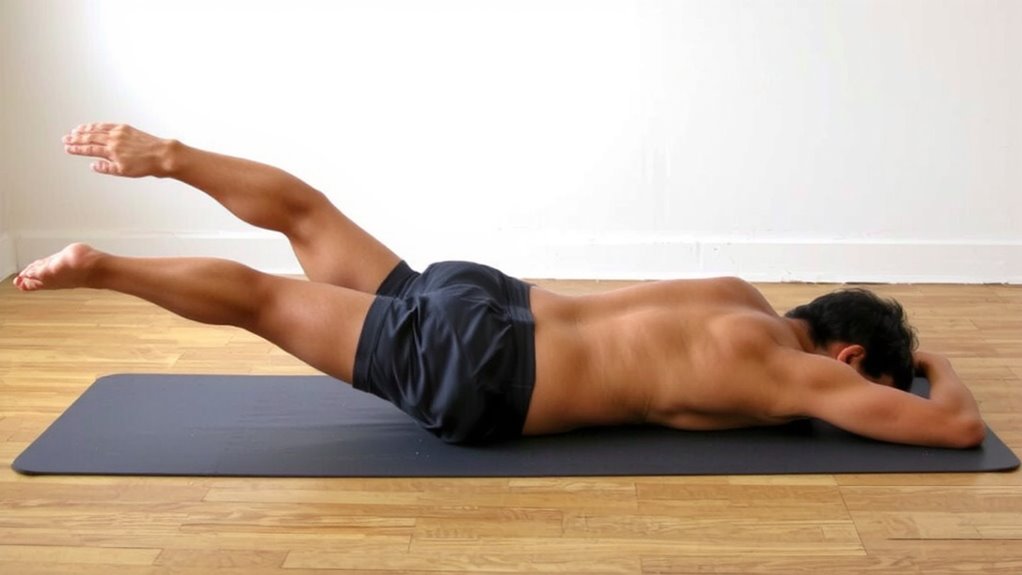
Knee drops are a simple yet effective drill that enhance lumbar mobility by promoting controlled rotation and segmental movement in the lower spine. You maintain supine positioning, letting gravity assist gentle side-to-side motion, which encourages proper spinal alignment without strain. This movement primes your lumbar vertebrae for daily activities like twisting, bending, or lifting, reducing stiffness and guarding against injury. Muscle relaxation occurs naturally as tension in the paraspinal and hip rotator muscles dissipates, especially when you pause at the end range. Unlike aggressive stretches, knee drops offer a low-load, high-control method to improve functional mobility. When paired with recovery-focused fitness gear-like supportive mats with adequate cushioning-you optimize comfort and consistency. The drill’s simplicity doesn’t undermine its value; it’s a practical tool that, when used regularly, maintains segmental integrity and reinforces neutral spine positioning essential for everyday motion. For those looking to complement this mobility work with targeted strength training, incorporating a core exercise machine can enhance overall spinal stability and support functional movement patterns.
How Supine Knee Drops Enhance Segmental Rotation
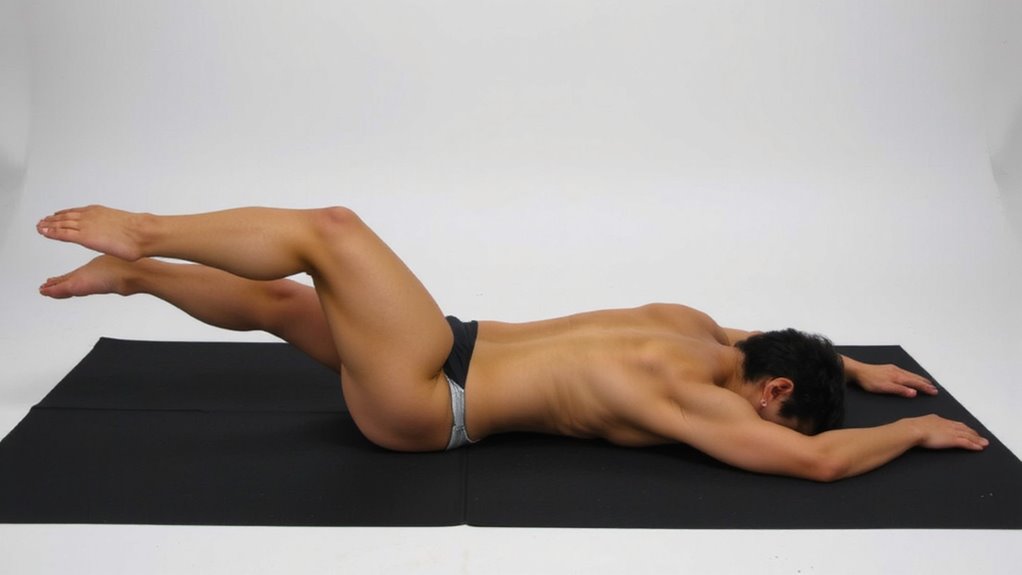
By lying on your back and guiding your knees side to side, you’re not just loosening tight hips-you’re creating the right conditions for each lumbar vertebra to rotate in sequence, which is exactly how supine knee drops enhance segmental rotation. This movement encourages precise spinal segmentation, allowing each segment to engage independently rather than moving as a single block. You’ll notice improved joint articulation, especially when you maintain a neutral pelvis and let your deep core muscles guide the motion. Over time, this drill trains your nervous system to access controlled intervertebral rotation, which supports safer bending and twisting in daily life. Unlike larger, more aggressive mobility tools, supine knee drops require no equipment, making them ideal for consistent recovery routines. They’re subtle but effective-especially when used alongside supportive fitness gear like non-slip mats that keep your position stable. You’re not forcing movement; you’re re-educating your spine to move smarter, one segment at a time.
How to Do Supine Knee Drops the Right Way
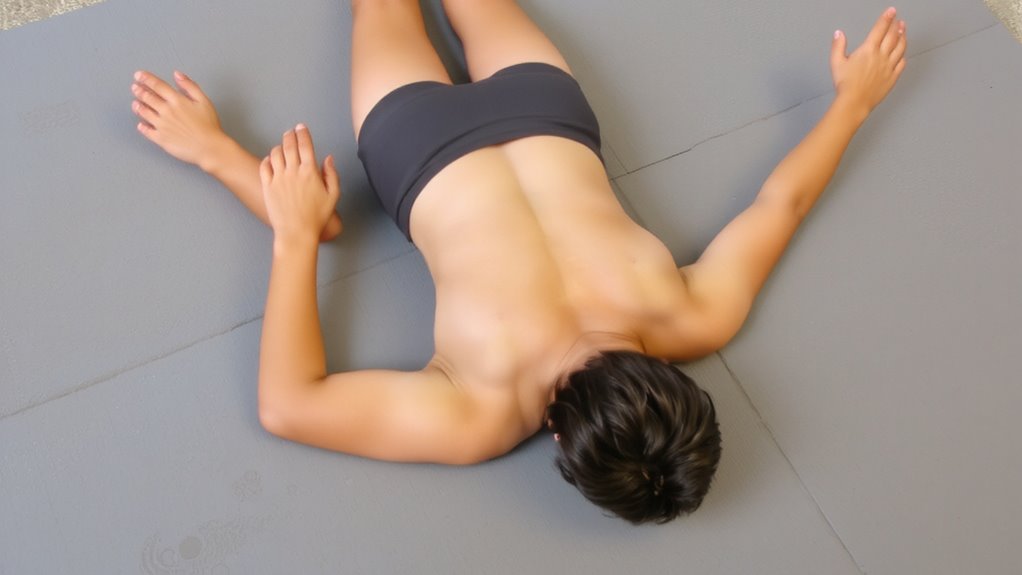
To perform supine knee drops correctly, you’ll want to start by lying on your back with your arms extended out to the sides in a T-position, palms facing up. Bend your knees and keep your feet flat, stacked over your knees. Engage your core slightly to support spinal alignment-this isn’t about crunching, but about stabilizing your lower back. Slowly let both knees fall to one side, keeping your shoulders grounded and your neck relaxed. The movement should come from your lumbar spine, not your hips, to encourage segmental rotation. Control the drop so it’s smooth, not floppy, and avoid forcing the range. Maintain consistent core engagement throughout to protect the spine and enhance mobility precision. This drill works best when done with mindful pacing, letting gravity assist without compromising form. Done right, it promotes balanced, functional movement essential for recovery and long-term spinal health. For added support during recovery, consider incorporating back stretching equipment recommended for pain relief.
Mistakes People Make Doing Knee Drops (And How to Fix Them)
Why do so many people feel a jolt of discomfort instead of relief during supine knee drops? Often, it’s due to poor knee alignment and faulty breathing technique. Letting your knees collapse past hip width restricts segmental rotation and strains the lower back. You should maintain controlled knee alignment just above the midline. Holding your breath amplifies tension-instead, use a steady breathing technique to ease into the movement. Avoid rushing through reps; mobility gains come from mindful repetition.
| Mistake | Fix |
|---|---|
| Knees too low | Keep knees higher than hips |
| Holding breath | Inhale through nose, exhale slowly |
| Arching lower back | Engage core slightly |
| Over-rotating quickly | Move slowly, control range |
| Ignoring knee alignment | Track knees over ankles |
Knee Drop Modifications for Tight Hips or Back Pain
How do you perform knee drops when tight hips or lingering back pain make the standard version uncomfortable? Start by bending one knee and letting it fall open slightly, not all the way to the floor-this reduces strain while still encouraging segmental rotation. Use a pillow under the dropping knee for pain modification, which supports the joint and limits over-rotation. If hip flexibility is limited, keep the opposite leg bent too, with foot flat on the floor, to stabilize the pelvis and reduce lumbar compensation. You can also shorten the range by only lowering the knee halfway. These adjustments maintain mobility benefits without triggering discomfort. Over time, as tissue adapts and joint tolerance improves, you can gradually increase the drop. These modifications aren’t just workarounds-they’re strategic progressions that honor individual biomechanics while promoting effective, sustainable lumbar and thoracic mobility.
Best Times to Do Knee Drops (Morning, Post-Sitting, Pre-Workout)
When should you actually be doing knee drops to get the most out of them? The ideal timing depends on your daily routine and goals. Doing them in the morning helps reset lumbar alignment after hours of stillness, gently activating deep spinal stabilizers. If you sit for long periods, performing knee drops post-sitting breaks up stiffness and restores segmental rotation before it leads to discomfort. Pre-workout, they serve as an effective neuromuscular warm-up, priming the lower back for movement without loading the spine. Each timing offers distinct recovery benefits-morning sessions enhance circadian mobility, while post-sitting reps combat adaptive shortening. Pre-activity, they improve movement efficiency. You don’t need special fitness gear, just a mat for comfort. Consistency matters more than timing, but aligning knee drops with these windows maximizes both acute relief and long-term spinal health.
On a final note
You’ve seen how supine knee drops boost lumbar mobility and segmental control, making them ideal for daily movement and recovery. When done correctly, they support spinal health without straining the hips. Pairing this drill with quality recovery gear-like supportive mats or compression tools-enhances results by promoting proper alignment and muscle relaxation. These practical, low-risk movements fit well into morning routines, post-sitting resets, or pre-workout warm-ups, offering measurable benefits for long-term spine function and overall movement efficiency.