Treadmill Incline Decline Methodology to Shift Quadriceps-Hamstring Recruitment
You shift muscle recruitment effectively by adjusting treadmill incline and decline to rebalance quad and hamstring demand. A 3–7% incline boosts hamstring and glute activation, correcting quad dominance, while a -3% to -5% decline increases eccentric quad loading, improving tendon resilience. Alternating both enhances neuromuscular coordination and joint stability. Always progress gradually and wear supportive shoes with responsive cushioning to manage impact. Smart programming sharpens performance and prepares you for more advanced strategies.
Notable Insights
- Incline running at 3%–7% enhances hamstring and glute activation while reducing quad dominance during treadmill exercise.
- Decline running at -3% to -5% increases eccentric loading on quads, promoting tendon resilience and muscle balance.
- Adjusting incline lengthens stride and increases hip extension, boosting biceps femoris involvement in push-off.
- Alternating incline and decline promotes symmetrical muscle recruitment and reduces joint stress through balanced loading.
- Gradual progression and proper form are essential to safely shift muscle recruitment and prevent overuse injuries.
Why Incline and Decline Shift Muscle Activation
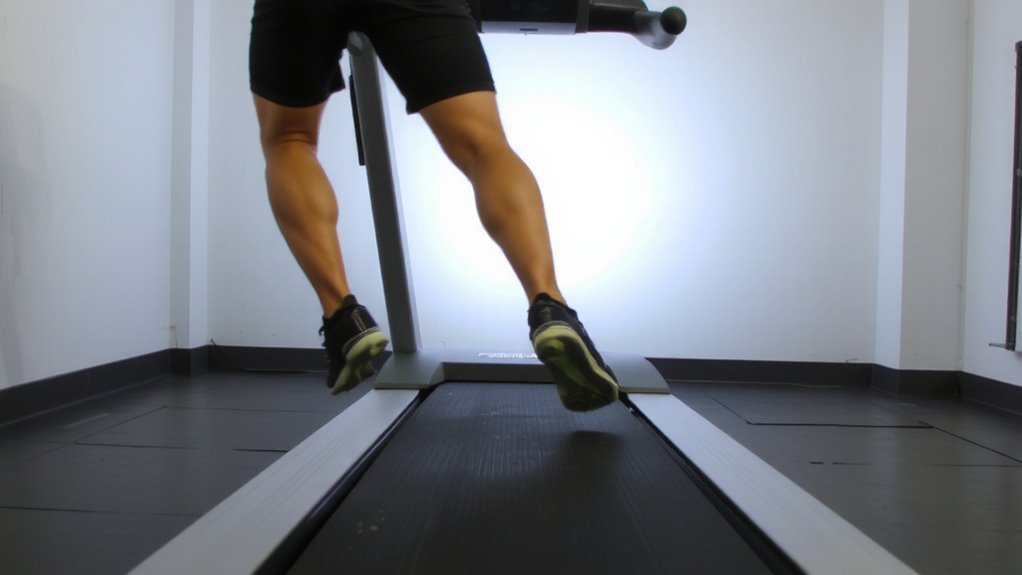
The way you adjust the incline or decline on a treadmill doesn’t just change how hard your workout feels-it actually shifts which muscles do the bulk of the work. When you incline, you place greater demand on your quadriceps, activating more type II muscle fiber types due to increased resistance. This recruits fast-twitch fibers better suited for power and fatigue quicker, making workouts more intense in shorter bursts. On a decline, the shift favors eccentric loading, subtly altering joint angles and increasing neuromuscular coordination. Your body responds with neural adaptation, improving motor unit recruitment patterns over time for greater movement efficiency. These adjustments aren’t just about intensity-they fine-tune muscle activation in ways that complement functional performance. High-end treadmills with precise incline/decline settings make this possible with consistent, measurable increments. Proper maintenance guarantees seamless shifts, allowing controlled, repeatable biomechanics essential for targeted training adaptations. For optimal results, consider treadmills specifically designed for interval training performance.
Target Hamstrings With Treadmill Incline Running
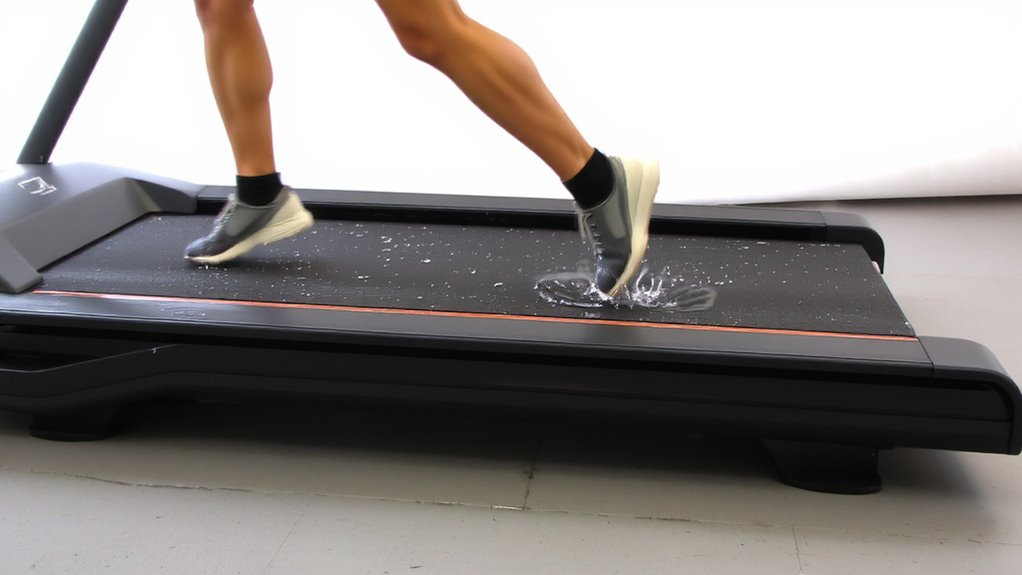
While most assume incline running primarily fires up the quads, you’re actually tapping into a potent hamstring stimulus when you dial in the right gradient and pace. At inclines between 3% and 7%, your stride lengthens slightly, increasing hip extension and demanding more from the posterior chain. This shift promotes hamstring isolation, especially during the push-off phase, where the biceps femoris works overtime. You’ll also notice enhanced glute engagement, which supports pelvic stability and reduces compensatory quad dominance. Running at a moderate pace-around 6.0 to 7.5 mph-keeps the focus on neuromuscular coordination rather than sheer power, refining muscle recruitment. Consistent use of this method builds endurance and activation patterns critical for runners seeking balance. Treadmills with precise incline control and a stable running deck amplify effectiveness, allowing progressive overload without joint strain. It’s a strategic tool for recalibrating leg drive and improving running economy.
Build Eccentric Quad Strength Using Decline Runs
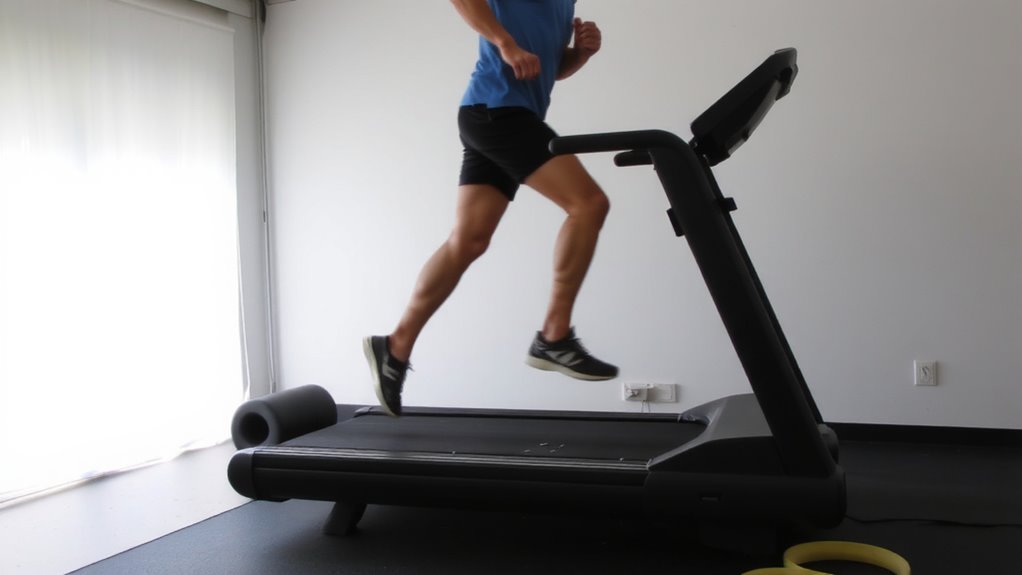
You’ve already seen how incline running shifts emphasis toward the hamstrings and glutes, but now consider what happens when you flip the script: running on a decline forces your quads to handle far more eccentric load with every step. This increased lengthening under tension builds eccentric strength effectively, helping correct muscle imbalance between your quads and hamstrings. Controlled decline runs-at -3% to -5% grade-improve neuromuscular coordination while conditioning connective tissue, but they aren’t without risk. If overdone, they amplify joint stress, particularly in the knees, due to repetitive impact during deceleration. That’s why proper footwear with responsive cushioning and a treadmill with precise incline calibration are essential. Limit sessions to 10–15 minutes initially, focusing on form: stay upright, minimize overstriding, and shorten your stride. Used wisely, decline runs enhance quad resilience and durability, but they demand respect-poor execution turns a recovery-boosting drill into a source of strain.
Combine Incline and Decline for Balanced Workouts
How do you balance muscle development and joint resilience without overloading your system? By combining incline and decline treadmill training, you create a dynamic synergy that promotes muscle symmetry and joint stability. Incline walking or running emphasizes the hamstrings and glutes, reducing quad dominance while enhancing posterior chain engagement. Conversely, decline runs increase eccentric quad loading, improving tendon resilience. Alternating between the two avoids muscular imbalances and distributes mechanical stress more evenly across the knee joint. You’re not just building strength-you’re training movement efficiency. This approach modulates muscle recruitment patterns smartly, making your workouts more functional. Over time, the integrated use of incline and decline shifts doesn’t just boost performance-it supports long-term joint stability. Proper form and mindful pacing are essential, but with consistency, you’ll see improved muscle symmetry and reduced strain risks, all while working within your body’s natural biomechanics. A high-quality heavy-duty treadmill ensures reliable performance during both incline and decline training sessions.
Progress Safely to Prevent Overuse Injuries
Building on the balanced muscle development and joint resilience you gain from combining incline and decline training, the next step is managing how quickly you increase workload to avoid setbacks. To prevent overuse injuries, proper form is essential-keep your posture aligned and avoid gripping the handrails, letting your natural gait do the work. Gradual progression isn’t just smart; it’s necessary for long-term adaptation. Increase either incline, decline, duration, or speed by no more than 10% weekly to allow tendons and muscles to adjust. Monitoring how your body responds-especially hamstring or quad tightness-helps catch strain early. Recovery tools like foam rollers or compression gear can support tissue repair, but they don’t replace smart programming. For deeper muscle release, consider using a vibrating foam roller to enhance recovery between sessions. Combine attentive technique with measured increases, and you’ll build endurance without crossing into overtraining. Safety lies in consistency, not intensity.
On a final note
You’ll shift muscle recruitment effectively using incline and decline treadmill training-uphills emphasize hamstrings concentrically, while downslopes build eccentric quad strength through controlled deceleration. Combined, they promote muscular balance and reduce overuse risks. When paired with proper recovery and reliable gear-like shock-absorbing treadmills and supportive footwear-this method enhances performance. Progress gradually, though, to avoid strain. It’s practical, biomechanically sound, and adaptable for most runners seeking strength and injury resilience.