Thoracic Mobility Drills With Side-Lying Arm Raises
You’re doing side-lying arm raises wrong if you’re not stacking hips, supporting your head, and breathing deeply. This drill boosts thoracic mobility by promoting spinal rotation without shoulder compensation. Keep movements slow and controlled, syncing each lift with exhalation to maximize ribcage expansion. Avoid arching or rushing-precision trumps reps. Pair it with foam rolling and scapular glides for greater gains in posture and joint health, and you’ll uncover smarter ways to access your spine’s full range.
Notable Insights
- Perform side-lying arm raises with stacked hips and supported head to optimize thoracic rotation.
- Engage diaphragmatic breathing to enhance ribcage expansion and spinal mobility during each lift.
- Maintain scapular stability and avoid shoulder shrugging to prevent compensatory movement patterns.
- Execute 8–10 controlled, breath-synchronized reps per side to improve neuromuscular control.
- Combine with foam rolling and scapular glides for enhanced thoracic mobility and movement efficiency.
How to Do Side-Lying Arm Raises Right
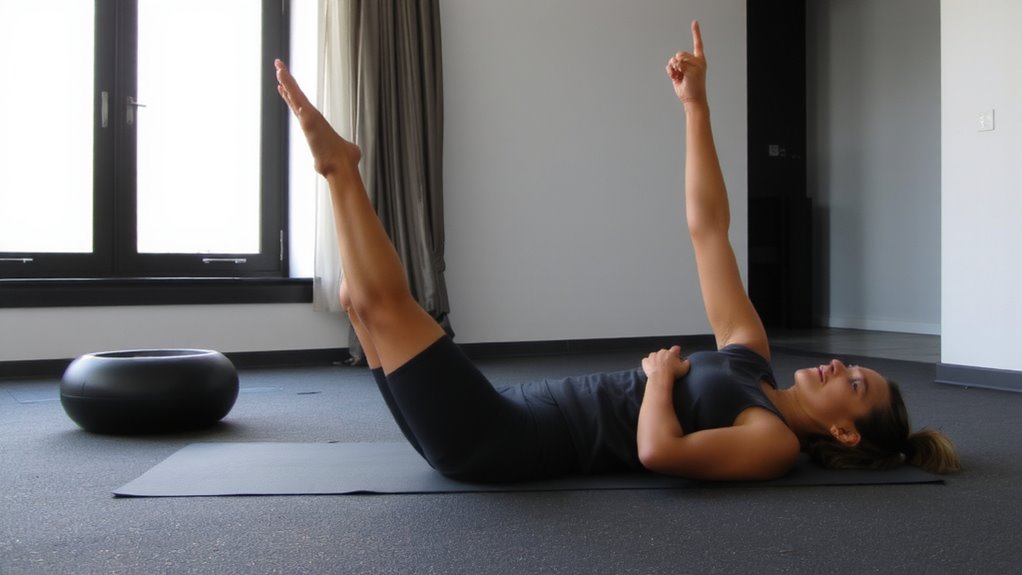
Proper form isn’t just a suggestion-it’s the foundation of effective thoracic mobility work, and nowhere is that more evident than in the side-lying arm raise. You’ll lie on your side, hips stacked, knees slightly bent-this position guarantees proper alignment from pelvis to ribcage. Your bottom arm supports your head, while the top arm rests palm-down on the floor. As you exhale, lift that top arm in a controlled arc, rotating through the mid-back, not the shoulder. That’s where shoulder engagement matters: keep the scapula stable, avoiding shrugging. You should feel mobility, not strain. Perform 8–10 reps per side slowly, focusing on movement quality. Use a foam roller under your head if alignment feels off. Consistent practice enhances joint mechanics and prepares your body for heavier lifts. This drill isn’t flashy, but its effectiveness in maintaining spinal health is well-documented.
Why Your Mid-Back Needs More Mobility
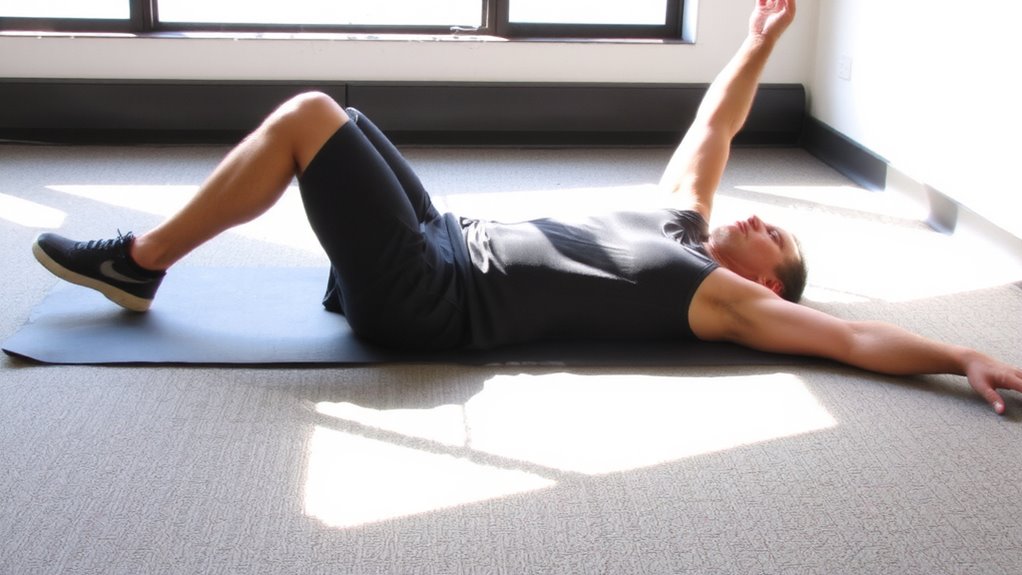
You might not think much about your mid-back until movement starts to feel stiff or discomfort creeps in, but that section of your spine plays a quiet yet powerful role in nearly everything you do-from lifting weights to twisting toward the passenger seat. Poor thoracic mobility often leads to spinal stiffness and disrupts posture alignment, increasing injury risk and limiting performance. Improving motion in this area enhances functional movement and reduces compensatory strain on your neck and lower back. Consider these key benefits:
| Benefit | Impact |
|---|---|
| Reduced spinal stiffness | Smoother, pain-free rotation |
| Improved posture alignment | Less shoulder tension |
| Greater lifting efficiency | Safer overhead mechanics |
| Enhanced daily function | Easier reaching and bending |
| Lower injury risk | Decreased joint strain |
Targeted mobility work supports long-term joint health and movement quality.
Breathe Better to Boost Arm Raise Movement
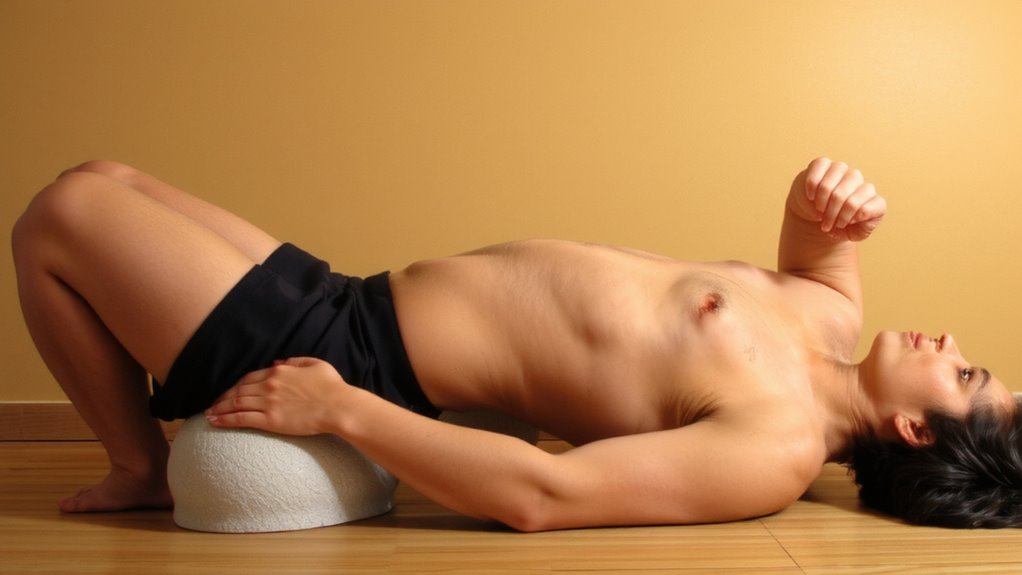
While movement quality often takes center stage in thoracic mobility drills, breathing mechanics quietly influence how well you perform side-lying arm raises. You’re not just moving your arm-you’re guiding your ribcage and spine into coordinated motion. Diaphragmatic breathing helps anchor this control, drawing air deep into your belly and promoting ribcage expansion. That expansion creates space between vertebrae, allowing freer movement during the lift. When you inhale fully, your thorax widens laterally, supporting better alignment and reducing compensatory shoulder hiking. You’ll notice smoother arm elevation and less strain once breath integrates with motion. Think of your breath as a foundational rep setter-each inhale primes the thoracic cavity for maximal mobility. You don’t just “do” the drill; you breathe into it. Proper diaphragmatic breathing isn’t optional here. It’s essential for accessing fuller range and maintaining spinal integrity throughout the exercise.
Common Mistakes to Avoid in This Drill
Why do some people still struggle with side-lying arm raises despite following the form cues? Often, it’s due to improper alignment. If your spine isn’t stacked-ribs over hips, neck neutral-you’ll limit thoracic rotation and shift stress to the lower back. Keep your body in a straight line, supported by a pillow under your head if needed. Another common error is rushing repetitions. Speed sacrifices control, reducing the drill’s effectiveness and increasing joint strain. Move deliberately, syncing each arm raise with a breath to maximize mobility gains. You’re not training for reps but for neuromuscular re-education. Avoid arching the back or letting the bottom shoulder lift-both signs you’re compensating. Proper execution demands patience and awareness. Over time, refined movement enhances recovery by improving posture and decreasing compensatory patterns, especially when supported by quality fitness gear designed for alignment and breathability.
3 Thoracic Mobility Variations to Try
Mastering the side-lying arm raise sets a solid foundation, but refining thoracic mobility often requires introducing variations that challenge range of motion in controlled ways. Adding foam rolling before dynamic drills primes the spine for improved spinal articulation. These variations enhance segmental movement and reduce compensatory patterns.
| Variation | Benefit |
|---|---|
| Reach-and-Roll | Integrates foam rolling with motion for smoother glides |
| Half-Kneeling Windmill | Challenges stability while promoting spinal articulation |
| Supine Arm Sweep | Encourages symmetrical mobility with less joint load |
| Quadruped Thoracic Rotations | Enhances mid-back rotation with tactile feedback |
| Supported Side-Lying Lift | Reduces shoulder compensation, focuses on T-spine |
Each variation builds on neuromuscular control, allowing precise, repeatable movement. Proper execution guarantees lasting gains in posture and upper-body mechanics without overloading sensitive structures.
When to Do These Drills for Best Results
How often should you perform thoracic mobility drills to see real improvements without overdoing it? Aim for 3 to 5 sessions per week, each lasting 5 to 10 minutes, to establish a consistent practice. The ideal timing is either during your warm-up to prepare the spine for movement or post-workout when your tissues are more pliable. Performing them daily can help, especially if you sit for long periods. You’ll notice better posture and reduced stiffness with regular use. These drills don’t require fitness gear, making them practical for most routines. Over time, consistent practice enhances spinal articulation and shoulder mechanics, supporting more efficient movement patterns. While results aren’t immediate, improvements in rotation and breathing mechanics become evident within a few weeks. Stick with it-ideal timing and consistency matter more than duration. Don’t rush it; progress comes from patience and smart, repeated effort.
Pair Arm Raises With These 2 Mobility Moves
You’ve already got the timing down-doing thor Crushers-orderly.mobility drills 3 to 5 times a week, especially when your body’s warmed up or post-training, helps build real, lasting movement gains. Now, pair side-lying arm raises with foam rolling and scapular glides to amplify results. Start with foam rolling your upper back for 60–90 seconds to release tight fascia and prep the thoracic spine for motion. Follow with 10–12 controlled scapular glides in a quadruped position-these activate serratus anterior and promote proper shoulder-blade control. Finish with 8–10 arm raises per side, keeping motion slow and precise. Together, this trio improves segmental mobility, enhances posture, and supports overhead function. Foam rolling reduces restrictive tension, while scapular glides retrain neuromuscular coordination-both are essential. This sequence isn’t just recovery; it’s active re-education. Use it consistently, and you’ll notice cleaner movement patterns, especially under load.
On a final note
You’ve learned how side-lying arm raises improve thoracic mobility, but consistency and form truly determine results. These drills, when done correctly, enhance spinal rotation and shoulder function. Combined with quality recovery gear-like foam rollers or mobility balls-you’ll maintain tissue health and movement efficiency. Not all gear delivers, so choose products with proven density and durability. Done regularly and paired with smart recovery, this routine supports long-term posture and performance without gimmicks or wasted effort.