Implementing Objective Strength Thresholds Before Clearing Runners for Sprint Work Post-Hamstring Tear
You’re not ready to sprint just because your hamstring feels fine-pain-free doesn’t mean prepared. You need at least 85–90% symmetry in peak torque between legs, measured via isokinetic testing at multiple speeds. Without meeting these objective strength thresholds, re-injury risk spikes. Neuromuscular control and movement symmetry matter just as much as strength. Relying on how you feel isn’t enough; data from force output and activation patterns guide safer, evidence-based progressions. There’s more to weigh in building true sprint readiness.
Notable Insights
- Pain-free status alone is insufficient; objective strength and neuromuscular control must be assessed before sprint clearance.
- Achieve at least 90% hamstring torque symmetry bilaterally at multiple isokinetic test speeds (60°/s, 180°/s, eccentric 30°/s).
- Use isokinetic testing to confirm peak torque and total work symmetry, minimizing re-injury risk from strength imbalances.
- Incorporate eccentric overload training, progressing from double-leg to single-leg Nordics to rebuild high-speed strength.
- Combine wearable sensors and biomechanical analysis to detect asymmetries and monitor neuromuscular fatigue during sprint progression.
Why Pain-Free Isn’t Enough After a Hamstring Tear
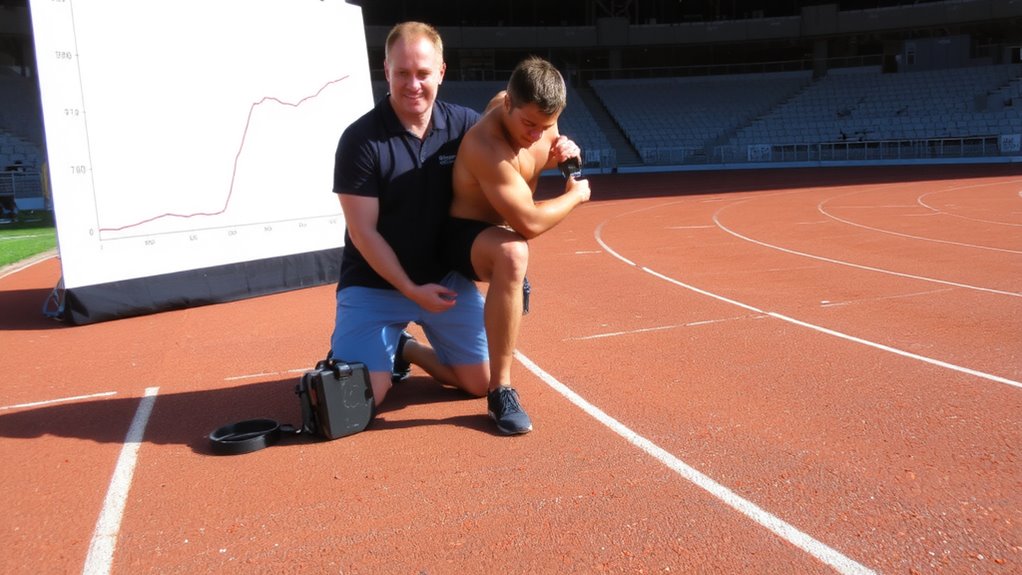
Recovery isn’t just about comfort-it’s about capability. You might be pain-free, but that doesn’t mean your body’s ready for sprinting. Without solid neuromuscular control, your hamstrings won’t activate at the right time or with the right force, increasing re-injury risk. Think of it like a misfired engine-everything looks fine, but the timing’s off. Movement symmetry is equally critical; imbalances between limbs can stealthily undermine performance and strain tissues. Research shows athletes often return with asymmetries they’re unaware of, especially during high-speed efforts. Relying only on comfort ignores these underlying deficits. Objective markers-like force output and muscle activation patterns-give a clearer picture than symptoms alone. Fitness recovery gear, like wearable sensors, helps track these metrics, but it’s only useful if you act on the data. Pain’s absence isn’t proof of readiness-function is.
Hamstring Strength Thresholds for Sprint Readiness
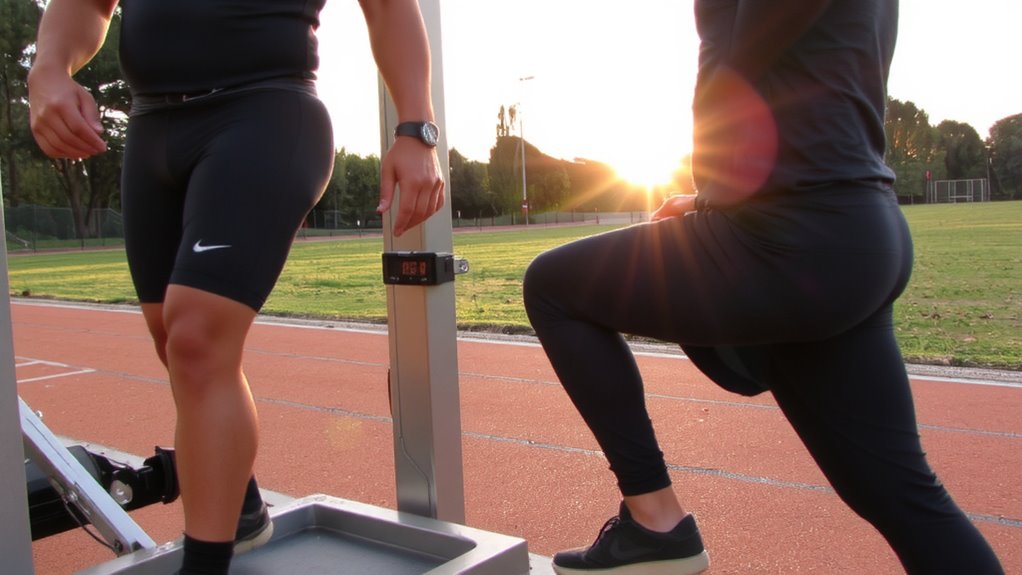
Strength is the gatekeeper to sprinting after a hamstring tear-without meeting specific force thresholds, your return to top speed isn’t just risky, it’s premature. You need at least 85–90% muscle symmetry in peak hamstring torque between limbs to handle sprint demands. Even if you’re pain-free, asymmetry above 15% increases re-injury odds markedly. Neural activation plays a key role-delayed or erratic firing patterns compromise force production, especially during high-speed lengthening. Your nervous system must recruit posterior chain muscles efficiently, not just generate raw strength. Isokinetic testing helps, but functional performance hinges on both neuromuscular control and strength balance. Relying on subjective feel won’t cut it; objective metrics keep you honest. Sprinting reactivates vulnerable tissue fast, so clearing these strength benchmarks isn’t optional-it’s foundational. Without them, you’re not ready, regardless of how good you think you feel.
How Isokinetic Testing Guides Return-to-Sprint Decisions
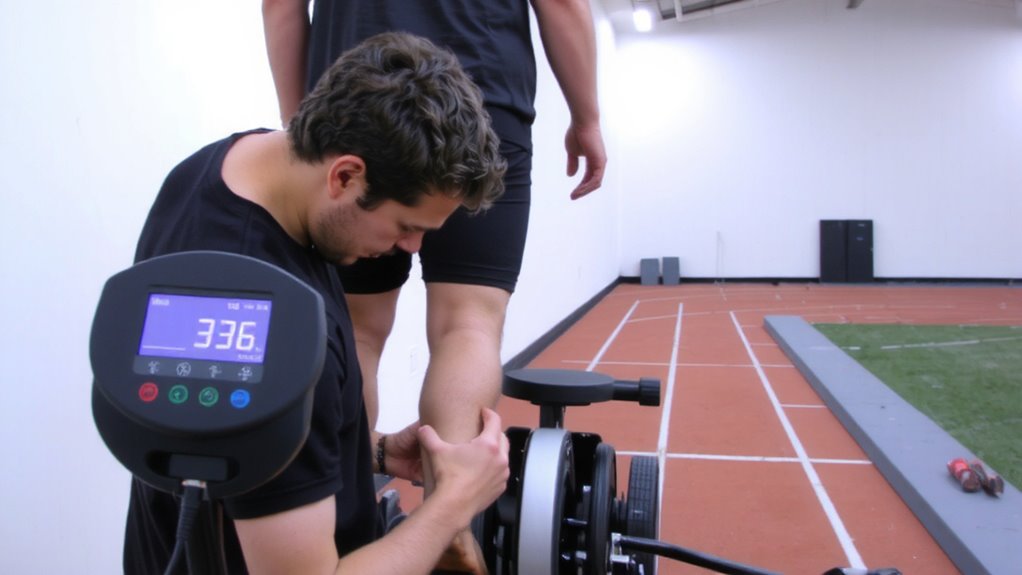
You’re cleared for sprint work only when the data says so, not when your leg feels ready-and that’s where isokinetic testing earns its spot in the rehab protocol. This assessment delivers objective metrics on hamstring strength, with high isokinetic reliability ensuring consistent, repeatable results across sessions. Central to your clearance is torque symmetry-the comparison between injured and uninjured legs. Aim for at least 90% symmetry in concentric and eccentric strength at common speeds like 60°/s and 180°/s. Below that, re-injury risk climbs.
| Test Speed (°/s) | Target Torque Symmetry (%) |
|---|---|
| 60 | ≥90 |
| 180 | ≥90 |
| Eccentric 30 | ≥90 |
| Peak Torque | Matched bilaterally |
| Work Total | Minimal side difference |
Without meeting these benchmarks, you’re not truly ready-no matter how good it feels.
Strength and Plyometric Training Post-Hamstring Tear
Once the isokinetic benchmarks are met, you’re ready to shift focus toward rebuilding power and neuromuscular control through progressive strength and plyometric training. Eccentric overload becomes essential here-loading the hamstrings during lengthening phases helps stimulate tendon remodeling and prepares tissue for high-speed demands. You’ll start with double-leg exercises like Nordic lowers, then progress to single-leg variations as tolerance increases. Plyometrics begin at low intensity-jumps in place, skips-then advance to bounding and depth jumps, emphasizing quality of movement over volume. This progression drives neural adaptation, sharpening muscle recruitment patterns and reaction speed. Equipment like resistance bands and weighted vests can add load, but form must never be sacrificed. Consistent, monitored increases in intensity guarantee the muscle-tendon unit adapts safely. The goal isn’t just strength-it’s resilient, responsive tissue capable of handling sprint-specific forces.
Preventing Re-Injury With Data-Driven Protocols
While strength gains are essential, they’re not enough on your own to keep you safe during a return to sprinting or cutting-re-injury prevention hinges on data-driven protocols that track progress beyond subjective readiness. You need objective metrics to detect lingering biomechanical asymmetry, which can persist even when strength appears balanced. Tools like force plates and motion analysis reveal subtle imbalances in limb loading and movement efficiency that traditional testing misses. Monitoring neuromuscular fatigue is just as critical; excessive fatigue alters motor control and increases injury risk, especially under high-speed conditions. Wearable sensors and session RPE tracking help you quantify this fatigue in real time. Together, these technologies create a thorough profile of your readiness, moving past guesswork. Implementing them isn’t just smart rehab-it’s a necessary upgrade in how we define recovery, ensuring you return stronger, more resilient, and truly prepared.
On a final note
You can’t rely on pain-free movement alone to clear sprinting after a hamstring tear. Objective strength thresholds, especially from isokinetic testing, give clearer return-to-play signals. Without meeting these benchmarks, re-injury risk stays high. Strength and plyometric work must precede sprinting, ensuring neuromuscular readiness. Data-driven protocols outperform symptom-based guesses, making recovery safer and more efficient. Monitoring progress with reliable metrics isn’t optional-it’s essential for long-term resilience and performance.