Functional Strength for Snowboarders: Eccentric Knee Control in Landing
You rely on eccentric control every time you land a jump or carve through rough snow, as it lets your quads and hamstrings absorb impact instead of stressing your knees. Without it, hard landings overload ligaments like the ACL, raising injury risk. Proper leg mechanics use glutes, quads, and hams together to stabilize joints and disperse force efficiently. Training with slow negatives and drop jumps builds this control, boosting both performance and joint longevity-especially when done consistently off-snow. Stronger eccentric strength means smoother landings and less wear on your body over time, something recovery tools alone can’t fix-see how your setup could improve with smarter prep.
Notable Insights
- Eccentric strength in quads and hamstrings absorbs landing forces, protecting knees during snowboard impacts.
- Controlled lowering exercises like split squats enhance eccentric control for better joint stability.
- Weak eccentric control shifts impact stress to ligaments, raising ACL and MCL injury risk.
- Drop jumps and slow descents train muscles to handle snowboarding-specific landing forces effectively.
- Knee wobble or early fatigue signals poor eccentric strength and increased injury susceptibility.
Why Eccentric Control Protects Your Knees
While you might not think about it during a descent, the way your muscles control movement when lengthening-known as eccentric control-plays a critical role in protecting your knees on the mountain. When you land or absorb terrain changes, your quads and hamstrings work eccentrically to slow joint motion, directly influencing knee biomechanics. This action reduces compressive and shear forces across the joint, minimizing injury risk. Strong eccentric control enhances joint stabilization, especially during unpredictable landings or carved turns, where your body must absorb significant load. Without it, even fit snowboarders experience early fatigue and compromised form. Functional training that emphasizes slow, controlled lowering movements-like Bulgarian split squats or eccentric step-downs-builds this specific strength. Recovery gear like percussion massagers can help maintain muscle elasticity, supporting ongoing performance. A high-quality best massage gun can further enhance recovery by improving blood flow and reducing muscle soreness. It’s not just about power; it’s about precision, control, and protecting your body through smart, science-backed preparation.
How Hard Landings Beat Up Your Knees
Hard landings do more than rattle your confidence-they transfer serious force through your lower body, especially your knees, where the impact can cause both immediate and long-term damage. You’re not just absorbing shock; you’re subjecting your knees to intense knee joint stress that compromises stability. Without proper control, that force concentrates in vulnerable areas, increasing your risk of injury. Ligament strain becomes a real threat, especially in the ACL and MCL, as sudden compression pulls these connective tissues beyond their limits. Even minor, repeated impacts add up, accelerating wear and potentially leading to chronic issues like tendinitis or cartilage degeneration. Your technique matters, but so does your body’s readiness. Without sufficient eccentric strength, your muscles can’t buffer the load, leaving joints and ligaments to take the brunt. It’s not just about toughness-it’s about smart preparation. Wearing supportive gear like best knee sleeves can help stabilize the joint and reduce strain during high-impact landings.
How Your Legs Absorb Impact Safely
When you land from a jump or carve through uneven terrain, your legs don’t just take the hit-they’re designed to disperse it, using a coordinated sequence of muscle activation and joint movement that turns impact into controlled motion. Proper joint alignment guarantees forces travel efficiently through your knees, hips, and ankles, reducing stress on any single structure. You rely on muscle synergy-especially between quads, hamstrings, and glutes-to eccentrically absorb energy, stabilizing your body without collapsing. This neuromuscular coordination isn’t automatic; it’s trained through functional movement patterns that mimic real snowboarding demands. Without it, even high-quality fitness gear can’t fully protect you from cumulative damage. The best recovery tools support this system, but they’re no substitute for well-tuned mechanics. Align your joints, sync your muscles, and you’ll land softer, recover faster, and ride stronger-consistently. Consider integrating best volleyball knee support into your training regimen to enhance joint stability during high-impact landings.
3 Eccentric Exercises for Stable Landings
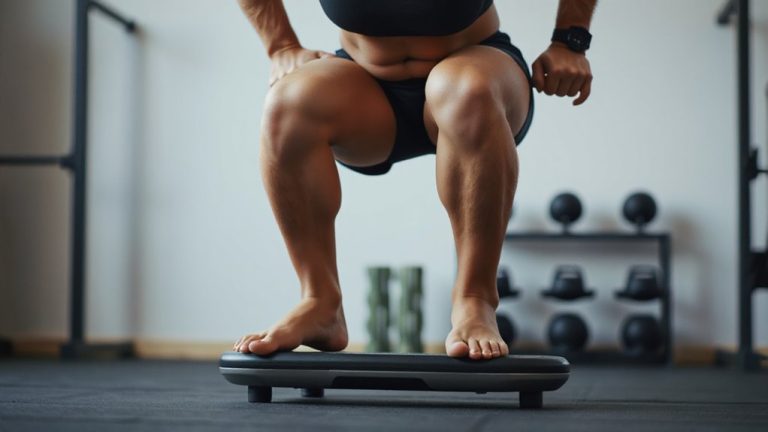
Because controlling your descent matters just as much as powering your lift, eccentric training plays a crucial role in prepping your muscles for the high-impact reality of snowboarding landings. You’re not just building strength-you’re teaching your legs to absorb force smoothly and safely. Incorporating plyometric drills like drop jumps and slow squat descents trains your quads and glutes to handle rapid loading, improving joint stability. These exercises mimic real landing mechanics, making them highly transferable. Don’t overlook balance training either-single-leg stands or wobble board routines enhance proprioception, helping you maintain control when terrain gets unpredictable. Together, these methods reduce injury risk and boost landing confidence. The best part? They require minimal equipment and can fit into any off-snow routine. When done consistently, eccentric exercises backed by balance training lead to more controlled, stable landings-one season at a time.
Train Eccentric Strength Anywhere
You’ve already seen how eccentric training sharpens landing control by improving force absorption and joint stability, especially with moves like drop jumps and slow squats. The good news? You can build this strength anywhere using portable workouts and minimal equipment. No gym? No problem. Bodyweight exercises done with control deliver real results, especially when you focus on the lowering phase. These routines are easy to transport, require little space, and adapt to any skill level. Below are five effective eccentric moves you can do anywhere:
| Exercise | Reps | Tempo (Eccentric) |
|---|---|---|
| Slow Squats | 3×8 | 4 seconds |
| Split Squat Downs | 3×6 | 5 seconds |
| Step-Downs | 3×5 | 4 seconds |
| Push-Up Negatives | 3×6 | 3 seconds |
| Nordic Curl Preps | 3×4 | 4 seconds |
They’re efficient, equipment-light, and ideal for consistent training.
Knee-Stabilizing Warm-Up Moves
What if the key to a resilient snowboarding session starts not with power, but with precision? Your knees take a beating on uneven terrain, so warming up with knee-stabilizing moves is essential. These drills improve joint mobility and reinforce proper knee alignment, reducing injury risk during dynamic landings. Start with controlled leg swings to lubricate the joint and prime neuromuscular pathways. Then, perform lateral lunges and supported single-leg squats-both demand balance while fine-tuning tracking of the patella over the foot. You’ll notice immediate gains in control and confidence. Unlike passive stretches, these dynamic moves prepare ligaments and tendons for load. Don’t rush them; quality repetition matters more than speed. Pair these with a foam roller for soft-tissue prep, and you’ve built a warm-up that supports eccentric strength later. It’s not flashy gear-it’s function that counts.
7 Signs You’re Missing Eccentric Strength
How often do you feel wobbly when landing jumps or struggle to maintain control during steep, carved turns? These could be signs you’re missing eccentric strength-the muscle’s ability to control movement under load, especially in your knees. Knee wobble isn’t just unsettling; it signals weak deceleration control, increasing injury risk. Joint fatigue sets in faster when your quads and glutes can’t absorb impact smoothly, leaving you sore and unstable by mid-day.
| Symptom | Likely Cause |
|---|---|
| Knee wobble | Poor eccentric quad control |
| Joint fatigue | Overreliance on passive structures |
| Early burnout | Inefficient energy absorption |
Without targeted training, recovery suffers and gear like braces only masks the issue. Strengthening eccentric control improves landing mechanics, reduces joint fatigue, and enhances overall ride endurance-critical for serious snowboarding performance.
On a final note
You’re not just building strength-you’re protecting your knees with smarter control. Eccentric training boosts joint stability and landing resilience, especially under sudden load. It’s proven to reduce injury risk by improving muscle coordination and shock absorption. Pair this with quality recovery gear like compression sleeves and durable foam rollers, and you’re supporting long-term performance. Smart training combined with reliable fitness tools doesn’t just aid recovery-it enhances how you move, land, and adapt on the mountain.