How to Perform a 10-Minute Dynamic Warm-Up for Improved Joint Mobility Before Low-Impact Training
Start with controlled articular rotations at your shoulders and hips to lubricate joints and boost tissue resilience. Add segmental spinal waves to enhance fluid distribution and vertebra-by-vertebra mobility. Perform dynamic moves like leg swings, arm circles, and walking lunges with a twist for 20–30 seconds each to activate key muscles and sharpen neuromuscular control. This sequence primes your body efficiently-skip static stretches and you’ll discover a smarter way to prepare for low-impact training.
Notable Insights
- Perform controlled articular rotations on major joints to enhance synovial fluid flow and prepare tissues for movement.
- Execute rhythmic shoulder and hip circles to boost circulation and improve joint readiness.
- Mobilize the spine vertebra by vertebra using segmental waves to increase spinal fluid distribution and control.
- Engage in dynamic movements like leg swings, high knees, and arm circles for 20–30 seconds each to activate key muscles.
- Integrate full-body motions such as walking lunges with twists and standing torso rotations to enhance multidirectional mobility.
Wake Up Your Joints: A 3-Part Mobility Warm-Up
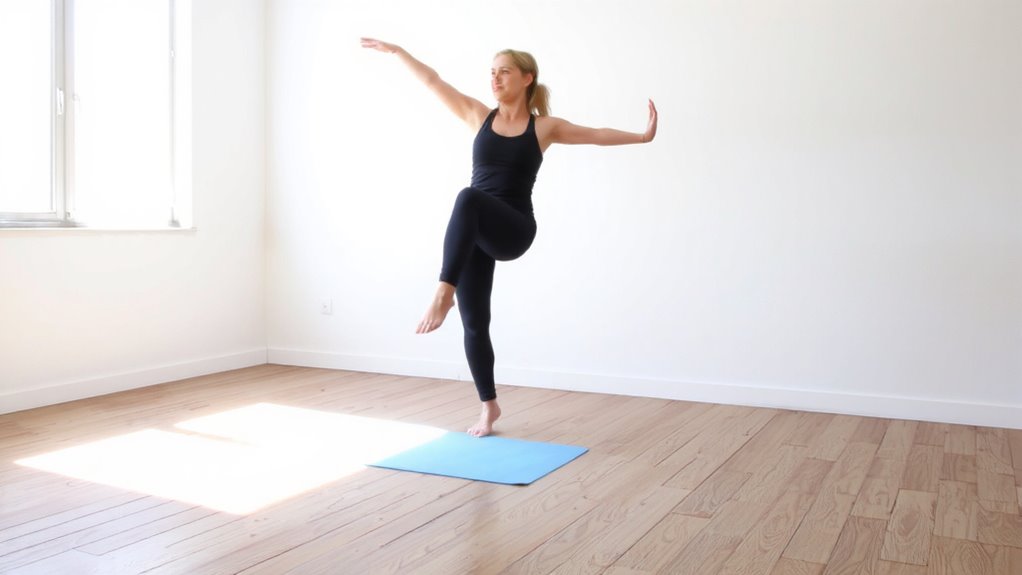
A smart warm-up starts by prepping your joints, and this 3-part mobility sequence does just that-efficiently. You begin with controlled articular rotations, gently moving each joint through its full range to stimulate joint lubrication and boost synovial fluid flow. This isn’t just movement for movement’s sake-each motion primes your connective tissues, reducing friction and increasing resilience under load. The second phase uses rhythmic joint circles, particularly at the shoulders and hips, to further enhance circulation within the joint capsule. Finally, segmental spinal waves awaken the spine’s mobility vertebra by vertebra, promoting segmental control and fluid distribution. Equipment isn’t needed, though high-density foam rollers can support recovery post-session. Compared to static methods, this dynamic approach delivers faster, more functional readiness. It reflects a smarter standard in fitness recovery-targeted, efficient, and grounded in biomechanical logic.
Do These 5 Dynamic Moves to Activate Muscles

While your joints are already primed from the mobility work, it’s time to fire up the major muscle groups with dynamic movements that blend activation and flow. This phase focuses on muscle activation to prep your body for effort, guaranteeing your nervous system and muscles communicate efficiently. Perform a dynamic movement like leg swings, walking lunges with a twist, high knees, butt kicks, and arm circles-each done for 20 to 30 seconds. These drills engage glutes, quads, hamstrings, hip flexors, and shoulders, promoting blood flow and neuromuscular readiness. Unlike static stretches, this dynamic movement approach enhances coordination and stability without sacrificing power. Quality matters: controlled motion beats speed. Proper form guarantees effective muscle activation while reducing injury risk. With consistent use, these drills integrate seamlessly into any pre-workout routine, laying the foundation for balanced performance and long-term joint and muscle health-all within a compact, efficient timeframe.
Add Full-Body Mobility: Swings, Circles, and Twists
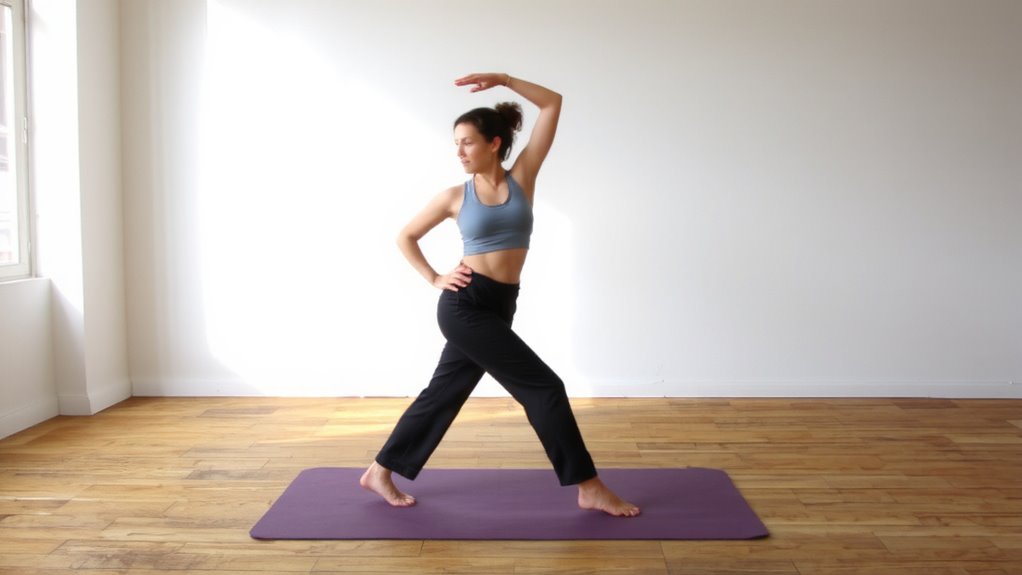
You’re already warmed up from the activation drills, so now it’s time to expand your range with full-body mobility moves that sync movement across multiple joints and planes. Dynamic swings, arm circles, and torso twists engage both shoulder mobility and hip mobility, priming your body for fluid, coordinated motion. Leg swings forward and sideways boost hip mobility by gently challenging range while activating glutes and hamstrings. Arm circles-both forward and backward-enhance shoulder mobility, reducing stiffness and improving scapular control. Add in standing twists to link upper and lower body motion, promoting spinal articulation and neuromuscular coordination. These movements aren’t just about looseness-they build dynamic awareness, preparing your joints and muscles for multidirectional loads. Unlike static stretching, dynamic mobility sustains warmth, supports joint integrity, and mirrors real movement patterns, making them essential before low-impact training.
Build Your 10-Minute Dynamic Warm-Up Routine
How do you build a warm-up that actually prepares your body without eating into your workout time? You structure it efficiently-start with 2 minutes of foam rolling techniques to release tight quads, glutes, and calves, boosting circulation and tissue quality. Then, shift to dynamic movements: 1 minute each of leg swings, arm circles, and torso twists primes joints and neuromuscular pathways. Focus on posture alignment tips throughout-keep your spine neutral, shoulders back, and core engaged to maximize movement efficiency. Include bodyweight lunges with a twist and cat-cow flows to link stability with mobility. This routine strikes a balance: it’s short but thorough, activating muscles without fatigue. Foam rolling enhances tissue readiness, while consistent posture cues reduce injury risk. Unlike static stretches, this approach supports dynamic performance, making it ideal before low-impact training. Quality gear-like a textured foam roller-improves results through better pressure distribution and durability. For optimal self-myofascial release, choose a high-density foam roller based on your preferred firmness and texture.
Skip Static Stretches: Do This Instead
Static stretching before a workout might feel familiar, but it doesn’t prime your body the way dynamic movements do. You’re better off skipping those long holds and focusing on dynamic stretches that boost circulation and trigger muscle activation. These movements mimic exercise patterns, gently increasing heart rate while prepping joints and connective tissues. Unlike static stretches, which can reduce power output pre-workout, dynamic drills enhance neuromuscular readiness.
| Exercise | Purpose | Duration |
|---|---|---|
| Leg Swings | Hip mobility & activation | 30 sec |
| Arm Circles | Shoulder warm-up | 30 sec |
| Walking Lunges | Glute & quad engagement | 40 sec |
| High Knees | Cardio & leg activation | 30 sec |
| Torso Twists | Spinal mobility & core prep | 30 sec |
This sequence delivers targeted muscle activation and primes movement efficiency-exactly what low-impact training demands.
On a final note
You’ve primed your joints and activated key muscles using dynamic movements, which boosts circulation and neuromuscular readiness far better than static stretching. This 10-minute routine enhances mobility, reduces injury risk, and prepares your body efficiently for low-impact work. Quality fitness gear, like supportive footwear and breathable clothing, complements recovery by minimizing strain and wicking moisture. Together, smart warm-ups and functional equipment optimize performance and joint health long-term.