Applying the Hoffa’s Test and Anterior Knee Pain Scale to Clear Cyclists for Hill Climbing
You can use Hoffa’s test to check for fat pad irritation by pressing beside your patellar tendon while extending your knee; sharp pain means you shouldn’t clear hill climbing yet. Combine this with the Anterior Knee Pain Scale to track discomfort during efforts and guide load management. These tools help differentiate between tendinopathy and fat pad issues, ensuring accurate recovery decisions. Proper bike fit and gradual progression reduce re-injury risk-knowing your pain’s pattern changes everything.
Notable Insights
- Perform Hoffa’s test to identify fat pad irritation before clearing cyclists for hill climbing.
- Use the Anterior Knee Pain Scale to quantify pain during simulated climbing efforts.
- A positive Hoffa’s test indicates need to avoid hyperextension and steep climbs.
- Monitor pain scores weekly to assess readiness for increased climbing volume.
- Clear cyclists for hills only if pain is Level 0–2 and Hoffa’s test is negative.
Why Anterior Knee Pain Flares When Climbing Hills
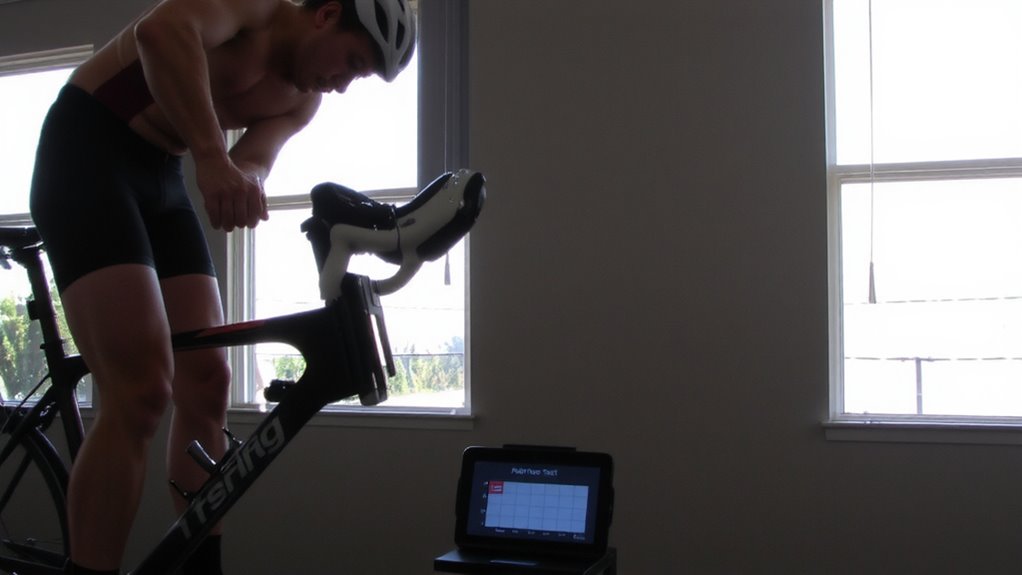
You’ve likely felt it yourself-the sharp ache just below your kneecap that creeps in halfway up a steep climb. This anterior knee pain often flares under increased biomechanical stress from prolonged flexion and forceful extension when seated on a steep gradient. Your body position, combined with higher resistance, amplifies load on the patellofemoral joint. If a muscular imbalance exists-say, weak vastus medialis or overactive quadriceps-it alters tracking, increasing irritation. Cyclists with tight hip flexors or poor glute engagement often compensate, further disrupting alignment. These factors don’t just cause discomfort-they undermine efficiency and recovery. Quality cycling gear, like supportive shorts with adequate padding and properly fitted cleats, helps minimize strain by promoting neutral alignment. Still, even the best equipment can’t fully offset flawed biomechanics. Addressing root causes-imbalance, technique, fit-is essential to sustained performance and long-term joint health on climbs.
How Hoffa’s Test Checks for Fat Pad Irritation
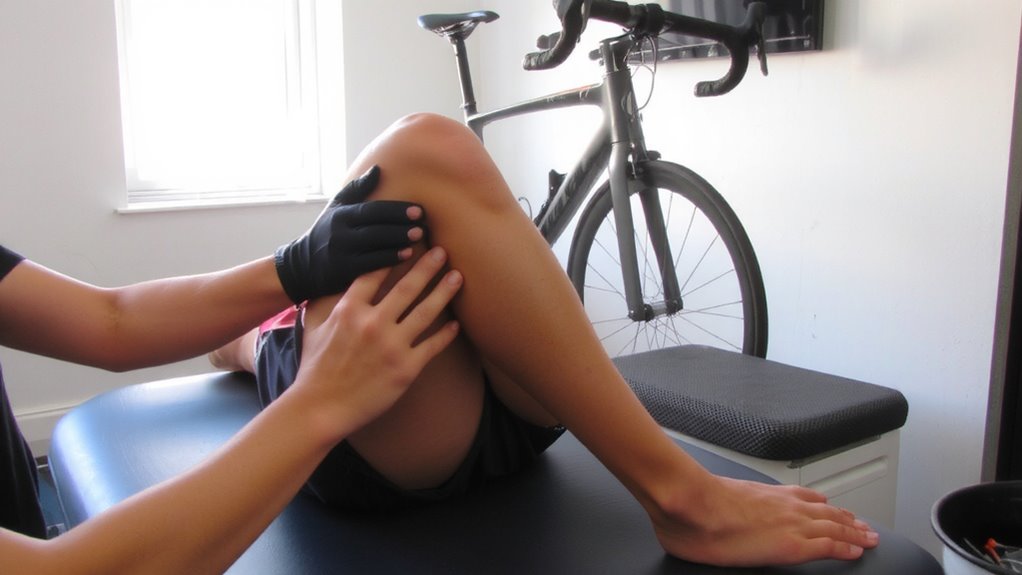
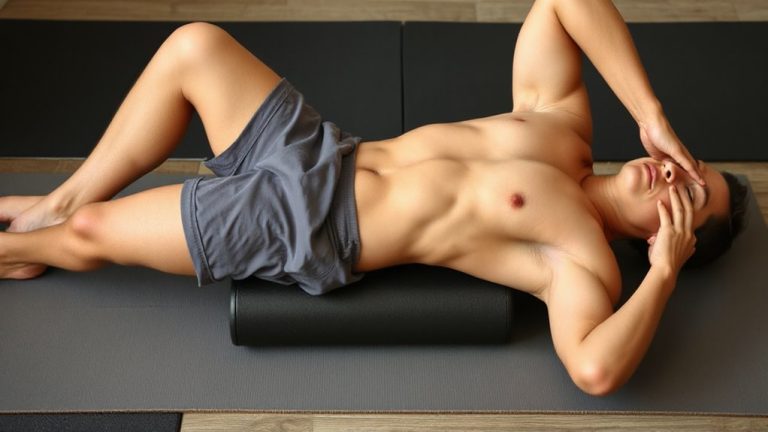
Hoffa’s test helps identify irritation in the infrapatellar fat pad, a common yet often overlooked source of anterior knee pain that can mimic patellar tendinitis or patellofemoral stress. You’ll perform the test by having the cyclist lie supine with knees bent and then pressing your thumbs along each side of the patellar tendon while asking them to extend the leg. If they report sharp pain or apprehension under your fingers, it suggests fat pad swelling or an active inflammation response. This mechanical compression helps differentiate fat pad irritation from other anterior knee issues. Positive findings often correlate with activities that involve prolonged knee flexion or repetitive extension force-like climbing hills. While not definitive alone, it’s a reliable clinical indicator when combined with history and movement analysis. Recognizing fat pad involvement early can guide better recovery strategies and prevent prolonged downtime.
Is It Patellar Tendinopathy or Another Issue?
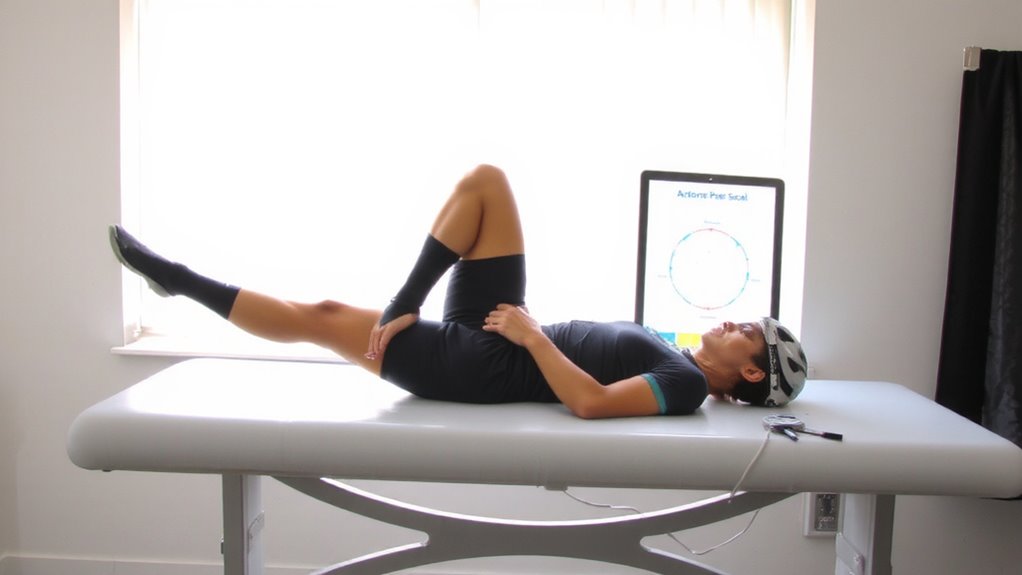
Could that nagging knee pain really be patellar tendinopathy, or is something else at play? While patellar tendinopathy often causes pain just below the kneecap, especially during hill climbing, you might actually be dealing with fat pad impingement. This condition produces sharp pain around the patellar tendon’s base and worsens with knee extension. Unlike tendinopathy, it’s often aggravated by prolonged kneeling or overextension-common in aggressive cycling postures. You should also assess for quadriceps imbalance, where the vastus medialis fires too late or too weakly compared to the lateralis, increasing lateral pull on the patella. This imbalance can mimic or worsen anterior knee pain and may be mistaken for tendon issues. Proper diagnosis matters, because treatment strategies diverge: tendinopathy needs load management and eccentric strengthening, while fat pad impingement responds better to avoiding hyperextension and improving neuromuscular control.
Track Pain Levels With the Anterior Knee Pain Scale
How consistently are you measuring your knee pain, especially when tackling long climbs or increasing training volume? Without accurate pain documentation, you might miss early signs of imbalance in your knee biomechanics. The Anterior Knee Pain Scale helps you assign a precise score to discomfort during cycling, making it easier to track changes over time. Instead of saying “it feels a bit off,” you’ll have measurable data-like pain intensity during a 10-minute climb or after a high-cadence interval. This objective approach supports smarter decisions about training load and recovery. Unlike generic fitness trackers, this scale targets symptoms related to patellofemoral stress, giving you insight that wearable gear alone can’t provide. You’re not just logging miles; you’re monitoring joint response. Consistent use improves accuracy, helping identify when subtle shifts in pedal stroke or saddle height affect your knees-critical for long-term performance and joint health.
When to Safely Resume Cycling After Knee Pain
You’ve tracked your knee discomfort with the Anterior Knee Pain Scale and noticed a pattern-maybe the pain flares during hill repeats or settles in after long rides. Understanding your pain triggers is key to evaluating when it’s safe to return. Recovery isn’t just about resting; it’s about aligning your comeback with improved knee biomechanics. If pain persists above level 3 during or after cycling, hold off on high-intensity efforts. Wait until daily movements-like stairs or squatting-feel smooth and pain-free. Then ease back with low-resistance spins. A proper support strategy may include using best knee sleeves for powerlifting to enhance stability during rehabilitation exercises.
| Pain Level | Action |
|---|---|
| 0–2 | Light cycling, monitor symptoms |
| 3 | No cycling, reassess biomechanics |
| 4–5 | Stop all load, consult professional |
| Post-ride soreness | Delay return by 48 hrs |
| Consistent 0 | Resume gradually |
Listen closely-your body’s feedback guides safe re-entry.
Optimize Bike Fit to Prevent Anterior Knee Strain
A well-tuned bike fit isn’t just about comfort-it’s a critical factor in preventing anterior knee strain, especially when returning from injury. If your cleat positioning is off, even slightly, it can alter knee tracking and increase patellar load, especially during high-resistance climbs. You should aim for neutral foot alignment, with the ball of your foot over the pedal spindle, to minimize shear forces. Similarly, saddle tilt plays a bigger role than many realize-too nose-up and you shift pressure forward, spiking quad activation and anterior knee stress; too nose-down and you’ll slide forward, compromising power and stability. Even a 2–3 degree tilt affects joint mechanics over time. Pair these adjustments with proper saddle height and setback, and you’re not just riding more efficiently-you’re protecting your knees with every pedal stroke. Small tweaks now prevent setbacks later.
Build a Gradual Return-to-Hill-Climbing Plan
After clearing the initial phase of recovery and refining your bike fit, it’s time to cautiously reintroduce hill climbs-the kind of sustained, high-resistance efforts that demand more from your quads and patellar tendon. Poor knee biomechanics or lingering muscle imbalances can flare under load, so progression must be deliberate. Start with low-gradient rollers, keeping cadence above 75 rpm to minimize joint stress. Use perceived exertion and the Anterior Knee Pain Scale to guide effort-never push through pain.
| Week | Hill Duration & Intensity |
|---|---|
| 1–2 | 5–10 min, low resistance |
| 3–4 | 15–20 min, moderate effort |
| 5+ | Progressive overload, monitor pain |
Reassess knee biomechanics weekly. Address any quadriceps-to-hamstring strength discrepancies immediately, as unchecked muscle imbalances increase re-injury risk. Smart progression guarantees long-term resilience.
On a final note
You’ve likely noticed anterior knee pain worsens on climbs due to increased patellofemoral load. Hoffa’s test helps confirm fat pad irritation, while the Anterior Knee Pain Scale tracks severity objectively. Ruling out patellar tendinopathy is essential before resuming high-load efforts. A proper bike fit reduces anterior strain, and a gradual return-to-climb plan supports durable recovery. These tools, combined, offer a practical, evidence-based path to getting you back on hilly terrain safely and efficiently.