Designing Eccentric-Focused Nordic Hamstring Curls for Injury-Prone Sprinters
You need eccentric-focused Nordic curls to build hamstring resilience under high-speed loads. Perform them with a strict 3-second lowering phase to boost force absorption and neural control. Set up on a soft surface, anchor your heels securely, and keep your torso rigid to avoid strain. Use partner assistance or bands early on, then progress toward full reps. Proper form and progressive overload reduce injury risk while enhancing performance-there’s more to optimizing this move than meets the eye.
Notable Insights
- Perform Nordic curls with a 3-second eccentric lowering phase to build functional hamstring strength and reduce injury risk.
- Use soft surfaces and secure heel anchoring to ensure safe execution for injury-prone sprinters.
- Maintain a rigid, neutral torso with knees under hips to optimize alignment and minimize strain.
- Start with band or partner assistance and gradually progress to unassisted reps as strength improves.
- Program 3–4 sets of 6–8 reps, 3 times weekly, while monitoring form and using padded support for comfort.
Why Eccentric Training Shields Sprinters From Hamstring Injuries
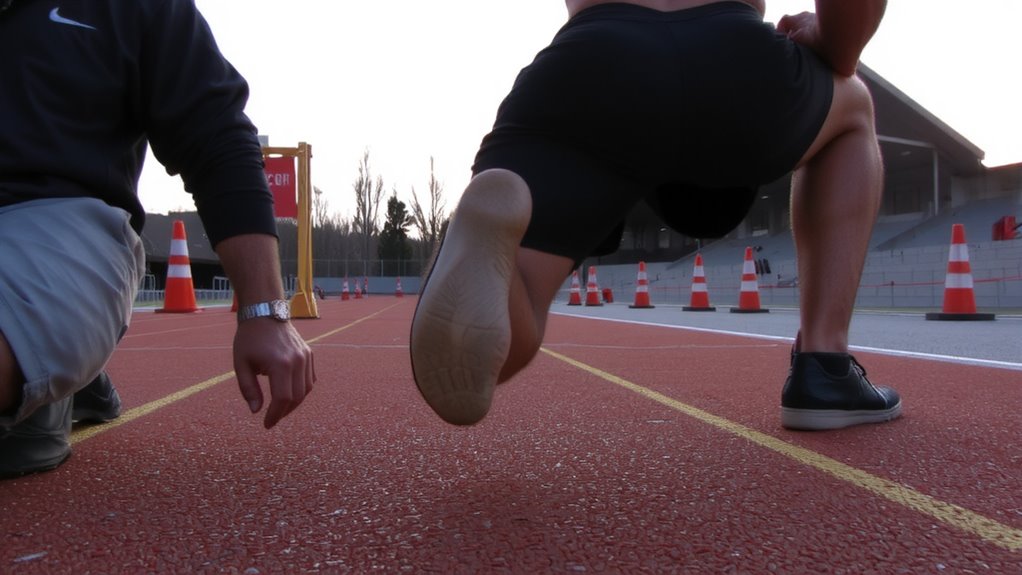
While you’re pushing your limits on the track, it’s the eccentric phase of movement-when muscles lengthen under tension-that often makes the critical difference in preventing hamstring injuries. Eccentric training strengthens your hamstrings in this vulnerable lengthened state, aligning with their natural muscle architecture for greater force absorption. Sprinters especially benefit because high-speed running imposes extreme eccentric loads during late swing phase. Regular Nordic curls reduce neural inhibition, allowing more efficient motor unit recruitment and better coordination under stress. This means your muscles respond faster and more uniformly when fatigue sets in. Unlike passive recovery tools, properly executed eccentric work actively reshapes neuromuscular control. You’re not just building strength-you’re improving communication between brain and muscle. Over time, this leads to resilient tissue capable of meeting sprint demands. It’s not a quick fix, but a sustained investment in durability. The gear matters less than consistency and form.
How Nordic Curls Target High-Speed Hamstring Demands
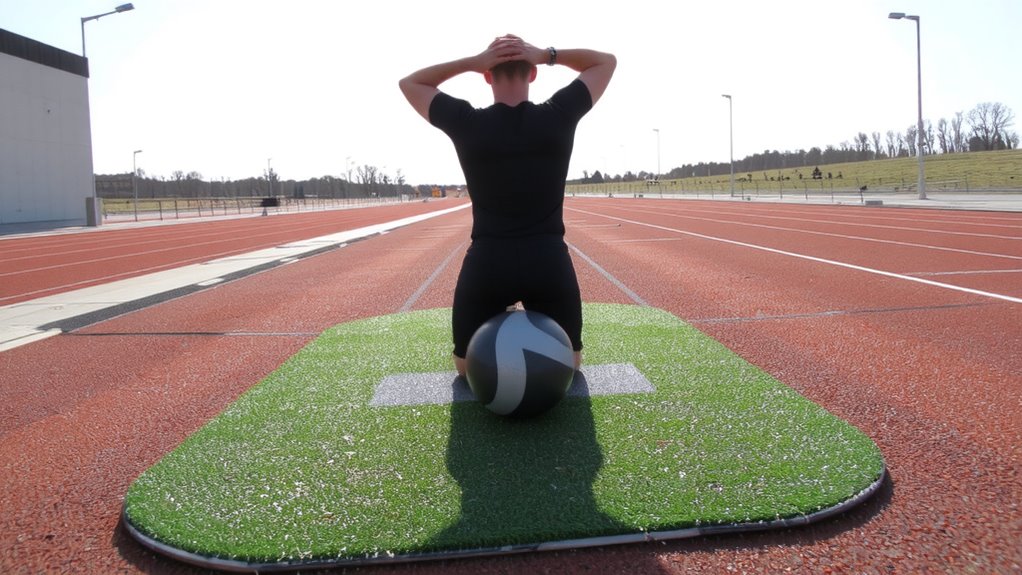
Because sprinting places enormous eccentric stress on the hamstrings during the late swing phase, Nordic curls uniquely prepare your muscles for these high-speed demands by mimicking the same lengthening contractions under controlled loads. You experience peak hamstring activation during the lowering phase, which closely mirrors the muscle’s role as it resists knee extension just before foot strike. This isn’t just strength work-it drives neural adaptation, sharpening the communication between your nervous system and muscles for faster, more coordinated responses during sprinting. The progressive overload from Nordic curls enhances your capacity to tolerate sudden forces, reducing the likelihood of strain. By training the hamstrings to stay strong under lengthening tension, you’re not just building muscle-you’re refining its ability to perform under speed-specific conditions. That makes Nordic curls a strategic choice, not just a preventive one.
Set Up Nordic Curls Safely for Injury-Prone Athletes
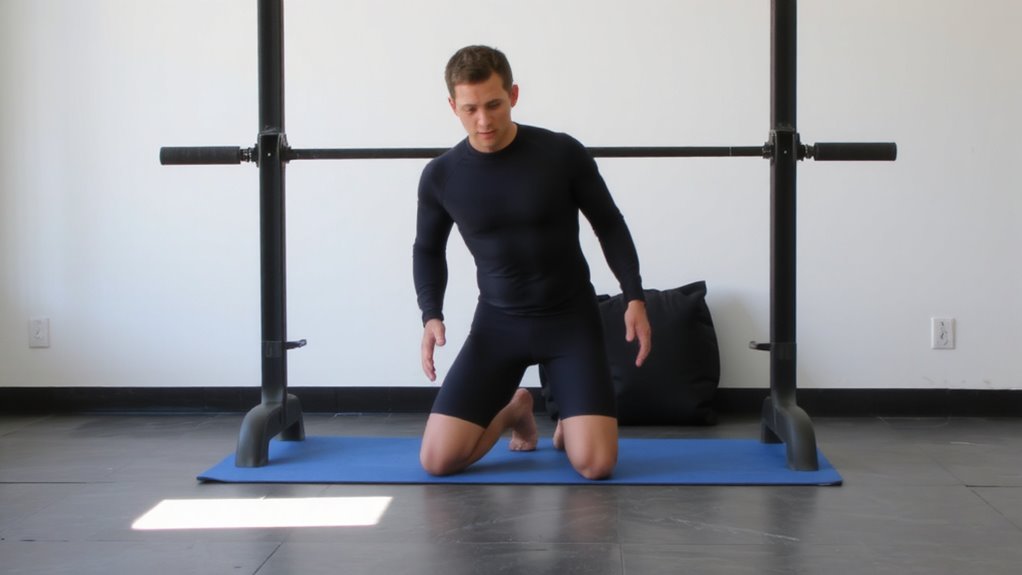
For injury-prone sprinters, setting up Nordic curls with proper precautions isn’t just a suggestion-it’s essential. You need proper alignment to protect your hamstrings while maximizing muscle engagement. Start on a soft surface with your heels securely anchored-either by a pad or a partner’s grip-so your knees stay directly under your hips. Keep your torso rigid and neutral throughout; any sagging or rotation increases strain and reduces effectiveness. Partner spotting isn’t optional here; a reliable spotter can guide your descent and catch you if control is lost, minimizing injury risk. Their hands should stay close, ready to assist without interfering. Use a mat under your knees for comfort and skin protection, especially during frequent sessions. This setup guarantees safety without sacrificing intensity, letting you focus on building strength where sprinters need it most-without setbacks.
Control the Lower: 3-Second Tempo for Eccentric Strength
A 3-second descent during Nordic curls isn’t just a timing cue-it’s the key to building real eccentric strength, the kind that helps sprinters absorb force and reduce hamstring strain. You’re not just going slow for effect; you’re training your muscles to handle high loads under stretch, which boosts tempo mastery and prepares your tendons for sprinting demands. Controlling the lower phase builds muscle integrity by reinforcing the connection between neural command and muscular response. This deliberate tempo increases time under tension, promoting structural adaptations that protect against injury. Don’t rush it-each controlled drop strengthens coordination and resilience. Over time, you’ll notice greater stiffness regulation in the hamstring complex, improving both performance and recovery capacity. Tempo mastery here isn’t optional-it’s foundational. When done right, this phase turns Nordic curls into a powerful tool for durable speed.
Fix These 3 Nordic Curl Mistakes Immediately
You’ve already tapped into the power of the 3-second eccentric phase, using time under tension to build tendon resilience and neuromuscular control. But if your form’s off, you’re risking more than just progress. First, avoid letting your hips sag-losing hip stability shifts strain to your lower back and undermines hamstring engagement. Keep your torso rigid, core braced, and movement isolated at the knees. Second, watch your knee alignment; collapsing inward or flaring out creates valgus or varus stress, increasing injury risk. Track knees straight over toes throughout. Third, don’t rush the setup-poor anchor positioning encourages cheating and uneven loading. Use a stable pad or partner to maintain tension without compensating. Fixing these boosts functional strength and guarantees the Nordic curl stays a protective tool, not a liability. Precision here translates directly to sprint performance and durability.
Build Resilience: Progress From Assisted to Full Nordics
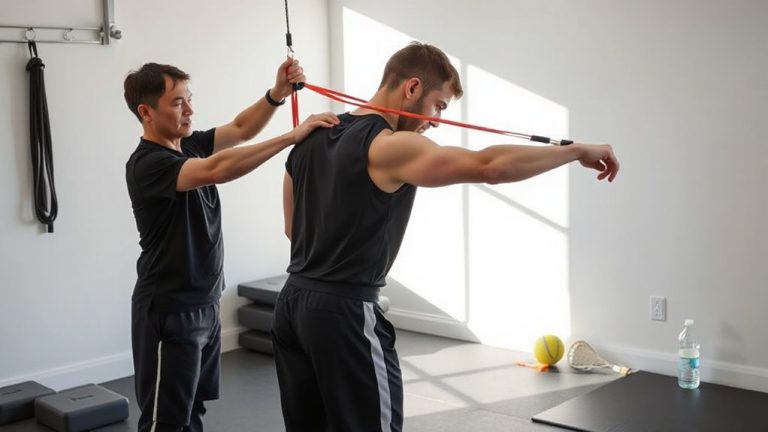
The path to mastering full Nordic hamstring curls starts with smart, stepwise progressions that prioritize tendon health and muscular control. You’ll want to begin with assisted variations-using a band or a partner-to reduce eccentric load while still stimulating adaptation. This approach builds joint stability by reinforcing proper pelvic alignment and minimizing shear forces at the knee. As strength improves, gradually decrease assistance, ensuring each progression feels controlled and symmetrical. Muscle symmetry is critical here; imbalances between legs can undermine performance and increase injury risk. Full Nordic curls demand serious eccentric strength, so rushing leads to poor mechanics. Use a soft mat for comfort, but avoid over-relying on padding that encourages faulty positioning. Monitor your form weekly-check knee angle, descent speed, and torso alignment. Well-executed progressions don’t just boost hamstring resilience-they enhance overall posterior chain coordination, making you sturdier during high-speed efforts.
Schedule Nordic Curls: Volume and Frequency for Sprinters
Three weekly sessions strike the right balance for most sprinters integrating Nordic curls into their training, allowing sufficient stimulus for hamstring adaptation without compromising recovery. You should aim for 3–4 sets of 6–8 reps per session, focusing on controlled eccentric movement to maximize muscle engagement. This volume promotes strength gains while respecting nordic curl recovery demands-critical for maintaining sprinter training balance. Since these contractions induce high hamstring load, pairing Nordic work with low-volume sprint drills or placing them on lighter training days helps prevent overlap in neural fatigue. Monitor soreness and performance; if sprint mechanics dip, adjust frequency or volume. A well-designed protocol enhances eccentric capacity without disrupting speed work. For best results, consider using a Nordic curl bench with ankle padding-this improves comfort and stability, supporting better form and long-term joint health.
On a final note
You’re building real resilience when you prioritize eccentric control in Nordic curls-it’s proven to reduce hamstring injuries in sprinters. That 3-second lower strengthens muscle under high load, mimicking sprint demands. Done right, with proper setup and progression, it integrates seamlessly into your routine. Assisted variations help starters gain strength safely. Used consistently, this exercise, paired with recovery-focused gear like compression and foam rollers, supports long-term tissue health and performance.