The Role of Diaphragmatic Breathing in Enhancing Static Stretch Depth
You deepen static stretches by using diaphragmatic breathing, where slow belly breaths activate your parasympathetic nervous system and reduce muscle resistance. This method boosts oxygen flow, clears metabolic waste, and enhances relaxation, letting you ease into stretches more effectively. Pairing breath control with supportive fitness gear improves recovery, but technique remains essential. Proper exhalation timing helps you move deeper into each stretch-consistency here is key to seeing real gains. There’s more to optimizing this practice than meets the eye.
Notable Insights
- Diaphragmatic breathing activates the parasympathetic nervous system, promoting deeper muscle relaxation during static stretches.
- Deep belly breaths increase oxygen delivery to muscles, reducing hypoxia and improving tissue elasticity for greater stretch depth.
- Coordinated breathing enhances core stabilization, allowing safer and more effective alignment in prolonged static positions.
- Rhythmic diaphragmatic breaths help release neuromuscular tension, decreasing resistance and enabling progressive stretch intensity.
- Real-time breath awareness allows immediate correction of tension imbalances, optimizing stretch quality and range of motion.
What Is Diaphragmatic Breathing?
Breathing-something you do without thought-becomes a powerful recovery tool when done right. Diaphragmatic breathing relies on deep, controlled inhalations that prioritize diaphragm engagement over shallow chest movement. You’re not just filling your lungs-you’re activating a core stabilizer and signaling your nervous system to shift into recovery mode. This technique emphasizes breath awareness, helping you detect tension and correct imbalances in real time. Unlike passive breathing, it requires focus and regular practice, especially when integrating with stretching routines. Fitness recovery isn’t just about gear or rest-it’s about how well you use your body’s built-in mechanisms. Devices like wearable breath trainers or posture-correcting apparel may support the process, but they can’t replace mindful technique. True progress comes from consistent application, proper form, and understanding how breath drives physiological adaptation.
Why Deep Breathing Relaxes Tight Muscles
You might not realize it, but every deep breath you take can start loosening those stubborn, tight muscles-especially when you’re coming off a hard workout or sitting too long. Deep diaphragmatic breathing boosts oxygen delivery, directly countering muscle hypoxia, a common cause of stiffness and delayed recovery. When oxygen flow improves, metabolic waste clears faster, reducing soreness. Plus, slow, intentional breaths activate your parasympathetic nervous system, helping to ease nervous fatigue-mental and physical exhaustion from prolonged stress or overtraining. You’ll notice that when your breath is controlled, your muscles don’t resist stretches as much. It’s not just relaxation; it’s a physiological shift. Quality fitness gear, like supportive mats or wearable breath trainers, can enhance this effect by promoting proper alignment and respiratory resistance. But nothing replaces the core mechanism: steady breathing resets your system. Over time, consistent practice supports faster recovery, deeper flexibility, and greater body awareness, making breath a foundational recovery tool.
How to Practice Belly Breathing in Stretches
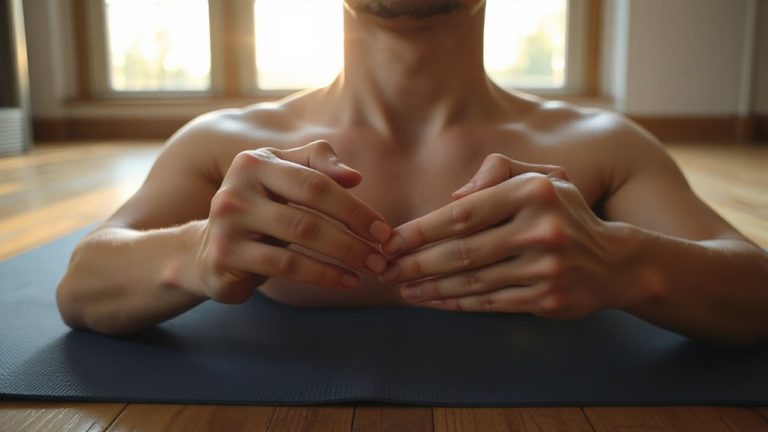
Why does stretching feel easier when your breath is deep and steady? Because belly breathing boosts breath awareness and optimizes muscle engagement. To practice, lie back or sit comfortably during your stretch. Place one hand on your chest, the other on your belly. Inhale deeply through your nose-feel your abdomen rise, not your chest. Exhale fully through your mouth, drawing your navel inward. This diaphragmatic action calms the nervous system and supports sustained stretching.
| Phase | Belly Movement | Focus Point |
|---|---|---|
| Inhale | Expands | Breath awareness |
| Hold | Gentle lift | Muscle engagement |
| Exhale | Contracts | Release tension |
Repeat this rhythm throughout your stretch. You’ll notice improved control and less strain. Proper breath technique complements quality fitness gear by enhancing recovery efficiency and helping maintain form, making each session more productive.
Sync Your Exhale to Go Deeper
When you time your movements with the rhythm of your breath, you activate a more effective stretch-especially when you synchronize your deepest exh face with the moment you ease further into the pose. This breath timing isn’t just calming; it triggers a neuromuscular relaxation that lets muscles yield more freely. As you exhale fully, your diaphragm rises, increasing intra-abdominal pressure and supporting spinal stability-key in deepening stretches safely. You’re not forcing; you’re working with your body’s natural rhythm. That’s where stretch synergy comes in: the breath and movement become coordinated, enhancing range without strain. Research shows this coordination improves tissue pliability and reduces protective tension. You’ll notice it in longer holds-your body lets go just a little more on each out-breath. Proper diaphragmatic engagement guarantees you’re not just stretching passively but actively refining control. It’s subtle, but consistent practice builds measurable gains in flexibility and body awareness-no gimmicks, just physiology.
Fix These Breathing Mistakes in Static Stretches
Holding your breath or breathing too shallowly during static stretches is more common than you might think, and it undercuts the benefits you’re working for. Breath holding spikes tension, making muscles resist lengthening instead of relaxing. You’re more likely to trigger protective reflexes that limit flexibility. Chest breathing compounds the issue-shallow, upper-chest inhales fail to engage the diaphragm fully, reducing oxygen flow and nervous system calm. Without diaphragmatic engagement, you miss the internal massage that helps release connective tissue tightness. You’re not just stretching muscles; you’re influencing neuromuscular control. Proper breathing isn’t passive-it’s an active part of the stretch. Fixing these errors means replacing chest breathing and breath holding with rhythmic, deep belly breaths. That shift boosts parasympathetic tone, encouraging muscles to yield. You’ll achieve greater range safely, with less strain. It’s not just about form-it’s about function working as intended.
Best Breathing Cues for Hamstring and Hip Stretches
How often do you find yourself straining through a forward fold, only to feel stuck just short of progress? The issue might not be your flexibility-it could be your breath. For hamstring and hip stretches, effective breathing cues enhance both active engagement and mindful release. Inhale to lengthen your spine, creating space; exhale slowly and deeply, letting the diaphragm guide tension downward. This rhythm signals your nervous system to relax, allowing deeper access into the stretch without force. Try whispering “release” on the outbreath-this prolongs expiration and boosts parasympathetic response. Pair each exhale with a gentle pelvic tilt or micro-squeeze of the glutes to maintain joint stability during lengthening. These cues work because they balance control with surrender, turning passive holds into dynamic recovery. When applied consistently, they don’t just improve stretch depth-they condition smarter movement patterns over time.
Breathe Smarter to Unlock Your Flexibility
Why do some people seem to glide effortlessly into deep stretches while others feel perpetually locked up? It often comes down to breath awareness. When you’re tense, your nervous system signals muscles to guard against perceived threat, limiting flexibility. But with diaphragmatic breathing, you activate the parasympathetic nervous system, calming this protective response. You’re not just stretching tissue-you’re retraining your body’s reaction. Controlled, deep breaths increase oxygen flow, reduce muscle resistance, and create space for deeper elongation. Think of it as upgrading from forced effort to intelligent engagement. Over time, consistent breath awareness enhances neuromuscular efficiency, making progress less reliant on brute force. Fitness recovery isn’t just about foam rollers or compression gear-your breath is a foundational tool. Unlike gadgets that promise quick fixes, diaphragmatic breathing delivers measurable, sustainable gains. It’s free, always available, and scientifically sound. Breathe smarter, not harder, and access real flexibility.
On a final note
You’ll find diaphragmatic breathing isn’t just calming-it’s a game-changer for deepening static stretches safely. By engaging your core and lowering sympathetic tone, it helps override muscular guard reflexes. When you sync long exhales with movement, you access greater range gradually. Done right, this technique complements recovery-focused gear like foam rollers or compression wear by boosting neuromuscular efficiency. It’s low-effort, high-impact-ideal for consistent flexibility gains.