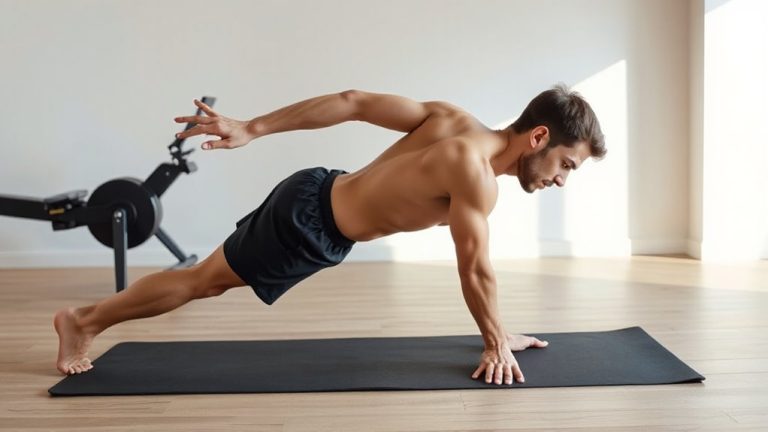
Core Stability Progression Using Swiss Ball Rollouts for Power Athletes
You start with Swiss ball knee rollouts to build foundational core control, using the unstable surface to sharpen proprioception and spinal alignment. Progress to standing rollouts to challenge anterior core and stability under load. Pair firm, textured balls with controlled reps to train explosive power transfer safely-ideal for sprinting and heavy lifts. Proper form and gear maintenance guarantee lasting performance gains. The next step reveals how to integrate these into dynamic training cycles.
Notable Insights
- Begin with Swiss ball knee rollouts to build foundational core control and spinal stability under low load.
- Progress to standing rollouts to increase demand on anterior core, shoulders, and hip stabilizers with full-body tension.
- Introduce resistance or unstable surfaces only after mastering form to enhance proprioception and stabilizer recruitment safely.
- Train dynamic core power by incorporating explosive return phases to mimic athletic movements like sprinting and lifting.
- Program 3–4 sets of 8–10 controlled reps early in workouts to maximize neural engagement and functional strength transfer.
Start With Swiss Ball Knee Rollouts for Control
While you might be keen to jump into advanced core movements, starting with Swiss ball knee rollouts lets you build the control needed for more intense variations. This beginner-friendly exercise emphasizes ball control, requiring you to stabilize your torso while rolling the Swiss ball forward and back using your knees. Maintaining a tight core throughout guarantees proper spinal alignment and reduces lower back strain. The unstable surface of the ball challenges your neuromuscular system, sharpening joint proprioception and enhancing knee stability-critical for power athletes prone to dynamic loads. A high-quality Swiss ball made from burst-resistant material improves safety and responsiveness during repetitions. You’ll notice improved endurance and coordination within weeks. Perform this movement on a non-slip surface, guaranteeing the ball grips the floor without wobbling. It’s a foundational step that refines control before advancing-practical, effective, and essential for building resilient core strength.
Step Up to Standing Rollouts Safely
Because you’ve built foundational control with knee rollouts, stepping up to standing Swiss ball rollouts makes sense as the next progression in core stability training. This move increases demand on your anterior core, shoulders, and hip stabilizers, requiring greater neuromuscular coordination. To perform it safely, start with a short range of motion-rolling the ball forward just a few inches while maintaining strict proper alignment from head to heels. Avoid sagging your hips or flaring your ribs; these faults compromise effectiveness and increase injury risk. Think of this as a gradual progression: mastering control before increasing reach. Your feet should stay planted, and your breath should remain steady, engaging the diaphragm with the core. Move slowly, emphasizing tension through the abs, not momentum. This variation builds functional strength critical for power athletes who need trunk rigidity under dynamic loads, improving performance and reducing strain during explosive movements.
Add Resistance and Unstable Surface Variations
Once you’ve mastered standing rollouts with consistent form, you can amplify the challenge by introducing resistance and unstable surface variations-both proven methods for escalating core activation and neuromuscular demand. Try weighted rollouts using a weight vest or resistance band anchored at the hips; these increase anterior core loading, forcing your rectus abdominis and obliques to work harder without compromising spinal alignment. For greater instability, perform rollouts over an uneven surface, like placing the Swiss ball on a foam pad or BOSU ball. This disrupts base stability, heightening proprioceptive feedback and engaging more stabilizer muscles. While effective, these modifications require strict control-rushing in can lead to form breakdown and lower back strain. Use them selectively, prioritizing tension and tempo over range of motion. Always inspect your gear for wear, especially when adding load or instability, to maintain safety and effectiveness during progression.
Train Core Power for Sprinting and Lifting
Power isn’t just generated in your legs or lifted with your arms-it’s transferred through your core, making it the critical link in explosive movements like sprinting and heavy lifting. To maximize performance, you need explosive engagement-your core must react instantly, stabilizing your spine while transferring force efficiently. That’s where dynamic tension comes in: it’s not just about strength, but the speed and coordination of muscle activation. Swiss ball rollouts train this precisely, forcing your abs, glutes, and hips to fire in sync under load and motion. Unlike static holds, rollouts mimic the actual demands of sprinting and lifting, where your trunk resists extension while moving. When done right, you build a stiffer, more responsive core-key for preserving energy and reducing injury. Use a firm ball with textured grip for safety and consistency. Rollouts aren’t just stability drills-they’re power builders, bridging strength and athleticism.
Program Rollouts for Athletic Performance
Explosiveness starts in the core-but only if it’s trained to respond under real movement conditions. Swiss ball rollouts aren’t just about strength; they teach your core to engage during explosive contractions, mimicking the demands of sprinting, jumping, or heavy lifts. As you roll forward, your abs, obliques, and lower back work together to maintain dynamic stabilization, preventing spinal sag and promoting power transfer from lower to upper body. For athletic performance, aim for 3–4 sets of 8–10 slow, controlled rollouts, progressing to explosive return phases that train rapid core engagement. Pair them early in workouts when neural drive is high. Use a textured stability ball for grip, and guarantee it’s properly inflated-underinflation reduces instability and diminishes training effect. Consistent programming enhances not just aesthetics, but functional resilience, making rollouts a non-negotiable for power athletes seeking efficiency and injury resilience in high-speed movements.
On a final note
You’ve built control with knee rollouts, progressed to standing variations, and added resistance for greater demand. Swiss ball rollouts enhance core stability critical for sprinting and lifting power. Paired with quality recovery gear-like foam rollers and compression sleeves-this progression supports resilience. The ball’s instability sharpens neuromuscular engagement, while structured programming guarantees transfer to athletic performance. It’s practical, scalable, and effective when integrated smartly into training.