Clock Reaches in Half-Kneeling to Expand Weight Shift Capacity in ACL-Rehab Patients
You’re building functional strength and neuromuscular control with clock reaches in half-kneeling, a must-do in ACL rehab to expand weight shift capacity. This drill challenges balance and core stability across multiple planes, mimicking real-life movements. By reaching in all directions-from 12 o’clock to diagonals-you enhance proprioception, joint control, and hip sequencing while minimizing compensation. It’s not just about strength; it’s about training smarter movement patterns that protect your knee. Mastering this now sets up safer, more dynamic progress down the line.
Notable Insights
- Clock reaches in half-kneeling enhance dynamic weight shift and neuromuscular control after ACL surgery.
- The exercise improves functional stability by challenging balance across multiple movement planes.
- Proper half-kneeling setup ensures knee alignment and core engagement to prevent compensatory motions.
- Reaching in diagonal and lateral directions increases proprioceptive demand and hip-trunk coordination.
- Progression depends on maintaining pelvic control, with gradual increases in reach distance or resistance.
Why Dynamic Weight Shift Is Crucial After ACL Surgery
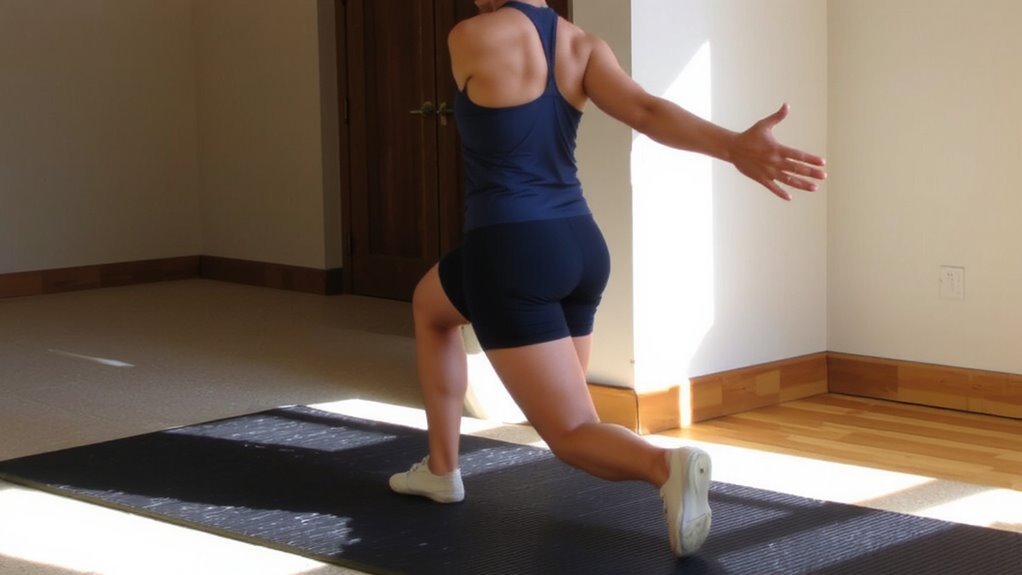
Frequently, rehabilitation after ACL surgery focuses too heavily on static stability, but you’ll need dynamic weight shift early in your recovery to build functional strength and neuromuscular control. Static exercises won’t fully prepare you for real-world movement, where balance and coordination are constantly challenged. Incorporating dynamic motions trains your body to manage force across changing planes, which is essential for both performance and injury prevention. You’ll improve neuromuscular control by requiring your muscles to fire in proper sequence during movement, not just in stillness. This enhances joint accuracy and response time. Introducing proprioceptive challenges-like unstable surfaces or limb movements-further refines your body’s awareness. Over time, these adaptations reduce re-injury risk and support smoother shifts into sport-specific tasks. Using functional fitness gear, like foam pads or balance discs, can amplify these benefits safely. Dynamic training isn’t just supplementary-it’s foundational in modern ACL rehab, offering measurable advantages over isolated, static routines. A high-density foam roller can further enhance neuromuscular activation during dynamic warm-ups and recovery phases.
How Clock Reaches Restore Stability in ACL Rehab
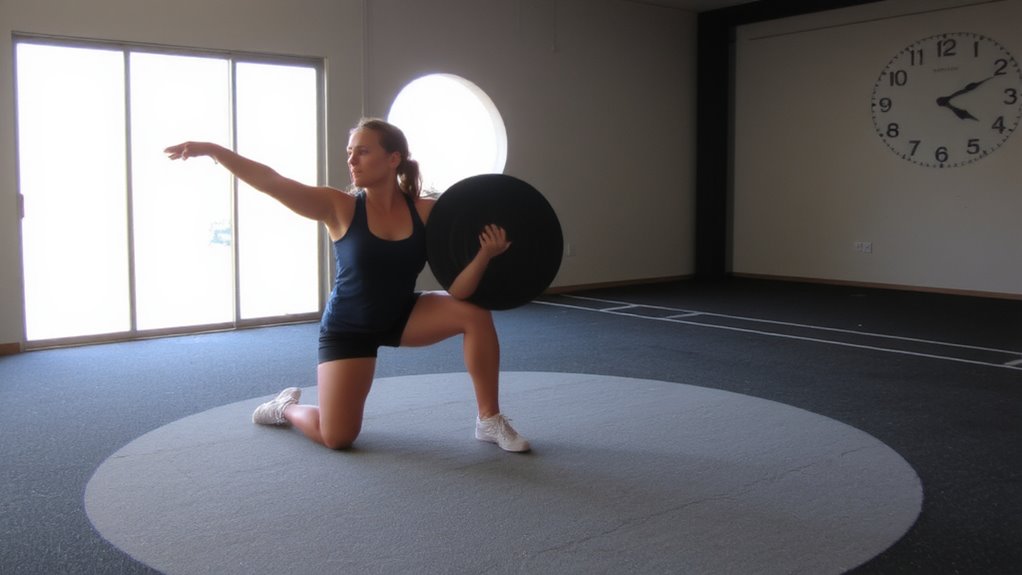
You’re probably no stranger to the wobble that follows ACL surgery-the subtle shifts in balance and confidence with every movement. Clock reaches in half-kneeling rebuild stability by challenging your body’s ability to maintain alignment under dynamic loads. This drill sharpens balance control while demanding consistent core engagement, training your neuromuscular system to react with precision. By reaching in multiple directions, you simulate real-world movements critical in both daily life and sport.
| Direction | Core Engagement | Balance Control |
|---|---|---|
| 12 o’clock | High | Moderate |
| 3 o’clock | Moderate | High |
| 6 o’clock | Low | Moderate |
| 9 o’clock | Moderate | High |
| Diagonal | High | High |
Consistent practice improves proprioception, joint awareness, and motor control, all essential in ACL recovery.
How to Set Up the Half-Kneeling Clock Reach
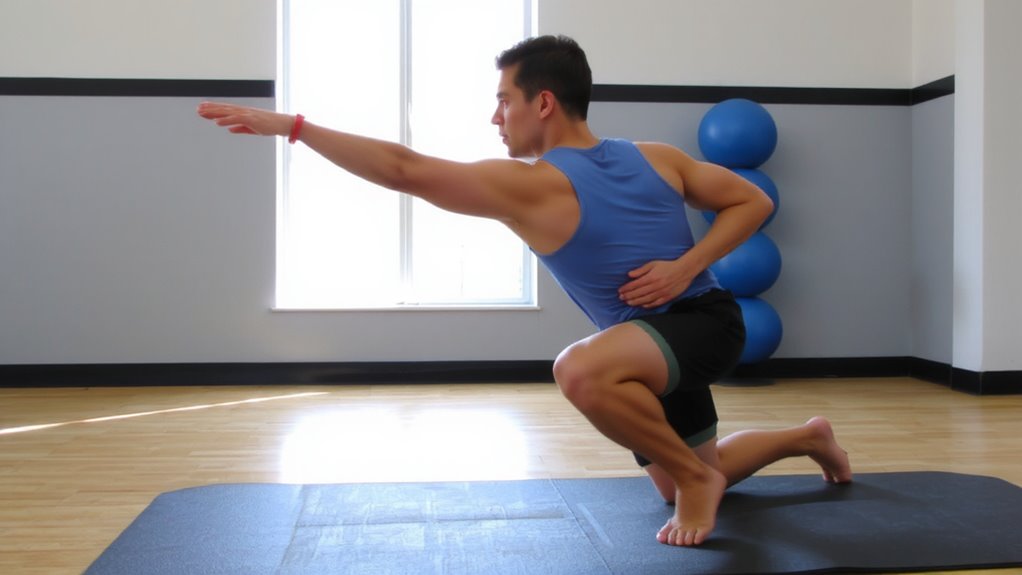
Starting in a half-kneeling position creates the ideal base for clock reaches, giving you control while still challenging your stability. You’ll place your back knee down and front foot flat, ensuring proper knee alignment-your front knee should stay stacked over the ankle, never caving inward. Engage your core and maintain neutral hips; this hip engagement prevents excessive arching and optimizes neuromuscular control. Position your hands at your sides or on your hips to monitor symmetry. Keep your torso upright and chest open throughout. This setup activates stabilizing muscles without overloading the recovering ACL. Using a mirror or trainer feedback improves accuracy. The half-kneeling base limits pelvic rotation, making it safer than standing drills early in rehab. Proper form here builds foundational strength and body awareness critical for dynamic movement reintegration-essential in fitness recovery where precision supports long-term joint health.
Moving Through the Clock: Reach Directions Explained
How do you guarantee each movement challenges stability without compromising recovery? You control reach timing and master joint sequencing. Start by reaching forward at 12 o’clock-this demands core engagement and tests balance subtly. As you move to 1, 2, and 3 o’clock, the diagonal shifts increase demand on hip and trunk control. Each reach should feel smooth, not jerky, with motion flowing from the ankle through the knee to the hip-proper joint sequencing prevents compensatory patterns. Lateral (3 o’clock) and posterior-diagonal (4, 5, 6 o’clock) reaches challenge weight shift further, but only if your form stays tight. Too fast, and you lose proprioception; too slow, and neuromuscular activation drops-ideal reach timing balances control with intent. These directions aren’t random-they map functional movement patterns essential in fitness recovery, safely expanding dynamic stability within a controlled range.
How to Progress Clock Reaches Safely
Why do some athletes advance too quickly through clock reaches and end up setbacks later? Because they overlook progression safety and misjudge exercise intensity. You need control, not speed. Start with anterior reaches, mastering stability before moving laterally or posterior. Only progress when you can maintain pelvic alignment, minimal trunk shift, and smooth movement-no jerking or wobbling. Increasing reach distance or adding resistance boosts intensity, but only if form holds. Your nervous system needs time to adapt; rushing disrupts motor patterning essential for ACL recovery. Think quality over quantity. Monitor for compensation-like hip hiking or foot flaring-as red flags. Progression isn’t just about direction; it’s about neuromuscular precision under increasing demand. Use real-time feedback, whether from a mirror or therapist, to stay honest. Push too hard, and you risk joint irritation or delayed healing. Respect the process: safe progression means sustainable gains.
Adding Clock Reaches to Your Rehab Routine
Where do clock reaches fit into your weekly rehab plan-specifically, how often, how many sets, and at what stage should you include them? Start incorporating clock reaches during mid-phase ACL rehab, once basic strength and joint control are established. Aim for 2–3 sessions per week, completing 2–3 sets of 8–10 reaches in each direction. They’re ideal for enhancing weight shift capacity while promoting core activation and balance training. Perform them in half-kneeling to maximize hip and pelvic stability. You’ll notice improved coordination and reduced compensation patterns over time. Use a resistance band or reach against light external load to increase difficulty as tolerated. Always maintain neutral spine alignment-this isn’t just mobility work; it’s neuromuscular re-education. When paired with functional movements, clock reaches support smoother shifts to dynamic tasks. Don’t rush progression; quality beats quantity. They’re simple but potent-especially when integrated thoughtfully into structured recovery.
On a final note
You’ve seen how clock reaches in half-kneeling boost dynamic weight shift after ACL surgery. This drill sharpens stability, control, and neuromuscular coordination-key for recovery. When paired with smart progressions, it bridges the gap between rehab and return-to-sport. Though simple, its effectiveness hinges on proper form and gradual loading. Used wisely, it’s a valuable tool, blending functional movement with targeted strength to support long-term knee health and performance resilience.