Aquatic Plyometric Alternatives: Jump Squats in Chest-Deep Water for Power Retention
You get explosive power training with less joint stress when you do jump squats in chest-deep water. Buoyancy supports your weight, softening landings and protecting sensitive joints, while water resistance challenges muscles through full range of motion. You maintain neuromuscular drive without the wear-and-tear of ground impact, making it ideal for rehab, recovery, or off-season conditioning. Muscle activation stays high, and power retention improves-especially if you’re managing fatigue or injury. There’s more to how form and programming maximize results.
Notable Insights
- Aquatic jump squats in chest-deep water reduce joint stress while maintaining high muscle activation through hydrodynamic resistance.
- Buoyancy support decreases ground reaction forces, making explosive movements safer during injury rehabilitation or sensitive conditions.
- Explosive concentric phases preserve power output, supporting neuromuscular coordination and power retention in water.
- Proper form includes shoulder-width stance, upright chest, heel drive, and soft landings to maximize effectiveness and safety.
- Recommended protocol is 2–3 sets of 8–10 reps with controlled tempo, progressing volume before intensity for optimal adaptation.
How Water Makes Jump Squats Safer and Stronger
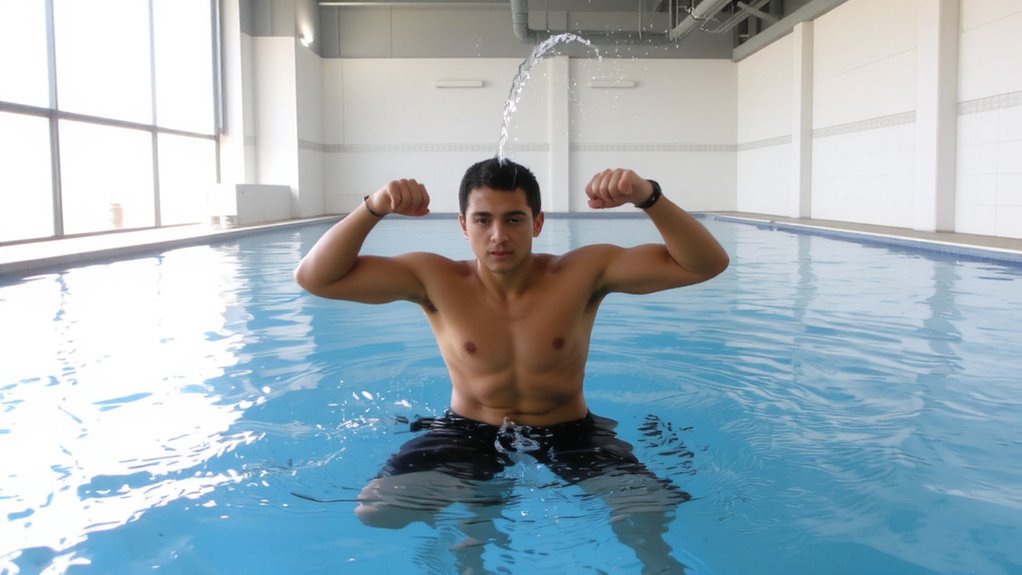
While gravity makes land-based jump squats tough on your joints, doing them in water reduces impact while still building power. You experience less strain thanks to buoyancy support, which offsets your body weight and cushions landings. That’s especially helpful if you’re recovering from injury or managing joint sensitivity. Yet you’re not just going easy-you’re working against hydrodynamic drag, which increases resistance with every fast, explosive movement. This forces your muscles to activate more fully than in standard water exercises, amplifying strength and speed development. Unlike bulky recovery gear, chest-deep water offers a natural, adjustable environment that challenges power without wear and tear. Trainers note sharper control and reduced soreness in athletes using aquatic plyometrics. Water doesn’t replace land training, but it complements recovery phases smartly-maintaining intensity while protecting connective tissues. You get resilience without compromise.
Do Water Jump Squats Maintain Power?
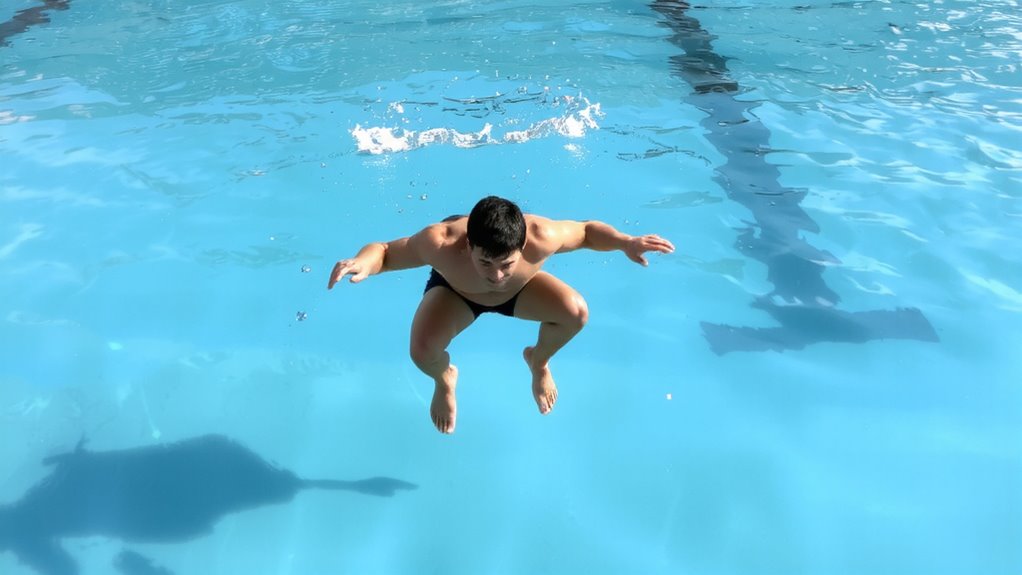
You might wonder whether swapping land for water means sacrificing explosive power, especially after seeing how buoyancy reduces joint stress during jump squats. Rest assured, research shows aquatic jump squats offer solid power retention when compared to their dry land counterparts. A power retention analysis reveals that while peak force is lower in water, the neuromuscular demand remains high due to resistance from water drag. This makes water jumps a smart choice during recovery phases without losing much explosive edge. Check the data below:
| Metric | Dry Land | Water |
|---|---|---|
| Peak Power Output | High | Moderate-High |
| Ground Reaction Force | High | Low |
| Joint Stress | Moderate | Low |
| Muscle Activation | High | High |
| Training Adaptation | Yes | Yes |
The dry land comparison confirms water jump squats maintain functional power, supporting fitness recovery with smart gear and programming.
How to Perform Water Jump Squats With Perfect Form
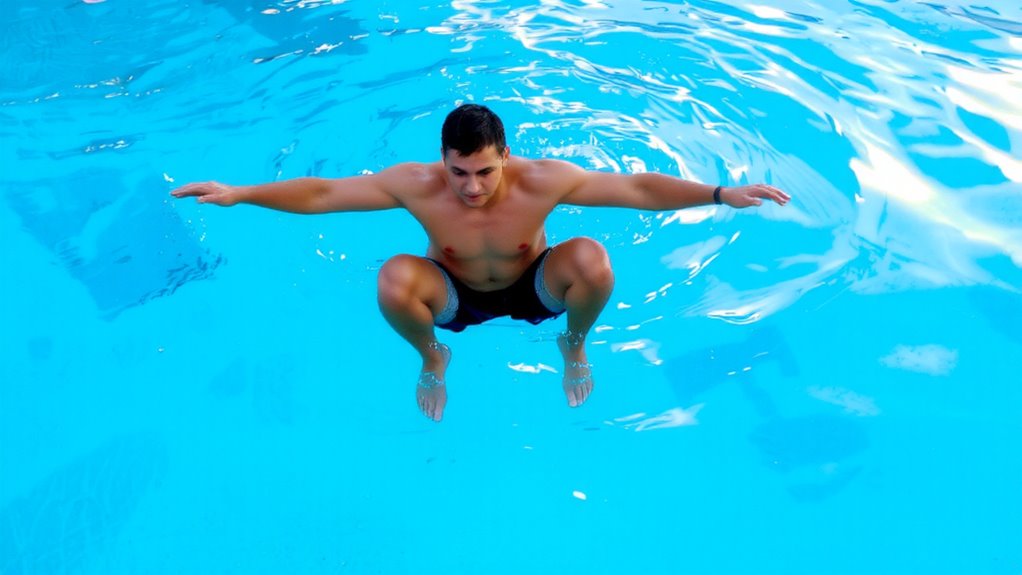
Execution matters when maximizing the benefits of water jump squats, especially during fitness recovery where form directly influences results. Start with proper foot positioning-feet shoulder-width apart, toes slightly turned out, flat on the pool floor for stability. Bend at the hips and knees, keeping your chest up as you lower into a squat. Drive through your heels to explode upward, mimicking a land-based jump squat but resisting the water’s drag. Maintain constant core engagement to stabilize your spine and prevent leaning or wobbling. This tension protects your lower back and improves movement efficiency. Land softly, absorbing impact through your legs without letting your knees cave inward. The water’s resistance supports joint safety, making it ideal for recovery. Perfect form guarantees you retain power without overloading healing tissues. Quality always trumps quantity here.
How to Program Sets, Reps, and Intensity in Water
Because water-based plyometrics demand precision in programming to align with recovery goals, you’ll need to balance volume, resistance, and effort carefully. Start with 2–3 sets of 8–10 reps, using controlled tempos to manage intensity and reduce joint stress. The water’s natural resistance allows high-effort movements with less impact, making it ideal for injury prevention. Gradually increase volume instead of intensity-add reps or sets before boosting speed or depth. Monitor fatigue closely; overtraining in water can still impede recovery. Use progress tracking tools like session RPE (rate of perceived exertion) or jump height consistency to assess adaptation. Avoid maximal efforts initially, focusing on neuromuscular re-education and stability. Proper programming respects the body’s need for repair while maintaining power output. Consistent, data-backed adjustments guarantee ideal stimulus without overload, supporting long-term fitness recovery and performance resilience.
When Water Jump Squats Work Best: Rehab, Recovery & Performance
While land-based jump squats emphasize max power, water jump squats shine in phases where joint safety and controlled intensity matter most. You’ll benefit most during rehab, post-game recovery, or when maintaining explosive capacity without overloading connective tissues. Buoyancy effects reduce impact by up to 75%, easing stress on joints, while hydrodynamic drag provides constant resistance-ideal for controlled, full-range movement. This mix supports neuromuscular retraining without compromising healing. A variety of low-impact cardio equipment can complement aquatic training for those managing knee issues. Here’s when to prioritize them:
| Use Case | Benefit |
|---|---|
| Injury rehab | Low impact, safe loading |
| Active recovery | Reduced soreness, maintained coordination |
| Pre-activation | Neuromuscular priming |
| Chronic knee issues | Joint-friendly power stimulus |
| Off-season retention | Power maintenance with less fatigue |
Hydrodynamic drag enhances muscle time under tension-perfect for conditioning when land drills are too taxing.
Mistakes That Weaken Land Transfer
How much are you really gaining from aquatic plyometrics if the movements don’t translate to the ground? You’re likely underestimating how limited buoyancy affects muscle recruitment. Without enough resistance mimicry, your power output doesn’t carry over effectively. If you’re not adjusting depth to simulate gravitational load, you’re training in a way that weakens land transfer. Improper timing is another issue-delayed concentric contractions in water can desynchronize your stretch-shortening cycle, messing with neuromuscular efficiency. You might feel explosive in the pool, but that doesn’t mean it counts on land. Syncing your tempo with land-based intent matters. Use chest-deep water to maintain some joint unloading while preserving movement specificity. Don’t just move-you must move smart. Without attention to timing and resistance alignment, you’re building power in a bubble that pops the second you step out of the pool.
Why Water Resistance Beats Land Impact for Plyometrics
You’ve probably been told that explosive power only develops on land, where gravity and impact forge real athletic gains-but that assumption overlooks what water resistance uniquely offers. Hydrodynamic drag provides multi-directional resistance, enhancing neuromuscular recruitment without joint stress. Buoyant loading reduces impact while maintaining eccentric control, making chest-deep water ideal for jump squats. This environment supports high-intensity effort with faster recovery, essential for power retention.
| Factor | Land Plyometrics | Water Plyometrics |
|---|---|---|
| Joint Impact | High | Low |
| Resistance Type | Gravity-dependent | Hydrodynamic drag |
| Loading Mode | Compressive | Buoyant loading |
| Recovery Time | Longer | Shorter |
You maintain velocity-specific training with less wear on connective tissue. Water isn’t a compromise-it’s a strategic alternative for resilient power development.
On a final note
You’re getting powerful, low-impact gains with water jump squats, ideal for recovery or rehab without losing explosive strength. The resistance builds power safely, reducing joint stress while maintaining neuromuscular demand. When programmed correctly-moderate volume, high intent-they transfer well to land performance. Avoid common errors like shallow depth or slow execution. This isn’t just splashy substitution; it’s smart, science-backed training that preserves athleticism when impact isn’t an option.