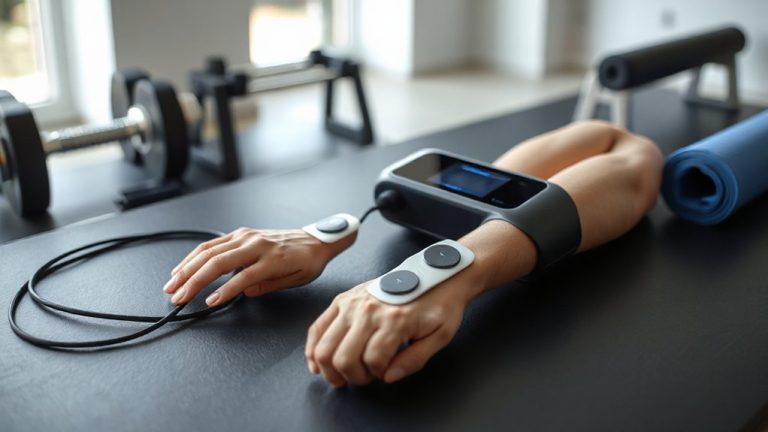
TENS Therapy Settings for Maximum Effectiveness in Chronic Neuropathy Management
You’ll get the most relief from chronic neuropathy by setting your TENS unit to 80–120 Hz and 250 μs, targeting sensory nerves with consistent, controlled pulses. This blocks pain signals and boosts endorphins for lasting comfort. Place electrodes below the ankle or along the foot’s arch, ensuring solid contact. Use sessions for 30–45 minutes, adjusting as symptoms change. Proper settings enhance signal clarity and circulation-key for nerve health. There’s more to optimizing treatment based on your specific response patterns.
Notable Insights
- Use a frequency of 80–120 Hz to effectively block neuropathic pain signals and stimulate endorphin release.
- Set pulse width to 200–300 μs to target sensory nerves involved in tingling and burning neuropathy symptoms.
- Place electrodes below the ankle or on the foot arch to access tibial and peroneal nerve pathways.
- Begin with 30-minute sessions, gradually increasing to 45 minutes based on treatment response and comfort.
- Adjust settings every few weeks to match changing pain patterns and maintain therapeutic effectiveness.
What Is TENS and How Can It Help Neuropathy?
Pain relief starts with understanding your tools, and one of the most accessible options for managing chronic neuropathy is transcutaneous electrical nerve stimulation, or TENS. You apply small electrodes to your skin, which deliver mild electrical impulses that create a tingling sensation. This nerve stimulation interferes with pain signals heading to your brain, offering you temporary relief. The TENS mechanism hinges on both gate control theory and endorphin release, making it effective for many users. You’ll find portable units easy to use at home or on the go, with adjustable frequency and intensity settings. While results vary, studies suggest consistent use improves comfort and function. Unlike invasive treatments, TENS is non-addictive and carries minimal risk when used correctly. For those seeking drug-free management, it’s a practical option worth considering as part of your long-term strategy.
Why TENS Works on Damaged Nerves
How does a simple electrical pulse help when nerves aren’t just sore but actually damaged? TENS doesn’t heal nerves overnight, but it supports healing by encouraging nerve regeneration and altering pain perception through signal modulation. Damaged nerves often misfire, sending chaotic pain signals. TENS delivers controlled pulses that disrupt this noise, replacing it with predictable input the brain can interpret more easily. Over time, this steady input may promote healthier nerve function.
| Mechanism | Effect on Damaged Nerves |
|---|---|
| Signal modulation | Reduces erratic pain signaling |
| Improved circulation | Supports nutrient delivery for repair |
| Neural feedback | Enhances sensory pathway clarity |
| Nerve regeneration | Promotes gradual structural recovery |
You’re not just masking pain-you’re reshaping how your nerves respond. While results vary, consistent TENS use aligns with long-term neuropathic recovery goals.
Best TENS Frequency for Neuropathy Pain
Where should you start when choosing the right TENS frequency for neuropathy pain? Most experts suggest beginning between 80 and 120 Hz, as this range often provides the best balance for nerve-related discomfort. Higher frequencies tend to deliver quicker pain relief by stimulating endorphin release and blocking pain signals. For many, this is the most suitable frequency range-not so intense it causes irritation, but strong enough to make a difference. You might find lower settings around 2–10 Hz help with longer-term discomfort, especially if tingling or deep aching dominates your symptoms. Still, research and patient feedback increasingly support moderate to high frequencies for consistent results. It’s not one-size-fits-all, but targeting 80–120 Hz gives you a strong starting point. Adjust gradually and track your response, since effective pain relief hinges on personal sensitivity and nerve involvement.
Set the Right Pulse Width for Nerve Symptoms
When fine-tuning your TENS unit for nerve symptoms, pulse width is just as critical as frequency-but it’s often overlooked. Pulse duration, typically measured in microseconds (μs), influences how deeply the current reaches nerve fibers. For neuropathy, a wider pulse width (between 200–300 μs) often works better because it activates larger sensory nerves more effectively. You’ll find this improves symptom specificity, targeting tingling and burning without overstimulating surrounding tissue. Too narrow, and you might miss the nerves needing modulation; too wide, and you risk muscle twitching or discomfort. Most clinical guidelines suggest starting at 250 μs and adjusting based on your response. Unlike general pain settings, nerve-related discomfort thrives on precise pulse duration. It’s not just about sensation-you want neurological feedback that aligns with your symptoms. Adjusting pulse width thoughtfully enhances treatment accuracy, making it a key lever in customizing therapy.
How to Adjust TENS Intensity Safely
You’ve already set the pulse width to match your nerve activity, so now it’s time to fine-tune the intensity-this is where comfort meets effectiveness. Start low, then slowly increase until you feel a strong but comfortable tingling. Too high, and you risk irritating sensitive skin or reducing battery life unnecessarily. Monitor how your body responds: consistent, gentle stimulation often works better than aggressive settings. Below is a quick guide to intensity levels:
| Intensity Level | Sensation & Effect |
|---|---|
| Low | Mild tingle, ideal for high skin sensitivity |
| Medium | Clear pulse, balances relief and comfort |
| High | Strong contraction, use sparingly |
| Max | Uncomfortable for most, drains battery fast |
Adjust mindfully-effective TENS isn’t about power, it’s about precision and sustainable symptom control.
Strategic Electrode Placement for Common Neuropathy Sites
Why do some TENS users find lasting relief while others see little change? Often, it comes down to electrode placement. You’re not just targeting pain-you’re interrupting nerve signals with precision. For diabetic or peripheral neuropathy, effective coverage matters. Start with ankle positioning: place electrodes just below the ankle bone to access tibial and peroneal nerves. Use foot mapping to identify high-sensitivity zones-typically the arch and ball of the foot-then position electrodes to bracket those areas. This guarantees a broader field of stimulation. Poor placement can miss key neural pathways, reducing effectiveness. Flat, secure adhesion prevents signal interruption during movement. Unlike generic pads, medical-grade electrodes maintain conductivity longer. When you align placement with nerve distribution patterns, not just pain location, results improve. Strategic positioning isn’t optional-it’s critical. You’re not just applying a device; you’re engineering relief where it’s needed most.
When and How to Update Your TENS Settings
How often should you adjust your TENS settings to maintain effectiveness? You’ll want to make timing adjustments every few weeks or when pain patterns change. Neuropathy symptoms can shift, so setting personalization is key to staying ahead. Start with low intensity and gradually increase until you feel a strong but comfortable pulse. Don’t wait for diminished results-update settings proactively.
| Factor | Initial Setting | Adjust After 3 Weeks |
|---|---|---|
| Frequency (Hz) | 50 | 80 |
| Pulse Width (µs) | 200 | 250 |
| Duration (min) | 30 | 45 |
Small tweaks improve relief and prevent tolerance. Always record changes to track what works. Proper timing adjustments and setting personalization turn short-term relief into sustainable management. You’re not just treating symptoms-you’re optimizing therapy.
On a final note
You’ll find TENS therapy most effective when settings are tailored to your specific neuropathy symptoms. Using high frequencies (80–120 Hz) helps block pain signals, while wider pulse widths (200–300 µs) target deeper nerve fibers. Proper electrode placement over affected nerves enhances relief, and gradual intensity adjustments guarantee comfort without irritation. Consistent, informed use-paired with quality, well-maintained gear-makes TENS a practical, non-invasive tool in your long-term nerve pain management.