Applying the Oslo Sport Trauma Center ACL Return-to-Sport Algorithm in Clinical Practice
You apply the Oslo Algorithm by progressing athletes through four stages based on objective criteria, not time. Focus on reducing swelling first, then build strength and neuromuscular control. Use hop tests and KOOS scores to assess symmetry and psychological readiness. Integrate movement analysis during dynamic tasks to spot imbalances. Clearance hinges on meeting specific benchmarks in strength, agility, and confidence-this method lowers re-injury risk. There’s more to optimizing each phase than meets the eye.
Notable Insights
- Implement objective, individualized criteria instead of time-based milestones to guide ACL rehabilitation progression.
- Use hop tests and KOOS scores to assess physical symmetry and psychological readiness before return to sport.
- Progress through four structured stages focusing on movement quality, strength, sport-specific drills, and readiness testing.
- Integrate biomechanical screening to identify and correct movement asymmetries during dynamic tasks like landing or cutting.
- Employ real-time feedback and motion analysis to refine neuromuscular control and ensure safe return-to-sport decisions.
Why ACL Recovery Needs the Oslo Return-to-Sport Algorithm
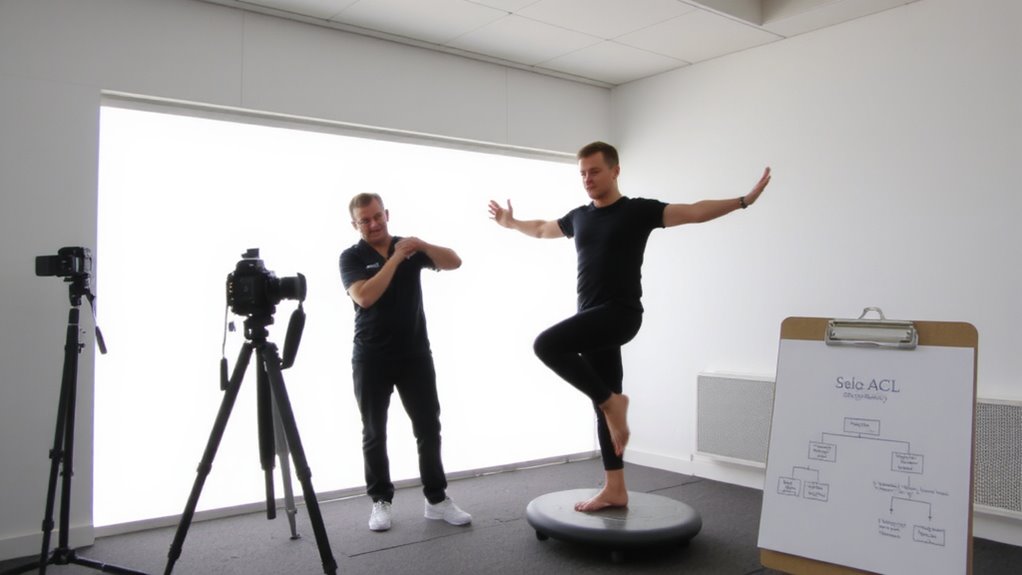
While traditional rehab protocols often rely on time-based milestones, you’re likely to find that they don’t fully capture your readiness to return to sport after an ACL injury-this is where the Oslo Return-to-Sport Algorithm steps in as a necessary upgrade. It shifts focus from arbitrary timelines to objective, individualized criteria, ensuring you’re physically and psychologically ready. Unlike standard plans, it emphasizes both performance metrics and psychological readiness, reducing fear-avoidance behaviors that hinder performance or trigger re-injury. You benefit from structured decision-making that integrates strength symmetry, movement quality, and sport-specific demands. Fundamentally, it enhances injury prevention by addressing modifiable risk factors before you return to full play. This method isn’t just about healing-it’s about preparing you to withstand real-game stresses safely. By merging clinical testing with functional outcomes, the algorithm offers a more reliable, holistic roadmap than time-based models ever could. Your recovery deserves that precision.
The 4 Stages of the Oslo ACL Return-to-Sport Protocol
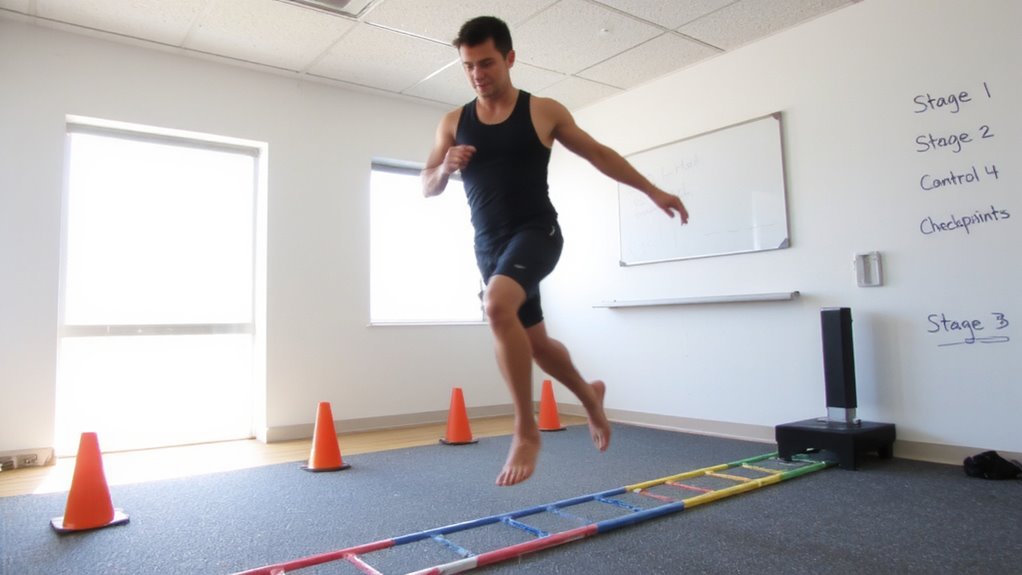
Four distinct phases guide your journey through the Oslo ACL Return-to-Sport Protocol, each designed to progressively rebuild your strength, coordination, and confidence in a way that aligns with actual sport demands. Stage 1 focuses on early recovery, prioritizing swelling control and basic movement quality. Stage 2 introduces strength and neuromuscular control, ensuring your joints move efficiently under load. By Stage 3, you’re performing sport-specific drills that challenge agility and power, with heavy emphasis on consistent movement quality to reduce re-injury risk. The final stage integrates return-to-sport testing, evaluating not just physical capacity but also psychological readiness-your confidence in cutting, jumping, or pivoting without fear. Unlike fixed-time rehab models, this protocol uses objective benchmarks, making it more reliable. You won’t just be physically prepared; you’ll move smarter and feel more capable, which is essential for long-term athletic resilience.
How Long Is Too Long? Why Timed Rehab Fails
You’ve just seen how the Oslo ACL protocol breaks recovery into clear, measurable stages that prioritize function over time, but here’s where most programs fall short: they rely on arbitrary timelines instead of actual readiness. You can’t rush healing with a calendar-tissues mature at different rates, and pushing based on weeks post-op increases reinjury risk. Timed rehab often ignores key psychological barriers like fear avoidance, where you subconsciously limit movement due to fear of rehurt, undermining strength and coordination gains. It also contributes to mental fatigue, especially when progress feels stagnant despite consistent effort. Without objective benchmarks, motivation dips and compliance wavers. The Oslo model avoids these pitfalls by advancing you only when functional thresholds are met-like strength symmetry and dynamic control-not because a schedule says so. That’s why it outperforms time-based approaches: it respects individual variability, reduces setbacks, and better prepares you for real sport demands.
Using Hop Tests and KOOS Scores to Track ACL Recovery
Because progress after ACL reconstruction varies so much from person to person, relying solely on time-based milestones can lead you astray-objective measures like hop tests and KOOS (Knee Injury and Osteoarthritis Outcome Score) surveys offer a clearer, more functional picture of your recovery. These tools assess both physical and mental aspects, helping determine not just if your knee is strong, but if you’re truly ready. Functional symmetry between limbs is critical-significant imbalances suggest higher reinjury risk. Psychological readiness matters just as much; fear of re-injury can hinder performance even when strength appears normal.
| Measure | Purpose |
|---|---|
| Hop Tests | Evaluate functional symmetry & power |
| KOOS Survey | Assess pain, function, and psychological readiness |
How to Apply the Oslo Algorithm in Rehab Sessions
Now that you’ve tracked progress with hop tests and KOOS scores, you’re better equipped to integrate those measurements into a structured rehab framework like the Oslo Sport Trauma Center’s ACL algorithm. You can start applying it by using biomechanical screening to spot movement asymmetries during dynamic tasks-jump-landings, cuts, or pivots-so you adjust exercises before advancing. Incorporate neuromuscular feedback through real-time cues or wearable sensors to improve motor control and guarantee the injured limb matches the healthy side. This approach isn’t just about strength; it’s about quality of movement. You’ll find that integrating these elements keeps rehab individualized yet systematic. Tools like motion analysis software or force plates enhance accuracy, but even visual assessments offer value when applied consistently. The algorithm guides your session design, helping you progress logically from stability drills to sport-specific loading without rushing.
When to Clear an Athlete for Return to Sport
How do you know when an athlete is truly ready to return to sport after an ACL injury? You can’t rely on time alone-objective criteria matter. The Oslo algorithm guides you through strength benchmarks, movement quality, and hop tests, but don’t overlook psychological readiness. If an athlete hesitates during cutting or fears re-injury, they’re not truly prepared, no matter the numbers. Equally important is sport specificity: a soccer player needs different agility and reaction demands than a cyclist. You must assess not just function, but context. Simulated game scenarios, change-of-direction drills, and sport-specific fatigue tests reveal real readiness. Clearing someone too early increases re-injury risk; waiting too long may harm confidence. Balance physical performance with mental preparedness and functional demands. Only then can you confidently say: they’re ready.
On a final note
You’re more likely to succeed returning from ACL surgery when using the Oslo algorithm, as it replaces arbitrary timelines with objective, performance-based benchmarks. Hop tests and KOOS scores give you clear feedback, while the four-stage framework guarantees neuromuscular and strength readiness. Unlike time-based rehab, this approach reduces re-injury risks markedly. Applying it consistently in rehab sessions guides smarter, safer return-to-sport decisions, making it a gold standard in modern recovery protocols.