Shoulder Mobility Drills With Wall-Assisted External Rotation
You maintain a 90-degree elbow bend against the wall while rotating your forearm outward, targeting the infraspinatus and teres minor for better joint centration. Keep your spine flush and movements slow to avoid compensation. This drill boosts shoulder stability and mobility, ideal for daily use in warm-ups or recovery. Pair it with posture cues like chin tucks to enhance effectiveness. You’ll find even greater gains as you explore advanced variations and integration strategies.
Notable Insights
- Stand sideways to a wall, press forearm against it with elbow bent at 90 degrees to perform controlled external rotations.
- Maintain shoulder depression and spine contact with the wall to prevent compensation during movement.
- Focus on slow, controlled motion with a 3-second eccentric phase to enhance rotator cuff activation.
- Use a resistance band for progression, ensuring proper form to increase challenge safely.
- Integrate with scapular retractions and chin tucks to improve overall shoulder and postural alignment.
The Basic Wall External Rotation Drill

While it might seem simple at first glance, the Basic Wall External Rotation Drill is a foundational movement for building shoulder stability and improving rotator cuff function. You stand sideways to the wall, elbow bent at 90 degrees, forearm against the surface-this wall alignment guarantees proper positioning and minimizes compensatory motion. Maintaining contact throughout the movement enhances joint articulation, promoting smooth, controlled rotation. Your shoulder girdle stays engaged, activating the infraspinatus and teres minor without strain. This drill’s effectiveness lies in its precision; even small deviations reduce its impact. Fitness recovery benefits are significant, especially when used post-workout to restore mobility. Unlike bulkier recovery tools, this technique requires no equipment, making it efficient and accessible. When integrated consistently, it supports long-term joint health. Though basic, its role in shoulder maintenance shouldn’t be underestimated-correct form turns a simple motion into a highly functional exercise for sustained upper-body performance.
Master the Movement: Avoid These Wall Rotation Mistakes
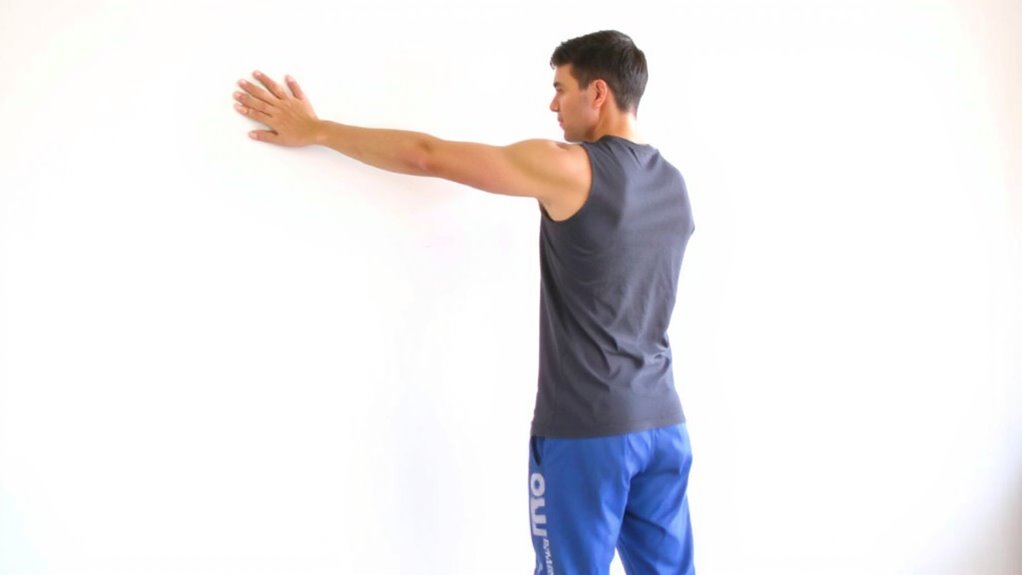
How often do you perform wall rotations only to wonder why you’re not seeing better results? Small mistakes can limit gains and lead to strain. Proper form is key-focus on elbow alignment and avoid excessive shoulder elevation. Keep your arm at 90 degrees, upper arm parallel to the floor, and move slowly to maintain control. Flaring your elbow or hiking your shoulder reduces effectiveness and could lead to injury over time.
| Common Mistake | Correct Fix |
|---|---|
| Flared elbow | Tuck elbow to 90° alignment |
| Raised shoulder | Keep shoulder down and stable |
| Rushed motion | Rotate slowly with control |
| Poor back contact | Maintain spine against wall |
You’ll get more from each rep by prioritizing precision. Proper technique guarantees mobility gains without unnecessary stress.
3 Progressions to Deepen Your Wall Rotation

Once you’ve mastered the fundamentals of wall rotations with proper alignment and control, taking the movement further means adding progressions that challenge your shoulder mobility without compromising form. Try advanced variations like resisted wall rotations using a looped resistance band-this increases activation in the rotator cuff while maintaining joint integrity. Another effective upgrade involves slowing the tempo, using a 3-second eccentric phase to deepen neuromuscular control. Pair these with dynamic stretching pre-workout to enhance range of motion; think arm circles or scapular wall slides to prime movement patterns. These progressions aren’t just about intensity-they refine precision and stability, essential for long-term shoulder health. While fitness gear like resistance bands or foam rollers can assist, they’re optional; effectiveness hinges more on technique than tools. Done right, these drills enhance joint resilience, making them valuable for active recovery and injury prevention.
Pair Wall Rotations With Posture Fixes
You’ve built a solid foundation with wall rotations and even stepped up the challenge with resistance and tempo variations, but don’t stop there-pairing those drills with targeted posture fixes can substantially amplify their impact. Poor posture alignment often undermines shoulder gains, especially if you sit for long hours. By combining wall rotations with chin tucks and scapular retractions, you reinforce ideal cervical and thoracic positioning. This synergy enhances scapular stability, promoting safer, fuller movement. Think of it like tuning a machine: if the base is misaligned, the parts won’t move efficiently. Posture-corrective drills don’t just feel good-they retrain neuro-muscular patterns that support lasting mobility. Consistency matters more than intensity here. Over time, these paired movements reduce strain on the rotator cuff and improve joint centration. It’s not about quick fixes; it’s about building resilient, functional shoulders through deliberate, daily alignment work. For those also dealing with low back discomfort, integrating a back stretching device can further support overall posture and reduce compensatory tension.
When to Do Wall Rotations: Warm-Up, Recovery, or Daily
Where should wall rotations fit into your routine-before a workout, during recovery, or as part of a daily mobility habit? The timing benefits depend on your goals. Used as a warm-up, they prep the rotator cuff and improve joint lubrication. During recovery, they enhance blood flow and reduce stiffness. As a daily habit, the frequency impact builds long-term shoulder resilience. Consistency matters more than intensity.
| Context | Emotional Effect | Physical Outcome |
|---|---|---|
| Warm-Up | Confidence in movement | Activated stabilizers |
| Recovery | Relief from tightness | Reduced soreness |
| Daily Habit | Sense of control | Improved posture over time |
| Missed Days | Frustration | Stiffness returns gradually |
Whether you’re rehabbing or maintaining, wall rotations offer quiet, cumulative gains.
Upgrade With Bands and Angled Wall Drills
While wall rotations alone build foundational shoulder control, adding resistance bands or adjusting your angle against the wall elevates the drill’s effectiveness by challenging stability and engagement more precisely. Band resistance increases rotator cuff activation, especially during the external rotation phase, forcing controlled movement under load. Use a light to medium resistance band anchored at elbow height-maintain tight scapular retraction to avoid compensation. Angled positioning, where you stand with your side partially facing the wall, shifts the plane of motion, targeting different portions of the posterior shoulder complex. This variation improves joint congruency and mimics real-world movement patterns better than standard alignment. Both upgrades demand attention to form; poor execution reduces gains and risks strain. These enhancements work best after mastering basic wall rotations, ensuring neuromuscular readiness. For fitness recovery, they aid in rebuilding strength without joint compression, making them ideal during rehab or active rest phases.
Why Wall Rotations Fix Tight Shoulders
Wall rotations tackle tight shoulders by retraining both mobility and neuromuscular control in a single, low-impact movement. You’re not just stretching-you’re re-educating the muscles around the shoulder joint to move efficiently. By pressing your forearm against the wall and rotating, you engage the anatomy of the rotator cuff in a controlled way, promoting balanced activation of the infraspinatus and teres minor. This drill respects the biomechanics of the shoulder joint, encouraging proper scapulohumeral rhythm while minimizing impingement risk. Because it’s axial-loaded yet low-force, it’s safe for frequent use, especially during fitness recovery. Unlike aggressive stretches or gear-dependent tools, wall rotations require nothing but technique and consistency. They don’t overstress connective tissues, making them ideal for long-term shoulder maintenance. You get measurable gains in external rotation without relying on expensive fitness gear-just smart mechanics.
On a final note
You’ll find wall-assisted external rotations effective for shoulder mobility, especially when consistency and form are maintained. These drills target tightness without heavy loads, making them ideal for daily recovery or warm-ups. Paired with posture work, they offer functional gains. While basic setups require no gear, bands or angled walls can increase challenge. Though simple, their long-term benefits in joint health and movement efficiency are well-supported by use.