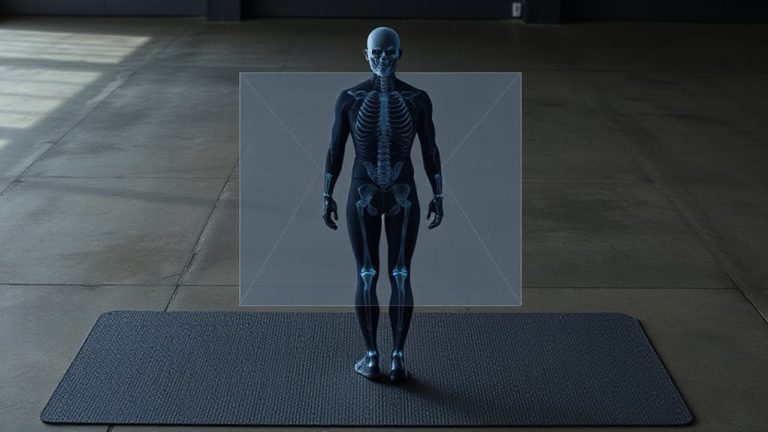
Core Bracing During Isometric Deadbugs to Enhance Lumbar Protection
You brace your core during isometric deadbugs by using the “punch in the gut” cue to activate your transverse abdominis without holding your breath. This builds 360-degree tension, supports intra-abdominal pressure, and protects your lower back. Keep your spine neutral by pressing the lower back gently into the floor and avoiding arching. Breathe deeply into your belly while maintaining tension, and avoid common mistakes like pelvic doming or over-tilting. Proper bracing trains real stability, not just passive support-there’s more to how this builds resilient strength than most realize.
Notable Insights
- Engage deep spinal stability by bracing the core as if preparing for a punch, activating the transverse abdominis efficiently.
- Maintain 360-degree core tension with diaphragmatic breathing to sustain intra-abdominal pressure and protect the lumbar spine.
- Draw the ribcage down and press the lower back gently into the floor to preserve neutral spine alignment.
- Avoid abdominal doming or excessive pelvic tilt by focusing on even, controlled muscle engagement across the core.
- Sustain active bracing throughout the hold to support spinal stability without breath holding or rigidity.
How to Brace Your Core During Isometric Deadbugs
You’ve probably tried deadbugs before, but if you’re not bracing your core properly, you’re missing the real benefit-building deep spinal stability that translates to stronger lifts and reduced injury risk. To activate the right muscles, inhale deeply, then brace as if preparing for impact, tightening your abs without holding your breath. This isn’t just about strength-it’s about abdominal coordination, syncing your diaphragm, pelvic floor, and transverse abdominis for ideal support. Proper bracing boosts neural engagement, sharpening the mind-muscle connection so your core responds automatically under load. You’ll notice better control during each limb extension, minimizing lumbar sway. Unlike passive recovery tools or compression gear that merely support externally, isometric deadbugs train active stability from within. When performed correctly, they enhance intramuscular efficiency and proprioception, making them a functional alternative to passive recovery aids. Consistency here beats flashy fitness gear-your core’s resilience hinges on technique, not accessories.
Use the “Punch in the Gut” Cue to Activate Abs
Why do some people struggle to feel their deep core engage during isometric deadbugs, even when they’re bracing correctly? The issue often lies in a lack of effective abdominal engagement. That’s where the “punch in the gut” cue comes in-it’s a powerful mental trigger that simulates sudden core contraction, helping you access the transverse abdominis more efficiently. Instead of just sucking in your stomach, visualize bracing for a surprise blow; this creates 360-degree tension. When used, this cue enhances diaphragmatic coordination by promoting a natural balance between breath pressure and core stiffness. You’ll notice improved spinal stability and better lumbar protection. Unlike passive cues, this one drives active neuromuscular recruitment, making it superior for functional core training. It’s especially useful in isometric holds where maintaining intra-abdominal pressure is key. For fitness recovery and performance gear designed to support core work, responsiveness to cues like this determines effectiveness-smart design meets precise neural feedback.
Breathe Without Losing Core Tension
How can you maintain core tension while still breathing efficiently during an isometric deadbug? You’ll need to master diaphragmatic breathing without disrupting your brace. Instead of shallow chest breaths, you draw air deep into your belly, letting it expand against your engaged core. This keeps intra-abdominal pressure high while oxygenating your muscles. Pair this with subtle pelvic tilting-slightly posterior-to stabilize the lower back and prevent compensation. Many beginners lose tension by holding their breath or over-rotating the pelvis, which defeats the exercise’s purpose. Diaphragmatic breathing, when synchronized with pelvic control, enhances endurance and lumbar protection. It’s not just about strength; it’s about coordination. Training with gear like ab rollers or stability balls won’t fix poor breathing mechanics. Master this foundational skill first, because no accessory replaces proper technique. You’ll perform longer, safer sets with real carryover to functional movement patterns.
Hold the Deadbug Position Without Arching
While maintaining a neutral spine is essential in most core exercises, it becomes absolutely critical during the isometric deadbug, where even slight lumbar arching undermines both effectiveness and safety. You must prioritize spinal alignment to protect your lower back and maximize muscle endurance gains. Focus on drawing your ribcage down and gently pressing your lower back into the floor without overarching. Engage your transverse abdominis early and sustain that tension throughout the hold.
| Cue | Purpose |
|---|---|
| Ribcage down | Prevents compensatory arching |
| Pelvis posterior tilt | Enhances spinal alignment |
| Core braced, not held | Supports muscle endurance |
Maintaining this position trains your core under load while minimizing shear forces on the lumbar spine. It’s not just about holding still-it’s about holding right. Quality reps build resilience, not just strength.
Fix These Common Bracing Mistakes
Isn’t it frustrating when you’re bracing hard but still feel like your core’s not firing right? You’re not alone-many people accidentally create abdominal doming during isometric deadbugs, a sign you’re overpressurizing the abdomen instead of engaging the deep stabilizers. That dome isn’t just a form flaw; it shifts strain onto your lower back. Another common mistake is excessive pelvic tilting, where you tuck or arch your pelvis to “feel” engagement. That movement compromises spine neutrality and reduces the exercise’s effectiveness. Instead, focus on evenly distributing tension across your entire core-think of bracing like you’re about to get tapped in the stomach. Keep your pelvis stable, ribs down, and breath controlled. Proper alignment beats exaggerated cues every time, especially when training for lumbar resilience.
Why Proper Bracing Protects Your Lower Back
Stabilizing your spine starts the moment you initiate a proper brace, and getting it right makes all the difference when protecting your lower back during isometric deadbugs. Proper bracing enhances spinal alignment and boosts intra abdominal pressure, creating a natural weight belt that supports your lumbar spine under load. Without it, unnecessary stress accumulates, increasing injury risk.
| Component | Role in Bracing | Outcome |
|---|---|---|
| Transverse abdominis | Contracts to stabilize spine | Supports spinal alignment |
| Diaphragm | Coordinates with core muscles | Optimizes intra abdominal pressure |
| Pelvic floor | Activates synergistically | Enhances overall stability |
| Rectus abdominis | Assists in tension maintenance | Reinforces trunk rigidity |
When intra abdominal pressure is properly managed, forces are distributed evenly, preserving spinal alignment. That’s not just effective training-it’s intelligent protection grounded in biomechanics. Your lower back doesn’t bear excess load; it functions as it should.
Train Your Core for Real-Life Stability
You’ve already seen how proper bracing shields your lower back by optimizing intra-abdominal pressure and aligning your spine-now it’s time to apply that foundation in ways that mirror everyday movement. Real-life stability isn’t just about strength; it’s about smart core engagement during dynamic tasks like lifting groceries or twisting to grab something. Stability training with moves like isometric deadbugs teaches your body to maintain control under subtle shifts in balance, preparing you for unpredictable motions. Unlike flashy fitness gear that promises quick fixes, these exercises build functional resilience-no equipment needed, just precision and consistency. You’re not just strengthening muscles; you’re retraining neuromuscular coordination to protect your spine. Over time, this translates to better posture, reduced injury risk, and smoother movement patterns. Forget short-term fixes: true core stability comes from disciplined practice, not gadgets. Invest in your body’s mechanics, and you’ll see lasting returns in daily performance and long-term spinal health.
On a final note
You now know how to brace correctly during isometric deadbugs, shielding your lower back by stabilizing the core like a natural weight belt. Proper tension-achieved through breath control and anti-arching-builds functional strength efficiently. Skimp on form, and you lose the benefits; master it, and you gain resilience for everyday movement. This isn’t just exercise-it’s foundational training done right, with precision that transfers directly to real-world stability and long-term spinal health.