Shoulder Mobility Drills With Wall Angels to Improve Scapular Control
Wall angels improve shoulder mobility and scapular control by using wall feedback to activate your serratus anterior and lower traps. Keep your head, upper back, and buttocks against the wall while sliding arms up and down in a controlled motion. Avoid arching your back or flaring ribs-form matters more than range. Pair them with band pull-aparts or scapular push-ups for better results. Do them 3–5 times weekly as part of warm-ups or recovery. You’ll soon discover how small adjustments access greater stability and movement efficiency.
Notable Insights
- Wall angels improve scapular control by promoting proper alignment and activation of the serratus anterior and lower trapezius.
- Maintain full back contact with the wall to enhance shoulder mobility and reduce compensatory movements during the drill.
- Perform wall angels with slow, controlled motion to reinforce scapular stability and neuromuscular coordination.
- Combine wall angels with band pull aparts to increase posterior cuff and scapular stabilizer engagement.
- Progress to foam roller-assisted wall angels to challenge proprioception and improve dynamic scapular control.
What Are Wall Angels and Why They Work

A wall angel is a foundational mobility drill that targets the shoulders, upper back, and posture-alignment system, and it works because it combines movement precision with neuromuscular re-education. You use the wall to reinforce anatomical alignment, pressing your head, shoulders, and spine against it while moving your arms through a controlled arc. This constant feedback helps correct postural drift common in daily sitting. The drill promotes proper muscular activation, especially in the serratus anterior, lower trapezius, and rotator cuff-muscles often inhibited in shoulder dysfunction. Because it emphasizes form over load, it’s ideal for recovery phases or as a warm-up. When paired with fitness gear like foam rollers or resistance bands, wall angels enhance overall shoulder function. It’s not flashy, but its effectiveness lies in consistency and attention to detail. Over time, you’ll notice improved scapular control and reduced stiffness-key markers of resilient upper-body mechanics.
Perfect Wall Angel Form: Step-by-Step

Few exercises demand as much attention to detail as the wall angel, and getting your form right makes all the difference in accessing its full recovery and mobility benefits. Start by standing with your back flat against the wall, feet slightly forward-this guarantees proper wall alignment. Your head, upper back, and buttocks should all touch the surface. Arms form a “goalpost” shape: elbows bent at 90 degrees, wrists relaxed. Press your forearms and palms gently into the wall without flaring ribs. As you slide your arms upward, maintain contact points and focus on smooth scapular positioning-your shoulder blades should glide down and in. Move slowly, resisting the urge to compensate. Keep your core engaged and chin slightly tucked throughout. Precision matters more than range; small, controlled motions build the neuromuscular control needed for shoulder health. Using this technique consistently improves mobility and supports long-term fitness recovery.
Common Wall Angel Mistakes to Avoid
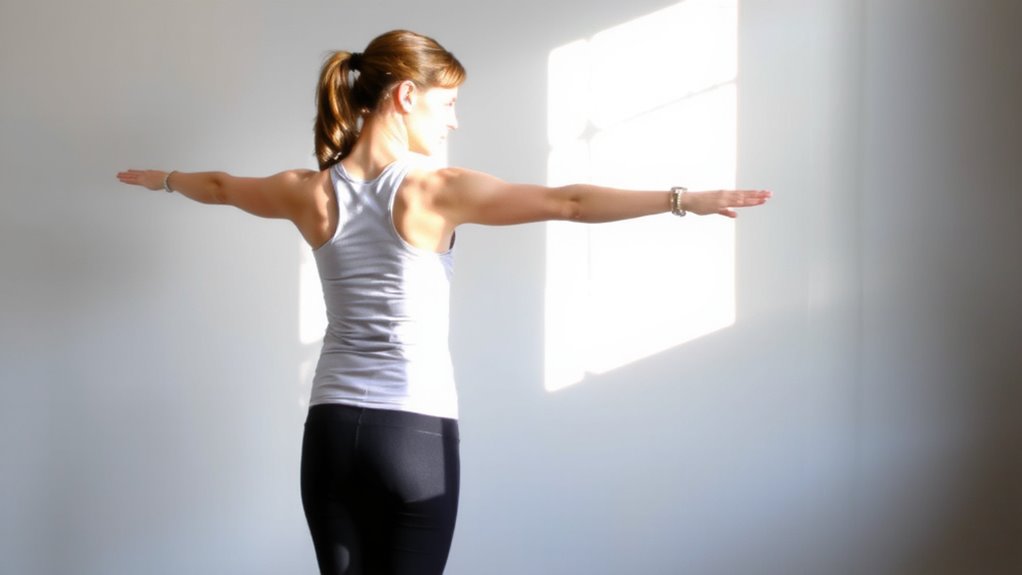
Why do so many people struggle to feel the real benefits of wall angels despite doing them regularly? You’re probably making a few key mistakes. Letting your lower back arch or heels lift disrupts alignment, reducing effectiveness and potentially worsening overhead limitations. You should maintain full contact: head, shoulders, glutes, and heels against the wall. Another common error is flaring your ribs, which encourages compensatory movement and masks scapular dyskinesis instead of correcting it. You might also rush through reps, sacrificing control-this drill is about quality, not speed. If your arms can’t move smoothly without snapping or hunching, you’re likely bypassing scapular engagement. Focus on slow, deliberate motion to retrain muscle memory. Avoid using momentum; let the wall guide proper mechanics. These corrections help guarantee you’re actually improving mobility and neuromuscular control instead of reinforcing faulty patterns.
Advanced Wall Angel Progressions for Mobility
Once you’ve mastered the basic wall angel with proper form, progressing to advanced variations isn’t just about increasing difficulty-it’s about deepening neuromuscular control and expanding functional shoulder mobility. Try performing wall angels on an unstable surface like a foam roller behind your back; this demands greater scapular precision and engages stabilizing muscles more effectively. Incorporating dynamic stretching before these progressions primes movement patterns and improves range. Slow, controlled eccentric loading during the downward phase builds tendon resilience and enhances movement efficiency. You’ll notice better joint feedback and reduced stiffness over time. These progressions challenge proprioception and coordination, making them ideal for active individuals seeking durable shoulder health. While they demand focus, the payoff-greater mobility, control, and injury resistance-is well worth the effort. Advanced wall angels aren’t just drills; they’re tools for long-term joint integrity and performance.
Best Drills to Pair With Wall Angels
How do you maximize the benefits of wall angels and translate improved shoulder mobility into resilient, functional movement? Pair them with complementary drills that reinforce scapular control and posterior chain engagement. Band pull aparts build rear delt and rhomboid strength, priming the shoulders for proper mechanics. Scapular push ups enhance protraction and retraction, deepening neuromuscular awareness. Together, these movements solidify stability across dynamic ranges.
| Drill | Purpose |
|---|---|
| Wall Angels | Improve scapular upward rotation and thoracic extension |
| Band Pull Aparts | Activate lower traps and posterior cuff |
| Scapular Push Ups | Enhance scapulothoracic rhythm and serratus anterior strength |
| Wall Slides (modified) | Reinforce glenohumeral alignment under low load |
Use this combination pre-workout to prime the upper kinetic chain-consistency with these drills sharpens control and reduces injury risk over time.
How Often Should You Do Wall Angels?
Typically, you’ll get the best results from doing wall angels 3 to 5 times per week, especially when integrated into your warm-up or recovery routine. These frequency recommendations support gradual neuromuscular adaptation, helping refine scapular control and posture. Performing them consistently enhances mobility and reduces tension from prolonged sitting. The consistency benefits include improved movement efficiency and decreased risk of shoulder impingement over time. Aim for 2–3 sets of 10–12 reps with controlled motion, focusing on maintaining contact at the head, upper back, and hips. You don’t need fitness gear-just a flat wall and proper form. While some recovery tools like foam rollers can complement your routine, wall angels work best when performed regularly without reliance on accessories. Over time, you’ll notice better alignment and shoulder resilience, especially if you pair the drill with other mobility work. Keep it simple, stay consistent, and let frequency do the work.
On a final note
You’ll find wall angels highly effective for building scapular control and shoulder mobility when performed with precision. Paired with complementary drills and consistent form, they support long-term joint health. Quality recovery gear-like foam rollers or resistance bands-enhances results by maintaining tissue quality and range. Done 3–4 times weekly, wall angels fit seamlessly into rehab or performance routines, offering measurable improvements in posture and movement efficiency over time.