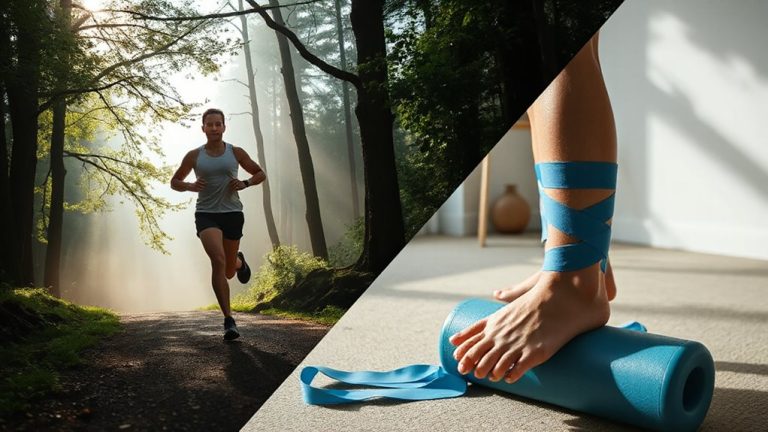
Exploring Advanced Techniques for Ligament Damage Recovery in Contact Sports Enthusiasts
You’re not just healing slower with traditional RICE methods-you’re risking residual weakness and reinjury. PRP therapy speeds recovery by using your own platelets to fuel tissue repair, while stem cell injections offer regeneration for more serious damage. Combined with biometric-guided rehab, these treatments adapt to your body’s needs. When matched to your injury level, they don’t just restore function-they optimize it. The right path ahead fine-tunes science to your sport’s demands.
Notable Insights
- PRP therapy accelerates ligament healing by delivering concentrated growth factors directly to the injury site.
- Stem cell injections promote tissue regeneration and reduce inflammation in moderate to severe ligament damage.
- Customized rehab using biometric wearables optimizes recovery by addressing individual movement patterns and imbalances.
- Compression sleeves enhance proprioception and provide support during early-stage ligament rehabilitation.
- Integrated treatment plans combining biologics, surgery, and real-time monitoring shorten recovery timelines for athletes.
The Limits of Traditional Ligament Recovery
While traditional methods like rest, ice, compression, and elevation have long been the go-to for ligament recovery, they often fall short when it comes to restoring full joint stability and function. You might follow the protocol exactly, but if you’re dealing with underlying genetic predisposition or unfavorable age factors, healing can stall. These biological variables influence collagen production and tissue elasticity, making recovery slower and less complete. Traditional rehab rarely accounts for such individual differences, relying instead on one-size-fits-all timelines. Even with top-tier fitness gear-like braces or compression sleeves-support is temporary and doesn’t address internal healing. You may regain mobility, but without targeted intervention, residual weakness often remains. That’s why more athletes are questioning whether standard protocols are enough, especially when returning to high-impact activities. The reality is, RICE stabilizes, but it doesn’t always rehabilitate. A properly fitted compression sleeve can enhance blood flow and provide proprioceptive feedback during rehabilitation.
How PRP Therapy Speeds Ligament Healing
Because your body already holds the tools to heal damaged tissue, PRP therapy leverages that natural potential by concentrating platelets from your own blood and injecting them directly into the injured ligament. This concentrated dose releases a surge of growth factors that kickstart cellular activation, speeding up tissue repair. You’ll likely notice reduced pain and improved function faster than with rest alone. While results vary, many contact sport athletes report returning to training quicker, with fewer setbacks. It’s minimally invasive, uses your body’s own biology, and avoids synthetic substances. Still, it’s not a magic fix-optimal outcomes depend on proper diagnosis, injection accuracy, and post-treatment rehab. Combined with smart recovery practices and quality fitness gear that supports joint stability, PRP can be a valuable tool. It won’t replace surgery when needed, but it enhances your body’s innate healing timeline.
Stem Cell Injections for Ligament Tissue Regeneration
Stem cell injections take regenerative recovery a step further by introducing cells capable of developing into new ligament tissue, offering a promising option for those dealing with moderate to severe ligament damage. You might benefit from this therapy because it harnesses the body’s natural repair mechanisms through cell differentiation, allowing stem cells to transform into the specific ligament cells needed for healing. These injections also support immune modulation, reducing inflammation that can hinder recovery. Unlike basic treatments, stem cells actively contribute to tissue regeneration rather than just managing symptoms. While still evolving, current results show improved healing in athletes with chronic injuries, especially when combined with structured rehab. It’s not a quick fix, but for you-someone serious about long-term joint stability and performance-stem cell therapy could be a strategic investment. Risks exist, but its regenerative potential stands out in sports medicine.
Customizing Rehab With Biometric Feedback
How do you know your rehab is hitting the right targets? With wearable sensors, you get precise data on movement, muscle activation, and joint stress-right when it happens. These devices sync seamlessly with platforms offering real time analytics, turning raw motion data into actionable insights. You’re not guessing if your form’s correct; you see it instantly. For contact sports enthusiasts, this means rehab tailored to your unique biomechanics, not generic routines. Wearable sensors track progress daily, adjusting load and range of motion based on actual performance. The tech spots imbalances before they cause setbacks, making recovery smarter and safer. While not all fitness gear delivers equal accuracy, validated systems provide reliable feedback essential for ligament healing. Real time analytics help therapists tweak exercises on the fly, ensuring you stay in the therapeutic sweet spot. This level of customization doesn’t just speed recovery-it builds stronger, more resilient movement patterns.
Integrating Advanced Therapies With Surgery
What if your recovery could start before you even leave the surgical suite? Now, surgeons are integrating gene therapy directly into ligament repair procedures, prompting cells to regenerate faster and with greater structural integrity. You’re not just healing-you’re rebuilding smarter. Combined with wearable sensors, this approach lets your medical team monitor inflammation, load distribution, and tissue formation in real time. These devices sync to your phone, giving you instant feedback on movement quality and compliance. While gene therapy is still emerging, early results show reduced scar tissue and stronger collagen alignment. Wearable sensors, meanwhile, are already proven in elite athlete rehab-offering objective data over guesswork. Together, they close the gap between surgery and active recovery, making the process more precise. For contact sport athletes, that means smarter healing from day one.
Recovery Timelines: PRP vs. Stem Cells in Athletes
You’re already seeing how real-time data and cutting-edge surgical integrations can reshape recovery-now consider how the therapies you choose post-op can directly influence your return-to-play clock. With PRP, concentrated growth factors from your own blood accelerate healing, often shortening recovery to 6–12 weeks for moderate ligament injuries. It’s less invasive and cost-effective, but effects vary based on your platelet concentration and injury severity. Stem cell therapy, meanwhile, introduces cells capable of robust tissue regeneration, enhancing cellular turnover more profoundly. Athletes with high-grade tears often see greater structural repair, though timelines stretch to 12–16 weeks due to complex processing and integration. While both leverage your body’s biology, stem cells may offer superior remodeling in severe cases. Still, PRP remains a pragmatic first-line option for many. Your choice shapes not just healing speed, but long-term joint resilience and functional performance on the field.
How to Match Your Injury to the Best Recovery Option
Where do you draw the line between a quick comeback and lasting joint integrity? It starts with accurate injury classification and smart recovery mapping. Not all ligament damage is the same-your treatment should reflect that. Below is a guide to match your injury grade with ideal recovery paths:
| Injury Classification | Recovery Option | Expected Timeline |
|---|---|---|
| Grade I (Mild) | PRP + bracing | 3–6 weeks |
| Grade II (Moderate) | Stem cells + rehab | 8–12 weeks |
| Grade III (Severe) | Surgery + biologics | 4–6 months |
| Chronic instability | Combined therapy | 6+ months |
You’ll boost outcomes by aligning therapy with injury severity. PRP works well for mild tears, but higher-grade injuries demand deeper intervention. Recovery mapping isn’t one-size-fits-all-it’s about precision. Use diagnostics first, then match the method to your ligament’s needs.
On a final note
You’ve seen how advanced recovery methods like PRP and stem cell therapy can markedly shorten healing time, especially when paired with biometric-guided rehab. While traditional protocols remain reliable, these innovations offer faster, more targeted ligament repair-particularly valuable in contact sports. Though costs and access vary, integrating such therapies with surgery often boosts outcomes. For serious athletes, combining cutting-edge medicine with smart, personalized rehab is quickly becoming the gold standard in effective, efficient recovery.