Tai Chi Brush Knee Twist Variation for Golfers With Right-Side Dominance Strain
You’re likely carrying excess tension from right-side dominance, which throws off your swing’s symmetry and strains your spine. The Tai Chi Brush Knee Twist helps rebalance that by promoting even weight shifts and controlled spinal rotation. Perform it slowly, engaging your core, keeping your knee aligned over your ankle, and rotating smoothly to retrain movement patterns. This variation specifically counters golf-related imbalances, enhancing joint mobility and swing efficiency-especially when paired with supportive recovery mats and flexible gear. You’ll soon discover how small adjustments amplify overall resilience and performance.
Notable Insights
- Focus on initiating weight shift to the left leg to counter right-side dominance and promote balanced loading.
- Engage core during exhalation while brushing knee to enhance spinal control and reduce compensatory strain.
- Maintain knee-over-ankle alignment to support joint integrity and improve lower-body symmetry.
- Emphasize slow, full rotation of the hips to mirror golf swing kinematics and restore mobility.
- Integrate into pre-round warm-ups to prime neuromuscular system for balanced, efficient rotational movement.
Why Right-Side Dominance Hurts Your Golf Swing
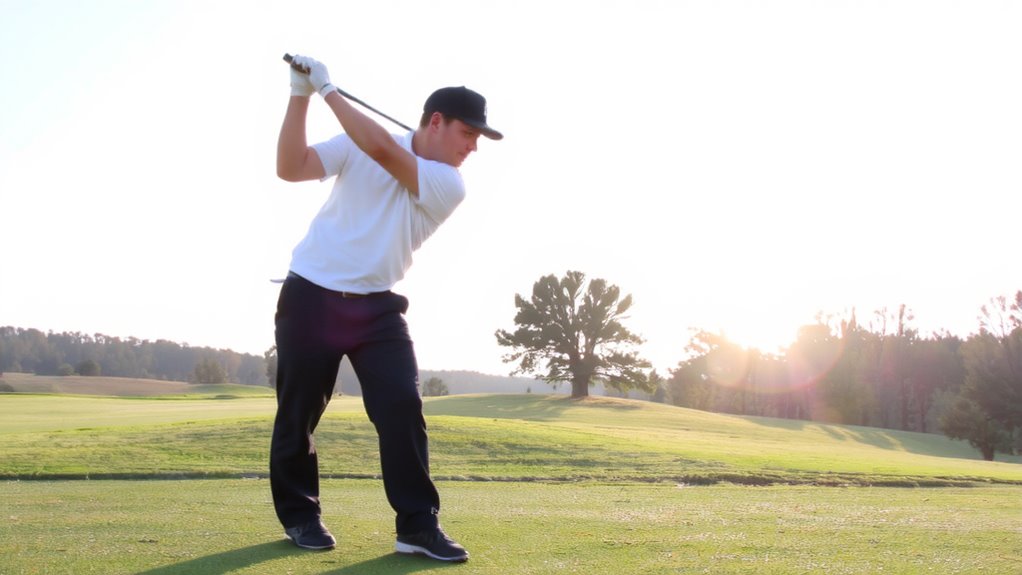
Ever wonder why your golf swing feels off even after hours of practice? Right-side dominance likely plays a key role, especially if you’re a right-handed golfer. When one side of your body consistently overpowers the other, it creates a core imbalance that disrupts symmetry in your swing mechanics. This imbalance forces your left side to compensate, limiting power and increasing rotational strain through your spine and hips. Over time, this strain reduces swing efficiency and raises injury risk. Unlike generic fitness gear that only builds strength, recovery-focused tools should address neuromuscular coordination and bilateral symmetry. High-performance recovery isn’t just about rest-it’s about correcting movement patterns. Ignoring dominance-driven imbalances undermines even the most disciplined practice routines. To truly enhance performance, you must first identify how asymmetry distorts force distribution. Without addressing core imbalance, you’re training harder, not smarter-and rotational strain will keep holding your game back.
How the Tai Chi Brush Knee Twist Relieves Swing Tension
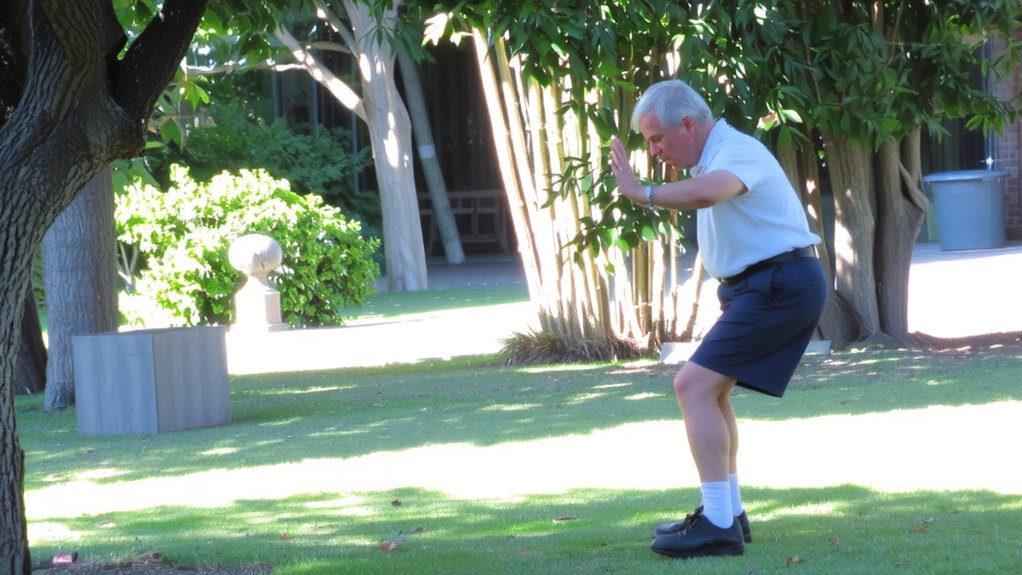
Right-side dominance creates asymmetrical tension that accumulates through your spine, hips, and shoulders, especially during repetitive rotational motions like the golf swing. The Tai Chi Brush Knee Twist counteracts this by promoting balanced weight shifts and spinal rotation, directly improving your swing mechanics. As you move through the twist, your torso unwinds with controlled fluidity, releasing stored tension while enhancing joint mobility. This motion encourages efficient energy transfer from the lower body up through the core and into the arms-mirroring the kinetic sequence of a peak golf swing. Practiced regularly, the movement retrains neuromuscular patterns, reducing compensatory strains. Unlike passive recovery tools, this active technique integrates mobility, stability, and coordination, making it more effective than foam rolling or static stretching alone. It doesn’t just ease discomfort-it rebuilds movement integrity. Over time, you’ll notice smoother progressions, reduced stiffness, and a more resilient kinetic chain, all critical for consistent, powerful shots.
Do the Brush Knee Twist Safely: A Step-by-Step Guide
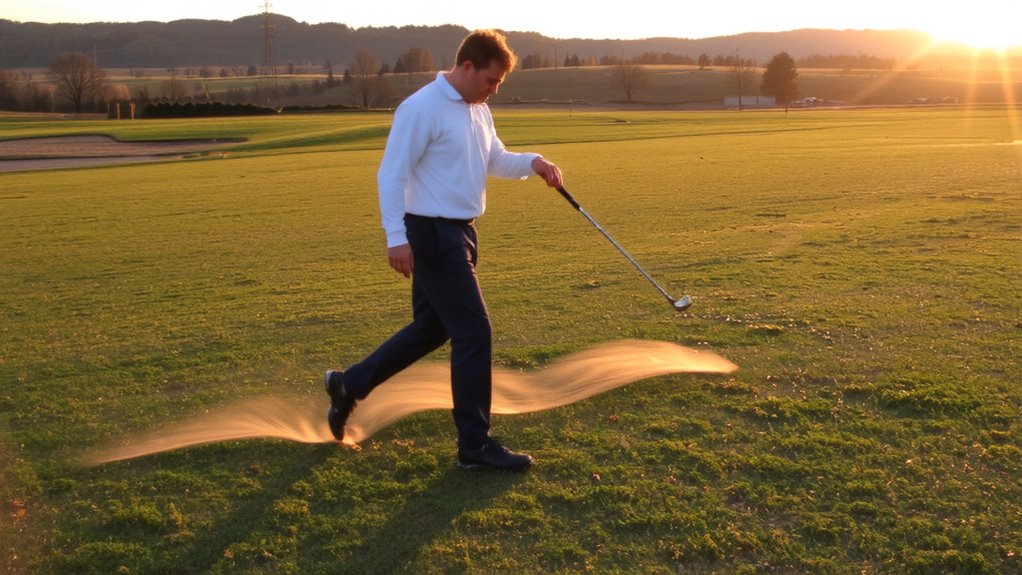
How do you guarantee your practice of the Brush Knee Twist enhances recovery without introducing strain? Focus on proper alignment and controlled breathing throughout each movement. Begin slowly, coordinating breath with motion to stabilize your core and support joint integrity. Maintain a neutral spine and relaxed shoulders to avoid overexertion. Choosing the right attire, such as moisture-wicking and flexible running joggers, can further support unrestricted movement during practice.
| Step | Movement Focus | Breath & Alignment Tip |
|---|---|---|
| 1 | Shift weight smoothly to one leg | Inhale deeply, align pelvis over heel |
| 2 | Gently brush knee upward | Exhale, engage core, keep spine long |
| 3 | Twist torso slightly, arms flowing | Inhale mid-twist, maintain hip stability |
| 4 | Return to center with control | Exhale fully, reset posture, breathe evenly |
These steps support muscular recovery and neuromuscular re-education, especially when practiced on supportive flooring or recovery mats that enhance balance and reduce joint load.
Avoid These Common Brush Knee Twist Mistakes
Why do some golfers walk away from the Brush Knee Twist feeling tighter instead of looser? Often, it’s due to incorrect alignment and an uneven weight shift. You might be leaning too far forward or letting your front knee collapse inward, straining the joint instead of releasing tension. This misalignment disrupts the flow of movement and reduces the stretch’s recovery benefits. An uneven weight shift-favoring your dominant right side, for example-creates imbalance, limiting mobility on the weaker left. You’re not just warming up; you’re reinforcing old patterns. Proper form means stacking the knee over the ankle and rotating the hips smoothly. That even shift from back leg to front is vital. Without it, the exercise loses its rehabilitative edge. For golfers seeking fitness recovery, precision matters. Correct these faults, and you’ll notice better joint lubrication, improved balance, and a looser swing.
Add the Brush Knee Twist to Your Pre-Round Warm-Up
While you’re lacing up your golf shoes and reaching for your favorite driver, don’t overlook the value of a smart warm-up that primes your body for rotation and balance-especially one that includes the Brush Knee Twist. This movement sharpens your pre round focus and builds dynamic balance, key for a controlled backswing. Performed slowly and with intent, it activates the hips and spine, easing tension from daily habits that skew your swing. Pair it with breathable, flexible gear that supports range of motion, and you’ll notice smoother shifts from stance to follow-through.
| Phase | Body Engagement |
|---|---|
| Step forward | Front hip opens, knee aligned |
| Hand arc | Opposite hand brushes imaginary knee |
| Twist through spine | Thoracic rotation over stable pelvis |
| Weight shift | Dynamic balance maintained heel to toe |
Build Balanced Swings With Daily Brush Knee Twists
You’ve already started using the Brush Knee Twist to prepare your body before stepping onto the first tee, but doing it daily can take your swing consistency to another level. Performing this movement each day enhances joint mobility, especially in your hips and thoracic spine-areas often restricted in right-side dominant golfers. Improved mobility supports smoother weight transfer and rotation, directly influencing swing symmetry. Over time, regular practice counters muscular imbalances caused by repetitive one-sided swings. You’ll notice a more centered pivot, reduced strain on your lead knee, and better follow-through control. Unlike passive recovery tools, this active exercise integrates neuromuscular coordination, making it more effective than foam rolling or static stretching alone. While fitness gear like resistance bands may辅助 the motion, they’re not necessary. The move’s simplicity and low time commitment-just 5 minutes daily-make it sustainable. Equipment flexibility and body awareness go hand in hand, letting you build resilience without added cost or complexity.
On a final note
You’ve likely felt how right-side dominance tightens your swing, but the tai chi brush knee twist counters that imbalance effectively. Regular practice improves rotational control and reduces strain. Paired with quality recovery gear-like supportive mats and posture aligners-this movement aids long-term joint health. It’s not a quick fix, but a sustainable method. You’ll notice smoother turns and fewer aches. Done correctly, it belongs in every golfer’s routine.