Negative Split Elliptical Workouts Where Effort Decreases Every Five Minutes
You’re doing it backward to get it right-starting strong and easing into each five-minute segment lets you build endurance without burning out. A negative split elliptical workout, where effort drops progressively, conserves energy early and sharpens aerobic efficiency. It’s smarter recovery, reducing joint strain and supporting taper phases. You’ll see better pacing, faster clearance of lactate, and smoother shifts-ideal post-long run or pre-race. Stick with it, and you’ll discover how less really becomes more.
Notable Insights
- A negative split elliptical workout starts at moderate intensity and gradually reduces effort every five minutes.
- Begin the first 10 minutes at around 80% max effort to build endurance and conserve energy.
- In the second 10 minutes, progressively decrease resistance and stride rate to lower intensity.
- This structure aids recovery by minimizing joint strain and preventing early burnout.
- Use responsive resistance controls to ensure smooth transitions and precise effort reduction every five minutes.
What Is a Negative Split Elliptical Workout?
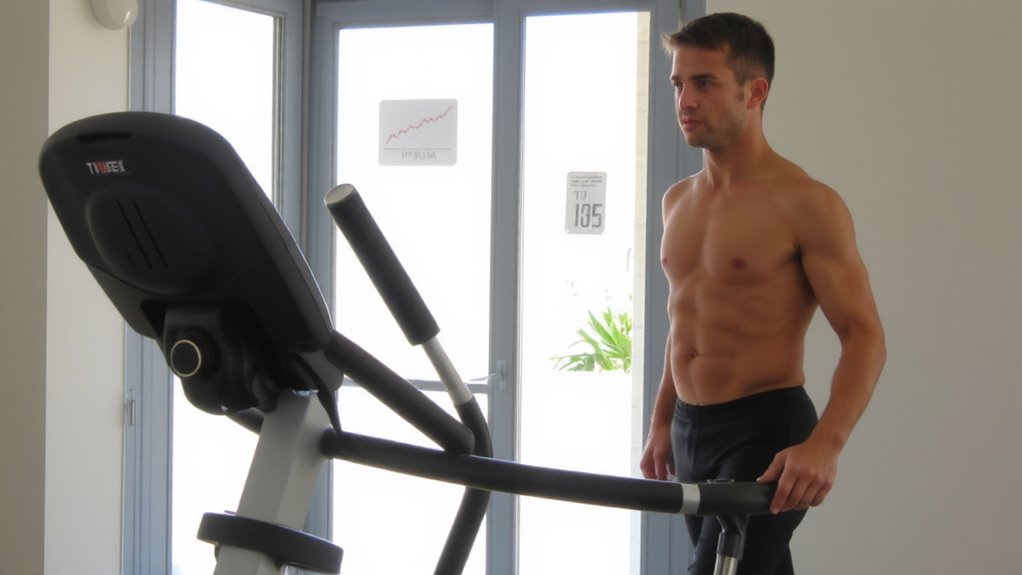
While you might already be familiar with steady-state cardio on the elliptical, a negative split workout flips the script in a way that can boost both performance and recovery. You start at a moderate intensity, then gradually increase your pace progression over time, finishing stronger than you began. What sets it apart is the intentional effort reduction earlier in the session, allowing your body to conserve energy for a powerful back half. Unlike constant-output routines, this method aligns better with how elite endurance athletes train-strategically managing exertion. On reliable ellipticals with accurate resistance calibration, you’ll notice smoother shifts and better cardiovascular feedback. This approach doesn’t just challenge fitness capacity; it promotes smarter muscle engagement and joint-friendly output. For recovery-focused users, the lower initial load decreases strain while still maintaining aerobic benefit. With consistent use, pace progression and effort reduction together support sustainable training patterns, making negative splits a practical upgrade from flat, monotonous sessions.
Why a Negative Split Builds Real Endurance

You’re already seeing how starting slower and finishing stronger reshapes your elliptical sessions. This negative split approach triggers real physiological adaptation by gradually stressing your cardiovascular system without overwhelming it early. By holding back at first, you conserve energy and delay the onset of muscular fatigue, allowing you to push harder in the final minutes. That sustained effort trains your body to perform efficiently under increasing demand, mimicking real-world endurance challenges. Unlike all-out starts that lead to early burnout, the negative split optimizes oxygen utilization and lactate clearance, enhancing aerobic capacity over time. It’s not just about willpower-it’s smart design. This method reflects how quality fitness gear supports intelligent training: durable, responsive machines let you focus on pacing, not mechanics. Over weeks, you’ll notice deeper stamina gains because your body adapts to sustained, progressive workloads-precisely what builds legitimate endurance.
How to Plan Your 20-Minute Negative Split

Since pacing is everything on the elliptical, splitting your 20-minute session into two distinct 10-minute blocks makes the strategy both manageable and effective. Start strong but controlled-maintain steady interval pacing in the first 10 minutes, targeting about 80% of your max effort. This builds endurance without burning out. For the next 10 minutes, gradually dial back resistance and stride rate, letting your heart rate ease. This progressive cooldown enhances recovery and reduces muscle fatigue. By lowering effort every five minutes, you train your body to handle decreasing intensity efficiently. It’s not just about finishing strong-it’s about managing output intelligently. Quality fitness gear with responsive resistance controls helps maintain precise interval pacing. A good elliptical’s smooth motion supports the progressive cooldown, making recovery active, not passive. This approach optimizes cardiovascular benefit while preparing your body for long-term performance. A compact design ensures the machine fits seamlessly into home spaces, making consistency easier with best compact ellipticals.
Mistakes That Ruin Your Negative Split
Starting your negative split with too much intensity right out of the gate can undo the careful pacing you’ve set up, turning a structured 20-minute session into a race you’re bound to regret by minute 12. You’re not maximizing performance-you’re inviting improper pacing, which sabotages the entire effort. When you push too hard early, your heart rate spikes, recovery time increases, and overtraining risks climb. That means fatigue accumulates faster, potentially affecting your next workout or disrupting sleep. You’re also putting unnecessary strain on your joints, especially if you’re logging daily elliptical sessions without adjusting resistance or cadence. The goal is controlled progression, not burnout. Stick to a lower RPE (rate of perceived exertion) in the first segment and gradually ease down-not up. This guarantees you finish strong while supporting fitness recovery. Properly executed, the negative split improves endurance with less wear and tear on your body and equipment.
When to Use Negative Splits in Your Training
How often should you integrate negative splits into your training, and under what conditions do they deliver the best results? Use them weekly to support recovery timing and boost workout consistency. These sessions work best when you’re coming off intense training blocks or preparing for endurance events. They ease metabolic stress while maintaining cardiovascular output, making them ideal during taper phases or active recovery weeks.
| Scenario | Benefit |
|---|---|
| Post-long run | Enhances recovery timing |
| Weekly routine | Improves workout consistency |
| Pre-race week | Maintains fitness, reduces fatigue |
| Overtraining risk | Lowers strain, supports adaptation |
They’re not for every day, but when timed right, negative split elliptical workouts help regulate intensity. They let you stay consistent without taxing joints or muscles. Choose controlled resistance and focus on smooth shifts between intervals. These sessions complement fitness recovery strategies and pair well with reliable elliptical gear designed for steady performance.
On a final note
You’ll find negative split elliptical workouts sharpen endurance by pacing effort strategically, not pushing blindly. As intensity decreases every five minutes, your body adapts to sustained output, enhancing aerobic efficiency. Paired with quality fitness gear-like cushioned shoes and well-maintained machines-these sessions reduce joint stress while maximizing performance. Recovery improves when workouts respect physiological limits, making this approach both effective and sustainable for long-term fitness.