Functional Single-Leg Stability Drills With Eyes Closed for Proprioception
You boost balance fast by standing on one leg with eyes closed-this simple drill sharpens proprioception by cutting visual input and forcing your body to rely on joint and muscle feedback. It builds neural control, stability, and quick reflex corrections. Add arm swings or toe taps to challenge coordination, or stand on a foam pad to heighten difficulty. These equipment-free drills enhance functional movement and injury resilience. Practical gains emerge within weeks, especially when integrated daily-there’s more to uncover about refining these skills progressively.
Notable Insights
- Perform single-leg balances with eyes closed to enhance proprioception by removing visual input.
- Focus on even weight distribution across the foot to improve joint alignment and stability.
- Add arm swings during single-leg stance to increase core engagement and dynamic control.
- Incorporate forward or sideways toe taps with eyes closed to challenge balance and coordination.
- Use foam pads or pillows to amplify difficulty and refine neuromuscular responses on unstable surfaces.
Start With a Basic One-Leg Balance, Eyes Closed
Close your eyes and stand on one leg-this simple yet powerful move forces your body to rely entirely on proprioception, the internal sense of joint position and movement. Without visual cues, your nervous system must fine-tune feedback from muscles and ligaments to maintain balance. Proper foot alignment is essential; distribute weight evenly across the ball of your foot, heel, and toes to prevent inward or outward rolling. Poor alignment compromises joint stability, increasing strain on the ankle and knee. This drill enhances neuromuscular control, a foundational skill for functional movement. While recovery-focused fitness gear like balance pads can amplify difficulty, they’re unnecessary at first. Begin on a firm, non-slip surface to guarantee accurate feedback. Consistent practice improves joint stability over time, aiding injury prevention and post-exercise recovery. This low-tech, high-return drill is a reliable benchmark for evaluating and developing true proprioceptive competence.
Close Your Eyes to Boost Proprioception Fast
Why rely on sight when your body already has an internal navigation system? Closing your eyes during single-leg drills forces your brain to depend on neural feedback from joints, tendons, and muscles-bypassing visual crutches. This shift accelerates proprioception because your nervous system must process subtle shifts in alignment instantly. Without sight, your body taps deeper into muscle memory, refining movement patterns through repetition under sensory challenge. Over time, this builds more accurate, automatic responses to instability. Functional gear like balance pads or foam surfaces can enhance the effect, but aren’t mandatory-your body’s innate feedback loop is the real tool. Though simple, this method is scientifically sound and time-efficient. Consistent practice yields noticeable gains in control and joint awareness within weeks. Closing your eyes isn’t just a tweak-it’s a fast, effective way to upgrade neuromuscular precision and movement intelligence where it counts: beneath the surface.
Feel How Balancing on One Leg Trains Your Nerves
While you’re standing on one leg, your nervous system is actively decoding tension, joint angle, and micro-adjustments in real time-transforming a simple pose into a dynamic nerve-training session. This isn’t just balance practice; it’s neural adaptation in action. Your brain fine-tunes signals to muscles, improving reaction speed and coordination. Over time, these frequent corrections build muscle memory, making stability feel automatic. Even subtle shifts become easier as your body learns ideal firing patterns. You’re not just strengthening muscles-you’re rewiring movement efficiency. The result? Better control during daily tasks or sports, especially when fatigue sets in. Closed eyes intensify this effect, forcing reliance on internal feedback over visual cues. Consistent single-leg work conditions your nervous system to respond faster and more accurately, enhancing proprioception. It’s low-impact, requires no gear, and delivers measurable gains in functional fitness. Simple, yes-but physiologically profound.
Add Arm Swings or Toe Taps to Level Up
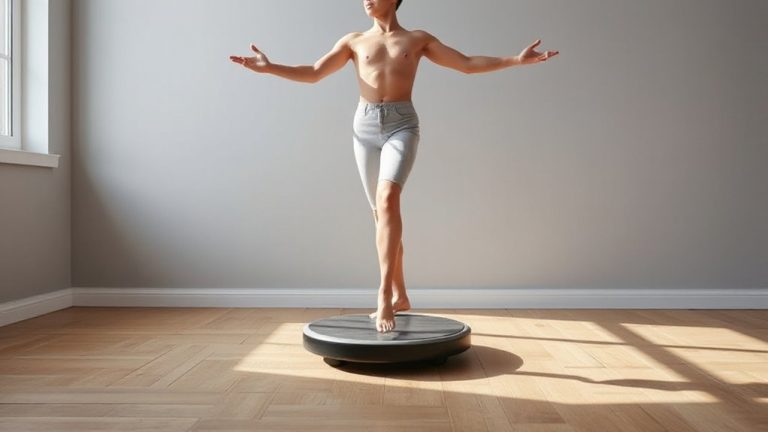
Challenge meets control when you introduce arm swings or toe taps into your single-leg stance. These small additions markedly boost arm coordination and dynamic stability, sharpening your body’s ability to respond during complex movements. Swinging your arms while standing on one leg forces your core and hips to adjust in real time, improving neural efficiency. Toe taps-lifting and touching the free foot forward or sideways-add a cognitive layer, demanding greater focus and precision. Both variations heighten proprioceptive feedback, especially with eyes closed, as your nervous system works harder to maintain equilibrium. They’re low-risk, equipment-free drills that fit seamlessly into warm-ups or recovery routines. Unlike gimmicky fitness gear, these progressions use your body weight smartly, promoting sustainable balance gains. You don’t need resistance bands or weighted cuffs-just consistency and attention to form. When done regularly, they build resilient movement patterns that translate to better performance and injury resilience.
Challenge Your Balance With a Pillow or Foam Pad
Standing on one leg already asks your body to adjust and stabilize, but toss a pillow or foam pad into the mix and things get meaningfully harder. These unstable surfaces disrupt your usual sensory feedback, forcing your proprioceptors to work overtime. Without firm ground underfoot, your muscles and joints must constantly correct your position, sharpening neuromuscular control. A foam pad offers consistent density, making it reliable for repeated drills, while a pillow sinks unpredictably-great for advanced challenges. Both tools are low-cost and portable, fitting easily into home routines. Over time, training on unstable surfaces improves joint stability and reduces injury risk. Though simple, they demand focus and control you won’t get on solid ground. For eyes-closed drills, they amplify the difficulty efficiently. Just make certain the surface beneath stays non-slip to prevent accidents during use. For consistent results, consider using a high-quality foam roller designed for balance and stability training.
Make Drills Practical: Add Motion and Surfaces
Since balance isn’t tested in stillness alone, you’ll want to introduce movement and varied surfaces to make your single-leg drills truly functional. Start by incorporating dynamic movement-like reaching your arms forward or shifting your hips-while standing on one leg. This challenges your proprioception more effectively than static holds. Then, progress to uneven terrain using tools like balance discs, foam pads, or outdoor grassy or gravel patches. These surfaces force your stabilizing muscles to adapt continuously, improving joint awareness and control. Uneven terrain amplifies the drill’s difficulty without requiring added weight, making it efficient and low-impact. You’ll notice sharper neuromuscular responses over time. Dynamic movement paired with unstable surfaces mirrors real-world demands, enhancing coordination and reducing injury risk. The right gear-firm yet yielding foam, durable balance boards-supports consistent training, though natural environments offer unpredictable but valuable feedback.
Fit Single-Leg Balances Into Your Daily Routine
You’ve already built a solid foundation by adding movement and unstable surfaces to your single-leg drills, sharpening your body’s ability to respond to shifts in balance. Now, focus on daily integration-embedding these drills into routine habits guarantees lasting gains in proprioception. Short, frequent bouts work best, requiring minimal time or equipment. Below are practical moments to incorporate them:
| Activity | Duration | Proprioception Benefit |
|---|---|---|
| Brushing teeth | 2 min | Enhances focus & ankle control |
| Waiting for coffee | 1 min | Builds neural adaptation |
| Standing in line | 2–3 min | Improves weight distribution |
| Post-work stretch | 3 min | Reinforces stability patterns |
| Midday break | 2 min | Reduces sedentary deconditioning |
These micro-sessions accumulate, reinforcing neuromuscular pathways without disrupting your flow. Consistent routine habits like these yield better long-term function than isolated gym sessions.
On a final note
You’ll find these single-leg drills, especially with eyes closed, sharpen proprioception quickly by forcing reliance on inner-ear balance and neuromuscular feedback. They’re low-equipment but high-return, building joint stability and control. When paired with proper recovery-like foam rolling and sleep-progress compounds. Fitness gear like foam pads adds variability, but isn’t essential. Consistency matters more than gear. These drills work because they mimic real movement demands, enhancing coordination where it counts.