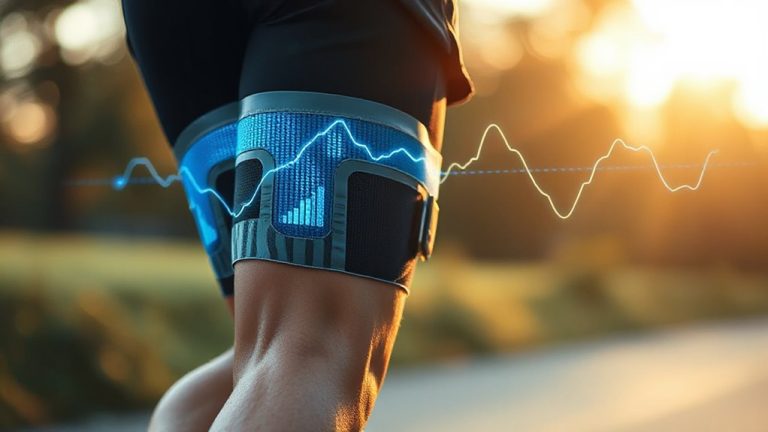
How Wearable Muscle Microtear Detectors Use Acoustic Emission Sensing
Your wearable detects muscle microtears by capturing faint acoustic emissions-tiny sound waves released when fibers tear under strain. Using sensitive skin-contact sensors and frequency filtering, it isolates these signals from noise and maps their origin. Onboard processing identifies dangerous stress patterns, triggering real-time alerts if damage risk spikes. It’s a smarter approach than heart rate or soreness tracking, giving you objective data to adjust training. You’ll see how this tech evolves to predict issues before they start.
Notable Insights
- Wearable detectors capture inaudible acoustic emissions from microscopic muscle tears during physical strain.
- Embedded sensors pick up sound signals generated by muscle fiber damage through the skin.
- Sound mapping technology localizes the source of acoustic emissions on the body for precise monitoring.
- Frequency filters isolate injury-related sound frequencies and remove ambient noise for accurate detection.
- Real-time signal analysis identifies microtear indicators like frequency shifts and amplitude spikes to trigger alerts.
What Are Muscle Microtears: And Why Detection Matters?
Tiny damage in your muscles-microtears-sounds bad, but it’s actually a natural part of building strength. When you push through tough workouts, these small tears trigger your body’s muscle recovery process, repairing fibers to become denser and more resilient. This is the core of training adaptation: your muscles don’t grow during exercise, but in the hours after, when rest and nutrition take over. Without proper recovery, though, microtears accumulate and increase injury risk. That’s where fitness recovery tools matter-especially smart gear that monitors your body’s response. While not all wearables deliver accurate insights yet, the best ones help you avoid overtraining by aligning workouts with your body’s repair cycle. They don’t replace experience, but they offer data to refine decisions. When used wisely, such devices support smarter training adaptation and more effective, sustainable progress.
How Wearables Detect Microtears Using Sound
How do your muscles really respond to strain during a workout? When fibers tear microscopically, they emit faint acoustic signals-tiny pops and cracks-inaudible to the ear but detect vilable by advanced wearables. These devices use embedded sensors to capture the sound emissions directly from your skin. Through sound mapping, the system pinpoints where these signals originate, differentiating normal muscle noise from concerning microtear patterns. Frequency filtering plays a key role by isolating the specific ranges linked to tissue damage, while discarding irrelevant background noise like movement or ambient sound. This targeted approach guarantees accuracy, reducing false alerts. Compared to older recovery trackers, these wearables offer a more precise, real-time glimpse into muscle stress. They’re not perfect-placement and skin contact affect performance-but for serious athletes, the insight into actual tissue behavior makes them a valuable upgrade in fitness recovery tech.
How the Device Turns Sound Into Injury Alerts
What happens when the subtle sounds of stressed muscle fibers are captured in real time? The wearable immediately sends that raw acoustic data to its onboard processor, where signal processing turns noise into meaningful patterns. You’re not just hearing sound-you’re tracking microtear formation through frequency shifts and amplitude spikes. Advanced alert algorithms analyze this processed data, distinguishing normal strain from dangerous stress levels. If thresholds are exceeded, the device triggers a real-time alert to your phone or smartwatch. These algorithms adapt to your activity type, ensuring runners don’t get false alarms during sprints while still catching early signs of overexertion. The system’s precision hinges on calibrated sensitivity, avoiding nuisance alerts without missing risks. Though no sensor is perfect, consistent signal processing improves injury prediction. For serious training, this feedback loop offers actionable insight, letting you adjust form or intensity before damage sets in.
Who Benefits Most From Real-Time Microtear Monitoring
You’re already tracking strain through sound, but knowing who gains the most from this kind of early warning system can shape how you use it. Real-time microtear monitoring offers game-changing advantages in athlete recovery and training optimization, especially for those pushing physical limits. Whether you’re a pro athlete, rehab patient, or fitness enthusiast, catching microtears early prevents serious injury and sharpens performance.
| User Group | Benefit Focus | Key Use Case |
|---|---|---|
| Elite Athletes | Training optimization | Adjust workouts before overuse |
| Weekend Warriors | Injury prevention | Avoid strain during peak effort |
| Rehab Patients | Athlete recovery | Monitor progress safely |
These wearables don’t just detect-they guide smarter movement. By integrating acoustic feedback into training routines, you gain precision that accelerates recovery and maximizes effort without guesswork.
What’s Next for Wearable Injury Prevention Tech
Where might the next leap in wearable injury prevention take you? You’re already tracking muscle microtears with acoustic emission sensors, but soon, real-time biomechanical feedback will guide your form mid-lift or mid-stride. These wearables won’t just detect strain-they’ll anticipate it. Using predictive analytics, they’ll analyze movement patterns over time, flagging subtle deviations that precede injury. Envision your smart garment warning you before a hamstring tears, not because it sensed damage, but because your gait shifted 3% off baseline. Future models will sync with training apps to adjust workout intensity automatically. They’ll learn your body’s rhythms, making prevention proactive, not reactive. Biomechanical feedback loops will close faster, with haptic cues correcting posture in real time. This isn’t sci-fi-it’s the next iteration. As materials get smarter and algorithms refine, the gear won’t just monitor; it’ll mentor, keeping you at peak performance without crossing into danger.
On a final note
You’re now able to track muscle stress before it becomes injury, thanks to wearables using acoustic emission sensing. These devices detect high-frequency sounds from microtears, converting them into actionable alerts. For athletes and fitness enthusiasts, this means smarter recovery and optimized performance. While still emerging, the tech shows strong potential in preventing overuse injuries. Proper calibration and consistent wear enhance accuracy, making it a practical tool in serious training regimens.