Creating a Visualization Script for Falling Asleep Calmly After Intense Evening Workouts
You’ve just finished an intense evening workout, but your elevated adrenaline and cortisol are keeping you alert. To wind down, use a visualization script that guides your mind into calm-picture warmth spreading from your toes upward, sync your breath with slow, rhythmic waves, and envision a quiet forest at dusk. This mental practice reduces nervous system arousal more effectively than physical recovery tools alone by targeting neural regulation. A well-crafted scene trains your brain to shift into rest mode quickly, especially when paired with dim lighting and cool room temperatures. Consistency turns this into a powerful cue for sleep-there’s a smarter way to recover, and it starts with what you picture in the dark.
Notable Insights
- Begin your script by visualizing a warm, soothing wave rising from your toes to relax tense muscles post-workout.
- Sync slow, deep breaths with imagery of ocean waves receding to calm the nervous system and reduce cortisol.
- Imagine a quiet forest at dusk, using fading light as a mental cue to disengage from stimulation and prepare for sleep.
- Focus on gradually releasing physical and mental tension with each exhale to shift from alertness to restfulness.
- Practice the visualization in a cool, dark, screen-free room at least 90 minutes after intense evening exercise.
Why Workouts Keep You Awake
Exercise, especially vigorous sessions late in the day, can act like a double-edged sword-boosting your fitness while sabotaging your sleep. You feel energized post-workout, but that’s partly due to adrenaline spikes that keep your heart rate elevated and your mind racing. These surges aren’t just fleeting; they can extend well beyond your cool-down, interfering with your body’s wind-down signals. At the same time, heightened mental alertness disrupts the natural shift into rest. While recovery gear like compression apparel or heart rate monitors helps track physical strain, they don’t immediately calm your central nervous system. You might log intense training accurately, but without managing post-exercise arousal, sleep suffers. Late workouts elevate core temperature and cortisol-additional barriers to rest. Smart fitness routines balance exertion with recovery timing. You need to account not just for performance, but for how your physiology unwinds. Timing is as essential as intensity.
Calm Your Nervous System After Exercise
You’ve tracked your reps, monitored your heart rate, and pushed through the burn-now your body’s buzzing with leftover adrenaline and heat, and that’s where recovery really begins. Cooling down physically is only half the battle; calming your nervous system is equally essential for restful sleep. Post-exercise, your sympathetic nervous system remains active, delaying relaxation. That’s where techniques like guided imagery come in-it’s not just soothing background audio, but a structured method to shift your brain into parasympathetic dominance. Pairing deep breathing with mental relaxation slows neural firing and lowers cortisol. Unlike recovery gear that focuses on muscles-foam rollers or compression suits-guided imagery targets the nervous architecture that governs rest. It’s low-tech but high-impact, requiring only focus and practice. When applied consistently, it helps recalibrate your body’s shift from exertion to stillness, making it a crucial, often overlooked, tool in post-workout recovery.
Build a Sleep Visualization Script
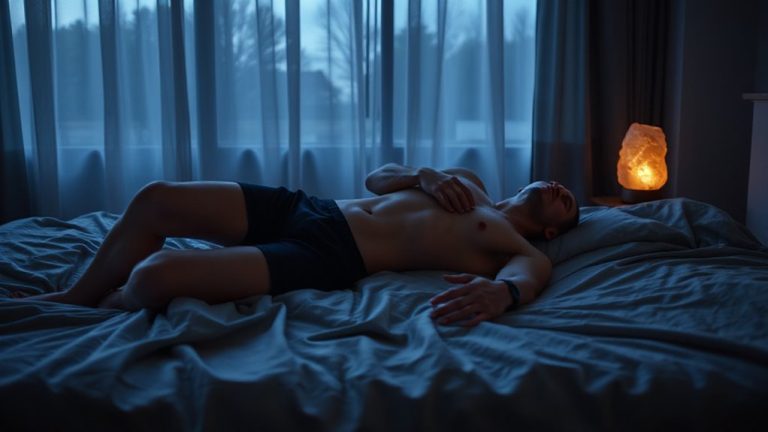
How do you bridge the gap between physical exhaustion and true rest? You build a sleep visualization script that supports mental clarity and emotional balance. Start by lying down, eyes closed, and envisioning warmth spreading from your toes upward, dissolving muscle tension. Picture each breath slowing, syncing with a calm, imaginary rhythm-like waves retreating from shore. This isn’t just relaxation; it’s neurological recalibration. Studies show guided imagery lowers cortisol, aiding recovery as effectively as some recovery gear like compression wear or foam rollers. Visualizing rest signals the parasympathetic system to activate, shifting you from exertion to repair mode. Unlike passive recovery, this method actively trains focus and emotional balance. With consistent use, you enhance mental clarity, making it easier to detach from workout intensity. The script becomes a tool-low-tech but high-impact-complementing advanced fitness gear by optimizing internal conditions for sleep. It’s recovery from the mind down.
Use These Scenes to Signal Rest
What if the mind could signal the body to shift from strain to stillness with nothing more than a mental cue? You can train yourself to recognize specific scenes as signals for deep rest. Picture a quiet forest at dusk-fading light filtering through trees, shadows growing longer, your awareness narrowing. Pair this image with slow, deliberate, gentle breaths: inhale for four counts, exhale with control. This visualization leverages neuroassociative conditioning, helping your nervous system disengage from post-workout cortisol spikes. Unlike recovery gear that relies on external compression or cooling, this method uses internal cueing-no equipment, just consistency. Over time, the brain links the scene and breath rhythm with relaxation, accelerating sleep onset. It’s effective because it’s portable and grounded in autonomic regulation. The fading light metaphor reinforces letting go, while gentle breaths stabilize heart rate variability. With repeated use, this mental trigger becomes a reliable passage tool from exertion to restoration, enhancing recovery naturally and efficiently.
Practice Right: Timing and Environment
When practiced consistently, visualization gains strength not just from technique but from timing and environment-both of which shape its effectiveness in post-workout recovery. You’ll get better results when aligning your sessions with your body’s wind-down phase. Ideal workout scheduling ends at least 90 minutes before bed, allowing cortisol to drop and melatonin to rise. Follow that with a visualization routine in a space optimized for rest. Your bedroom lighting should be dim, preferably warm-toned (below 3000K), to support circadian alignment. Avoid blue light from screens; opt for soft lamps or salt lights. Consistency here enhances neural association between the environment and sleep onset.
| Factor | Ideal State |
|---|---|
| Workout scheduling | Ends 90 min before bed |
| Bedroom lighting | Warm, dim, no screens |
| Room temperature | 65–68°F (18–20°C) |
| Noise level | Quiet or white noise |
Fix Common Visualization Struggles
You’ve set the stage with proper timing and a sleep-friendly environment, but even under ideal conditions, visualization doesn’t always go smoothly. Mental imagery can feel forced, especially when your body’s still buzzing from an intense workout. If focus slips, it’s not failure-it’s feedback. Try softening your approach: instead of commanding your mind to obey, guide it gently with structured mental imagery, like picturing a slow river or sinking into warm sand. Guided relaxation audio can help anchor your attention when self-led visualization falters. Some find success using noise-canceling headphones alongside breathable sleepwear to minimize distractions. Don’t expect perfection; the goal is gradual downregulation. Repeated practice improves efficacy, much like conditioning muscles. Over time, consistent use of guided relaxation trains the nervous system to shift from alertness to rest, making mental imagery more vivid and effective for post-workout recovery.
Pair Your Script With a Bedtime Routine
While visualization alone can support recovery, its effects multiply when integrated into a consistent bedtime routine that signals to your body it’s time to unwind. You strengthen the mind body connection by combining mental rehearsal with familiar physical cues. This synergy prepares your nervous system for deep rest, especially after intense evening exertion. Think of your routine as a sequence-each step guiding you closer to sleep.
| Step | Purpose |
|---|---|
| Dim lights (9 PM) | Triggers melatonin release |
| Wear breathable loungewear | Supports thermal regulation |
| 5-minute breathing exercise | Calms sympathetic activation |
| Run visualization script | Reinforces mental rehearsal and recovery |
Consistency enhances effectiveness. Over time, these actions become conditioned signals, improving sleep onset and overall fitness recovery. The right gear-like moisture-wicking fabrics or blackout curtains-supports sustainability. Build your routine strategically; small details amplify results.
On a final note
You’ve pushed your body hard, and now your nervous system needs signaling to shift from performance to recovery. A well-structured visualization script helps bridge that gap, lowering cortisol and supporting parasympathetic activation. When paired with quality sleep gear-like breathable, temperature-regulating fabrics-it enhances recovery efficiency. Consistent use improves sleep latency and depth, making it a practical tool. This isn’t just relaxation-it’s strategic fitness recovery.