Isometric Split Squat Holds to Improve Front Knee Stability
You build front knee stability with isometric split squat holds by forcing your lead leg to control load and maintain alignment under tension. This static lunge position strengthens quads, glutes, and hip stabilizers while reducing shear forces on the knee. Proper form-upright torso, 90-degree knee angle, and no inward collapse-ensures joint integrity. It’s not just strength; it’s neuromuscular control that protects your knees over time. You’ll see how mobility pairings enhance the benefits.
Notable Insights
- The isometric split squat hold enhances front knee stability by reinforcing proper alignment under static load.
- Maintaining a 90-degree knee angle over the toes reduces shear forces and prevents inward collapse.
- Engaging quads and glutes during the hold improves neuromuscular control for knee joint integrity.
- Holding the position 20–45 seconds builds time under tension, strengthening stabilizers without dynamic stress.
- Progressing from bodyweight to loaded variations gradually increases demand while preserving knee safety.
Why Knee Stability Starts With Your Front Leg
While most people focus on quad strength when tackling knee stability, it’s actually the front leg during unilateral movements like the isometric split squat hold that sets the foundation for real joint integrity. You’re not just building strength-you’re training control. The front leg bears the load, demanding precise knee alignment to prevent excessive forward drift or inward collapse. When you hold the position, your hip, knee, and ankle must work together, reinforcing proper tracking and minimizing shear forces. This static challenge enhances proprioception and muscular endurance, both essential for maintaining joint integrity under stress. Without this control, even strong quads can’t protect your knee. Equipment like stability discs or foam pads can amplify the demand, but the real tool is your own neuromuscular awareness. You’ll notice better balance, sharper movement patterns, and reduced knee strain-especially during dynamic activities. It’s not about gear; it’s about how you use your body.
How Split Squat Holds Protect and Strengthen Knees
The isometric split squat hold doesn’t just build strength-it actively reinforces knee protection by demanding sustained joint alignment and muscular coordination. You maintain knee alignment over the foot while resisting forward collapse, training your body to stabilize under load without movement. This static position boosts muscle activation in the quadriceps, glutes, and hip stabilizers, all of which support the front knee during dynamic activities. Unlike dynamic squats, the hold minimizes shear force while maximizing time under tension, giving you a safer way to reinforce proper mechanics. Over time, you’ll notice improved control and reduced strain during lunges or stairs. It’s not just about strength-it’s about teaching your knee to stay protected through precise positioning and balanced muscle activation. This makes the exercise a smart addition to injury prevention routines, especially when used consistently alongside proper recovery tools.
Perform the Isometric Split Squat Hold (Step by Step)
Think of the isometric split squat hold as a strength checkpoint-one that tests your stability, alignment, and muscle endurance without a single movement. Start by stepping one leg forward and lowering into a lunge until your front thigh is parallel to the floor. Your back knee should hover just above the ground. Make sure your front foot positioning places the heel flat, aligned with your knee at a 90-degree angle-this reduces unnecessary strain. Keep your torso alignment upright, avoiding any forward lean that could shift weight improperly. Engage your core and glutes to maintain balance. Hold this position for 20 to 45 seconds, focusing on consistent breathing. This static challenge builds isometric strength critical for knee stability, especially in dynamic movements. Proper form guarantees you’re training the right muscles safely and effectively.
Fix These 4 Form Mistakes to Protect Your Knees
With your knee health on the line, skipping proper form in isometric split squat holds can turn a protective exercise into a risk. First, avoid letting your front knee cave inward-maintain proper knee alignment by tracking it over your toes. This reduces joint stress and boosts stability. Second, don’t let your back knee slam the floor; control the descent to preserve tension and joint safety. Third, failing to engage your glutes and quads limits muscle activation, making the move less effective and increasing strain on ligaments. Finally, rounding your lower back shifts load improperly-keep your core tight and spine neutral. These corrections guarantee the hold actually protects your knees instead of risking them. When performed with attention to alignment and activation, the exercise builds resilience, enhances control, and supports long-term joint integrity. Precision now prevents pain later.
Add Holds to Your Warm-Up or Strength Work
You’ll find isometric split squat holds slot seamlessly into either your warm-up or strength work, depending on your goals and recovery strategy. For warm up integration, they prime the glutes, quads, and hip flexors while reinforcing knee alignment-making them ideal before power or lifting sessions. Holding for 20–30 seconds activates stabilizers without fatiguing muscles, preserving energy for main lifts. When used in strength enhancement phases, longer holds (45+ seconds) with added resistance challenge muscular endurance and joint integrity, supporting hypertrophy and neural adaptation. Positioning the back knee on a 4–6 inch pad can improve comfort and range, though minimalist mats work fine for most. These holds demand no special gear, but consistent form maximizes benefits. Whether you’re activating muscles pre-workout or building resilience post-load, they offer functional carryover with minimal time investment-making them a smart, adaptable tool in any recovery-conscious program.
Try These 3 Progressions to Build Stability Safely
Isometric split squat holds don’t just activate muscles-they build the kind of joint stability that protects your knees and hips during heavier lifts or explosive movements, and how you progress them matters. Start with bodyweight holds for 30 seconds per side to nail the form and boost initial muscle activation. Once you’re stable, add light dumbbells-this introduces progressive loading without compromising technique. You’ll notice better control and reduced knee wobble, a sign your stabilizers are adapting. Next, progress to front-racked kettlebells or a barbell, which increases demand on your core and frontal plane stability. This level intensifies muscle activation while reinforcing proper alignment under load. The final step? Elevate your rear foot slightly on a foam pad or low bench. This subtle change challenges balance and further refines joint stability. Each progression should feel controlled-never rushed-so you build resilience safely over time.
Combine Holds With Hip and Ankle Mobility Drills
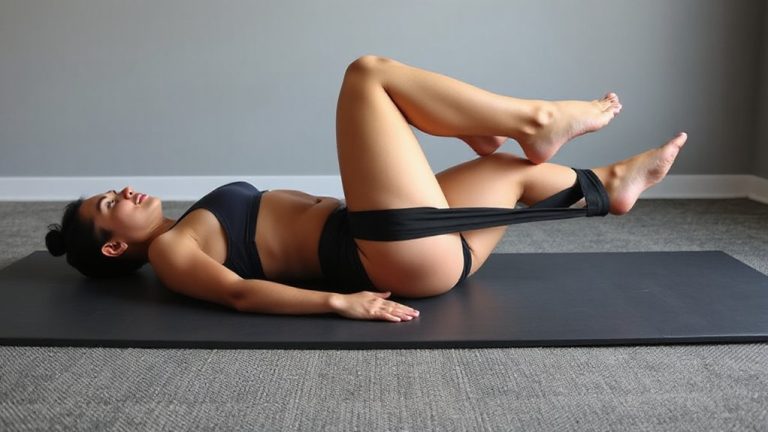
Why do some athletes breeze through split squat holds while others struggle to stay balanced, even at bodyweight? The answer often lies in mobility-specifically hip activation and ankle dorsiflexion. Without adequate ankle dorsiflexion, your front knee can’t track properly, limiting depth and increasing joint stress. Poor hip activation leads to pelvic instability, making it harder to engage the glutes and maintain alignment. Combining split squat holds with targeted mobility drills improves both. Try banded ankle mobilizations to enhance dorsiflexion and glute bridges to prime hip activation before your holds. These pairings aren’t just complementary-they’re essential. Athletes who integrate mobility work report better control, reduced compensations, and smoother progressions. Over time, this combination supports safer, more effective loading patterns. Don’t treat mobility as an afterthought; sequence it before holds to maximize neuromuscular readiness and movement quality.
On a final note
You’re building real knee resilience with isometric split squat holds-these aren’t just filler exercises. They target quad control, hip alignment, and joint stability under load, making them smart for injury prevention. Paired with proper recovery gear like compression sleeves or quality foam rollers, you’ll maintain tissue quality and joint feedback. Used consistently, this combo sharpens neuromuscular control while supporting long-term joint health, especially when mobility work and smart progressions back it up.