Wave-Action Balancing Exercises Standing on Floating Mats in Lap Lanes
You’ll engage your core 30% more on a floating mat in a lap lane than on land, thanks to the unstable surface and wave feedback from nearby swimmers. High-density EVA foam resists waterlogging while demanding constant micro-corrections for balance. Ideal for seniors, athletes, and rehab patients, these mats boost proprioception safely. Choose closed-cell, textured-surface models to guarantee grip and durability-your next-level stability training starts here.
Notable Insights
- Standing on floating mats in lap lanes increases core engagement due to inherent water instability.
- Nearby swimmers generate waves that enhance balance challenges during floating mat exercises.
- Wave-action training on floating mats sharpens proprioception through dynamic, unpredictable motion.
- High-density EVA foam mats provide durable, buoyant surfaces ideal for lap lane balance drills.
- Perform double-leg stands, single-leg holds, and arm reaches to maximize stability and alignment.
Why Floating Mats Make Pool Workouts Harder (In a Good Way)
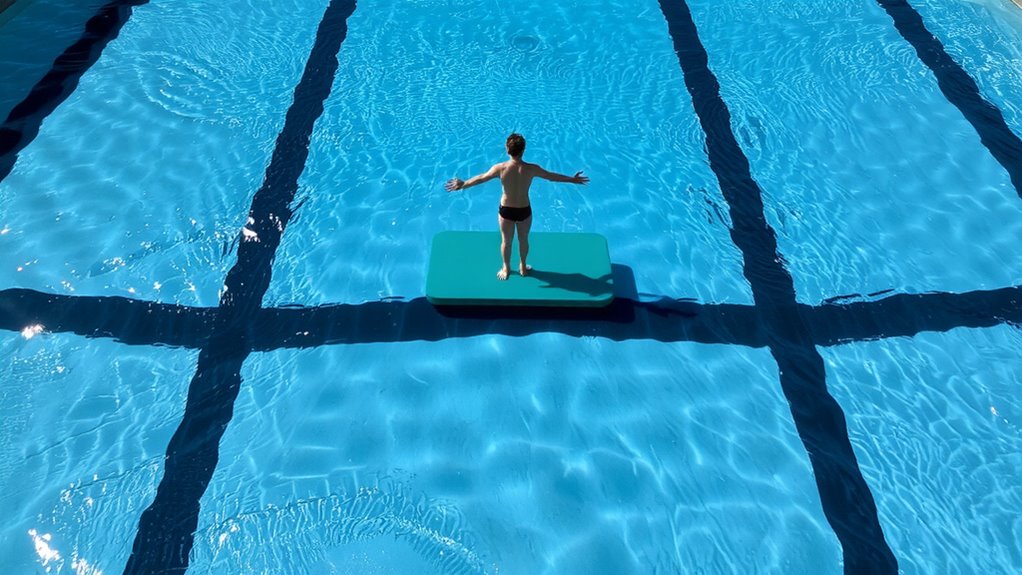
While you might think working out in water is inherently easier on the joints, using floating mats actually increases the challenge in ways that benefit your fitness-especially when it comes to balance and core engagement. The unstable surface forces your muscles to constantly adjust, boosting core engagement far more than stable ground ever could. Every shift creates subtle resistance, and when combined with the water’s natural drag, you’re met with dynamic resistance throughout each movement. This isn’t just about building strength-it’s about training stability and control. High-density EVA foam mats respond to wave action, amplifying instability without compromising safety. Unlike firm gym equipment, these mats adapt to pool dynamics, making them ideal for functional training. They’re lightweight, easy to clean, and hold up well over time. Used correctly, they transform low-impact exercise into a rigorous, joint-safe workout that challenges coordination, enhances proprioception, and delivers measurable gains in trunk stability and muscle endurance.
Who Should Try This Water Balance Workout?
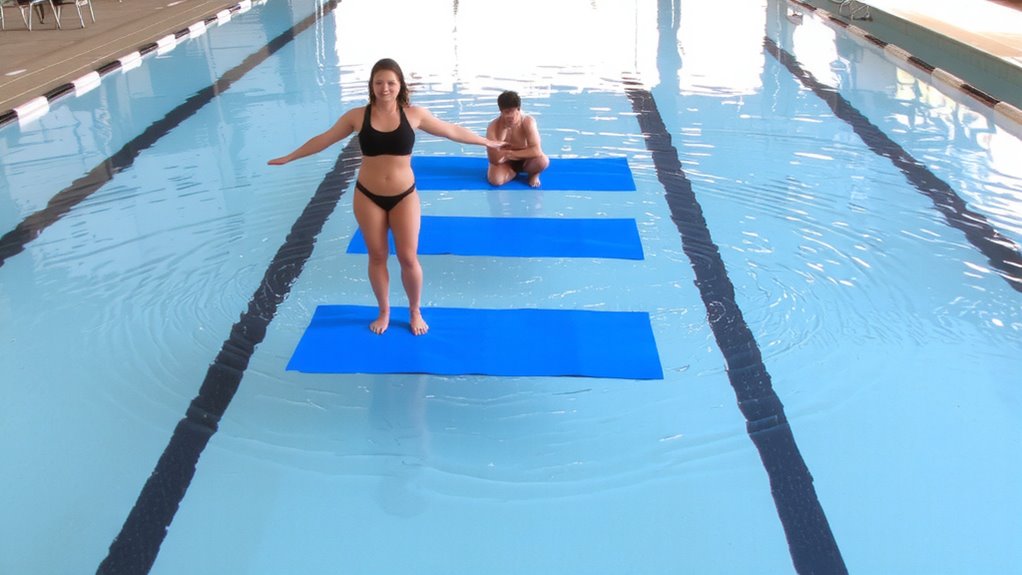
You’re already balancing on unstable ground-literally-when you step onto a floating mat in the pool, and that constant micro-adjusting your body does? That’s where real gains begin. This workout shines for those seeking improved core engagement and proprioception focus. Whether you’re rehabbing an injury, enhancing athletic coordination, or maintaining mobility as you age, the water’s resistance and mat’s instability create a low-impact, high-return challenge.
| Who Benefits | Why It Matters |
|---|---|
| Seniors | Boosts balance, reduces fall risk |
| Athletes | Sharpens neural control and stability |
| Injured individuals | Supports recovery with gentle resistance |
| Fitness enthusiasts | Increases core engagement without strain |
| Physical therapy patients | Reinforces proprioception focus safely |
It’s not just exercise-it’s retraining your body’s awareness with each wobble.
Choose the Right Floating Mat for Stability Training
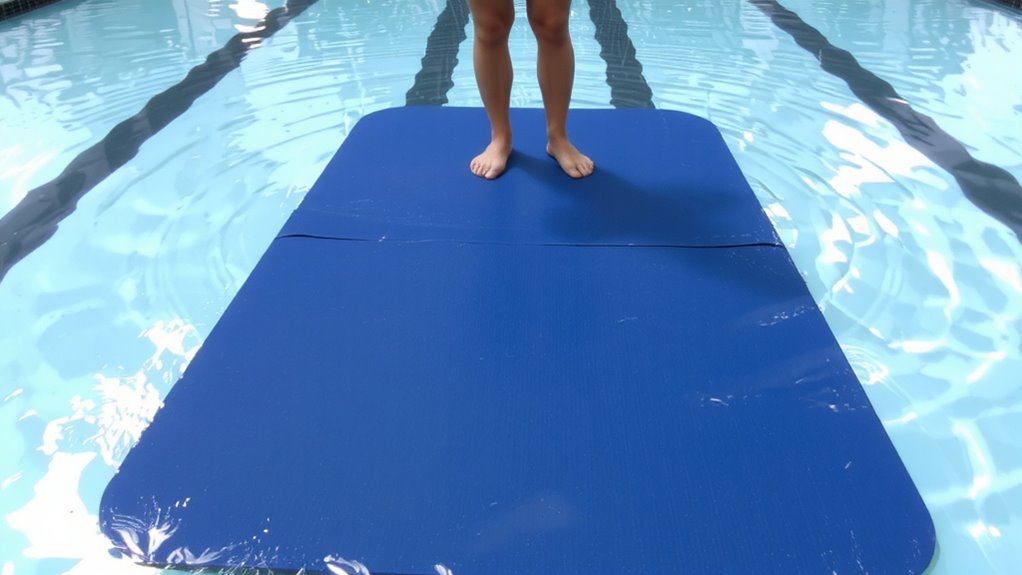
How do you know which floating mat will actually support your stability training without turning your session into a struggle against equipment failure? The answer lies in two key features: material density and surface texture. You need a mat with high material density-it resists waterlogging and maintains buoyancy, giving you consistent support during wave-action drills. Thin or low-density mats shift unpredictably, undermining your balance work. Equally important is surface texture; a slightly textured or non-slip top prevents foot sliding, even when wet, enhancing safety and control. Avoid overly smooth surfaces-they compromise grip. Look for mats made from closed-cell foam or similar durable composites, as they combine ideal density with long-term structural integrity. You’ll train more effectively-and safely-when your equipment supports your effort instead of fighting it. Choose wisely.
Do This Wave-Action Balance Routine on a Floating Mat
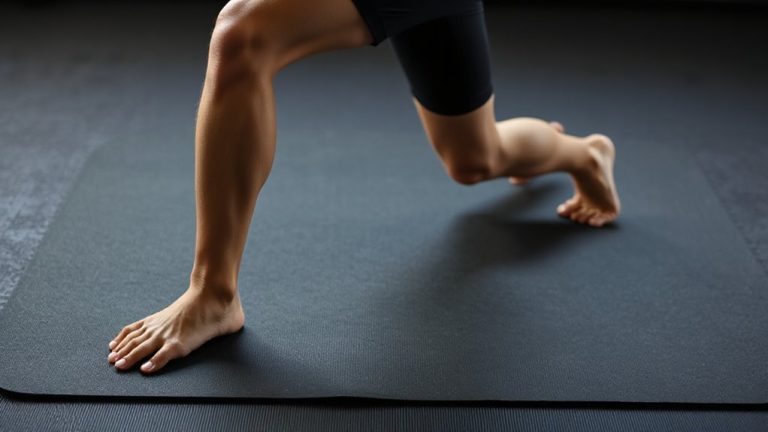
Once you’ve secured a high-density, non-slip floating mat, you’re ready to begin a wave-action balance routine that challenges your stabilizer muscles far more than land-based exercises can. Focus on core engagement with every shift, maintaining dynamic posture as water subtly shifts beneath you. Begin with feet shoulder-width apart, then progress through controlled movements like single-leg stands and slow arm circles. This routine enhances proprioception while conditioning deep stabilizing muscles.
| Exercise | Duration | Focus Area |
|---|---|---|
| Double-Leg Stand | 30 sec | Balance & Alignment |
| Single-Leg Hold | 20 sec each leg | Core Engagement |
| Controlled Arm Reach | 45 sec | Dynamic Posture |
Perform 3 rounds, adjusting stance as micro-movements test stability. The mat’s buoyancy demands continuous muscle correction, making it ideal for functional fitness recovery and neuromuscular retraining. Always maintain awareness of form to maximize benefit and prevent strain.
How Swimmer-Made Waves Boost Balance Training
Though often overlooked in standard training environments, the waves created by nearby swimmers greatly amplify the challenge of balance exercises on floating mats. You’re not just fighting to stay upright-you’re adapting to real-time shifts caused by wave resistance from others’ strokes and turns. This dynamic instability forces your core, hips, and stabilizing muscles to engage more intensely than on stable or predictably wobbly surfaces. Unlike controlled balance trainers, swimmer-made waves are irregular, making each second on the mat a unique neuromuscular test. You’ll find your proprioception sharpens faster, as the body learns to react to unexpected motion. While some recovery tools offer passive benefits, this active resistance builds functional strength. The floating mat, while simple in design, becomes far more effective in a live pool setting. With regular use, you gain resilience that translates directly to athletic stability-no added equipment needed.
On a final note
You’ll find wave-action balance training on floating mats both challenging and effective, turning lap lanes into dynamic stability workouts. The instability forces constant micro-adjustments, boosting proprioception and core engagement. Mats with textured surfaces and moderate buoyancy offer the best performance. While not ideal for recovery, they enhance neuromuscular control, making them valuable for active training phases. Just rinse after use to maintain durability.