Buoyancy Vest Utilization for Offloading Weight in Early ACL Reconstruction Phase
You’re offloading up to 75% of your body weight with a buoyancy vest, reducing stress on your healing ACL graft right after surgery. The closed-cell foam provides consistent flotation, letting you move safely in chest-deep water while minimizing shear forces. Hydrostatic pressure helps control swelling and improves joint awareness. This early movement builds strength without risking graft integrity. Adjustable support means you’ll progress smoothly into later rehab stages-what comes next could reshape your entire recovery approach.
Notable Insights
- Buoyancy vests reduce knee joint stress by offloading up to 50–75% of body weight during early ACL recovery in water.
- Closed-cell foam in vests provides consistent flotation without water absorption, ensuring stable support during aquatic rehab.
- Water-based exercises with buoyancy vests enable safe early movement, protecting the ACL graft from excessive shear and torsional loads.
- Adjustable buoyancy levels allow customization to recovery stages, supporting progressive weight-bearing as strength improves.
- Hydrostatic pressure and resistance in water enhance circulation, reduce swelling, and improve proprioception during early rehabilitation.
How Buoyancy Vests Protect Your ACL Graft
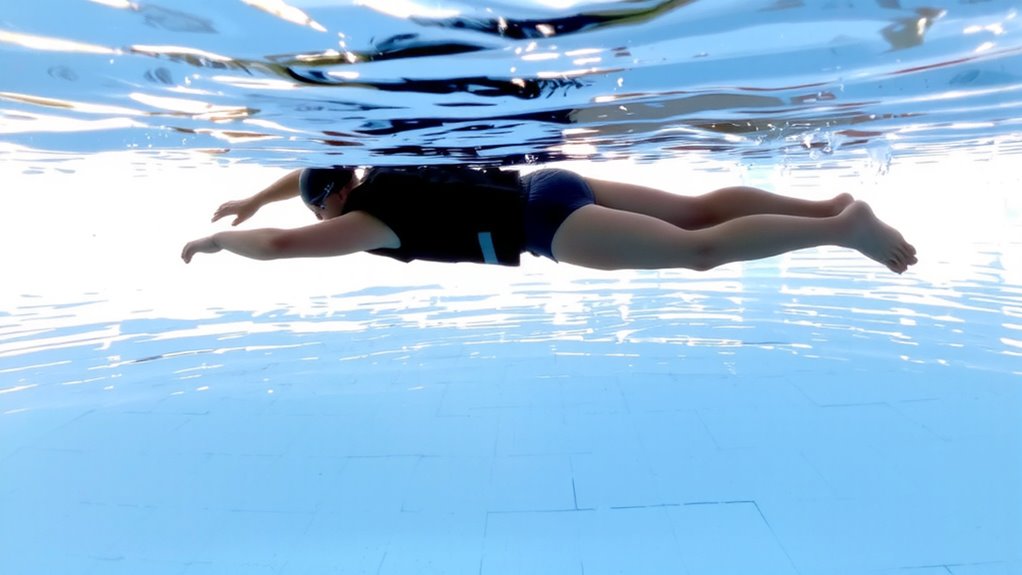
While you’re focused on regaining strength and mobility after ACL surgery, protecting the graft during early rehabilitation is just as critical-and that’s where a buoyancy vest comes in. By leveraging flotation mechanics, the vest supports your body weight in water, markedly reducing downward stress on the healing graft. This controlled environment allows safe initiation of movement without compromising structural integrity. Hydrodynamic resistance provides natural, adjustable opposition to motion, letting you build strength gradually while minimizing abrupt force transmission. Unlike land-based exercises, water-based rehab with a vest limits shear and torsional loads on the knee-common risks during early recovery. Most vests use closed-cell foam, offering consistent buoyancy without water absorption. You’ll find they’re lightweight, easy to adjust, and durable across frequent therapy sessions. When calibrated properly, the vest guarantees effective body alignment, enhancing exercise precision. It’s not just about support-it’s about smarter graft protection.
How Buoyancy Vests Reduce Knee Joint Stress
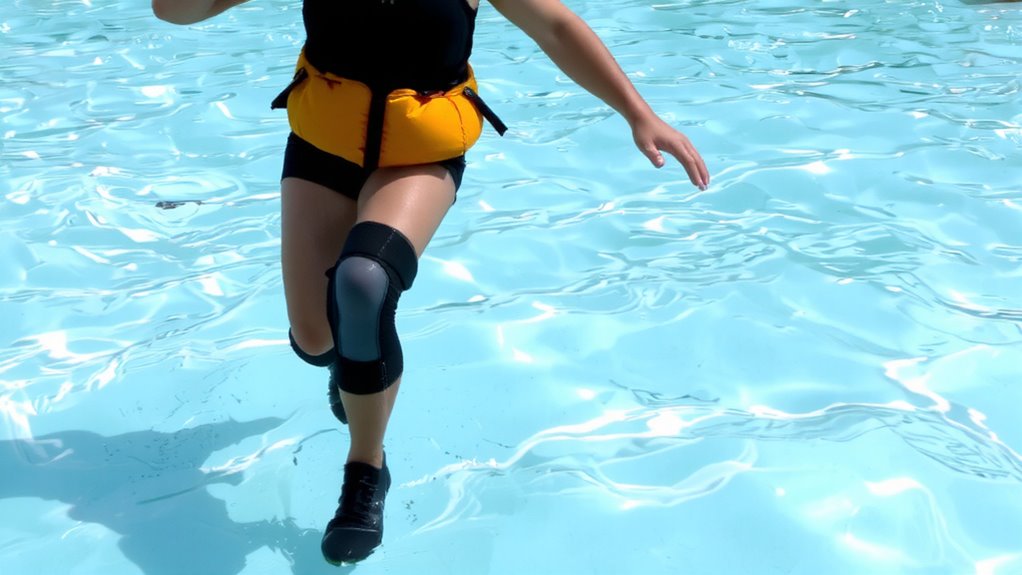
A buoyancy vest doesn’t just shield your ACL graft-it actively lowers the strain on your knee joint by offsetting your body weight in water. Thanks to hydrostatic pressure, your leg feels lighter, reducing compression on the joint while allowing safe initial movement. This pressure also helps decrease swelling, promoting better circulation without added stress. Fluid resistance supports controlled motion, giving your muscles a workout while protecting fragile tissues during early recovery.
| Benefit | How It Helps |
|---|---|
| Weight offloading | Up to 50% body weight reduction in chest-deep water |
| Hydrostatic pressure | Decreases joint swelling and improves proprioception |
| Fluid resistance | Enables strength training with low impact on healing ligaments |
The vest’s adjustable design guarantees stability, letting you focus on form without compromising safety. It’s not a shortcut-it’s smart recovery, grounded in biomechanics and rehab science.
Top Early ACL Exercises With a Buoyancy Vest
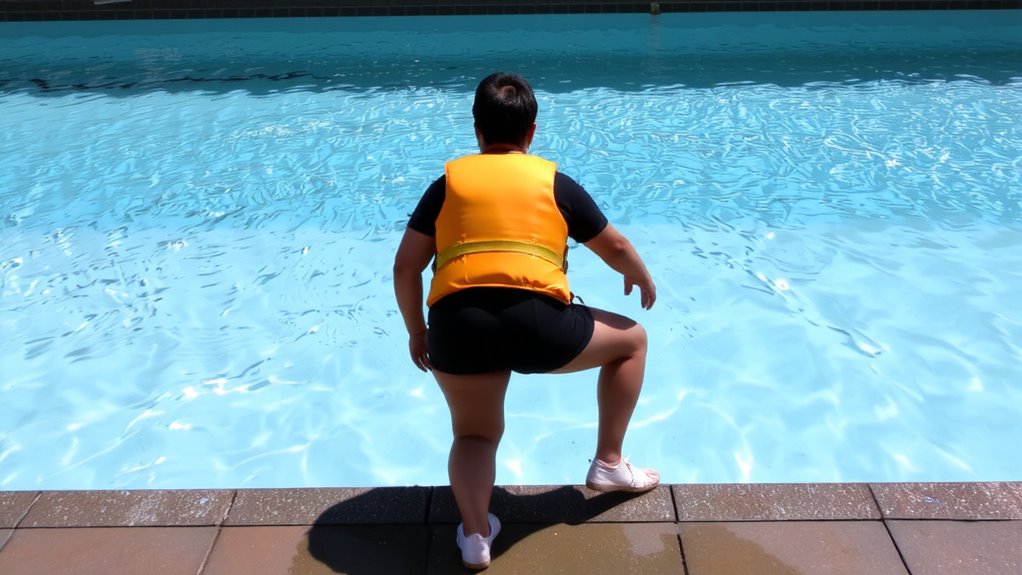
You’ll find the buoyancy vest opens up safe, effective exercise options right after ACL surgery, when your knee can’t yet handle full weight or high resistance. Simple walking in chest-deep water provides low-impact movement, while the vest supports your posture and reduces joint loading. Forward and lateral leg lifts become practical, using water resistance to gently challenge your hip and thigh muscles without straining the graft site. You can also perform controlled squats, where buoyancy offsets body weight, allowing earlier range of motion. These exercises promote consistent muscle activation, particularly in the quadriceps and glutes, which is critical for joint stability. The vest’s design enhances workout precision, letting you maintain proper form. Unlike land-based routines, water resistance offers smooth, variable load-reducing shear forces while building neuromuscular control. Physical therapists often observe improved coordination and earlier functional gains when these exercises are done consistently.
Choosing Your Buoyancy Level by Recovery Stage
Because your body’s needs shift as your ACL heals, picking the right buoyancy level isn’t a one-size-fits-all decision-it’s a staged process tied directly to where you are in recovery. In the first 2–4 weeks post-op, high buoyancy calibration is key, offloading 50–75% of your body weight to protect the joint while allowing movement. At this stage, water resistance supports gentle range-of-motion work without straining healing tissue. As inflammation decreases and strength improves around weeks 5–8, you can reduce buoyancy slightly-aiming for 40–50% support-to increase load progressively. Too much buoyancy too soon hampers functional adaptation; too little risks overloading the graft. Adjustable vests let you fine-tune support as you advance, making them more effective than fixed-buoyancy models. Thoughtful buoyancy calibration guarantees you’re working with the water, not against it, while leveraging water resistance to rebuild strength safely.
Moving From Aquatic Therapy to Land Exercises
How do you know when it’s time to step out of the pool and back onto solid ground? It’s when your water adaptation shows consistent gains-your balance improves, pain stays low, and joint control strengthens even without buoyancy support. Your therapist will assess whether your movement progression matches recovery milestones, like achieving 90% leg strength symmetry and smooth weight transfer. The shift from aquatic therapy to land exercises isn’t just about readiness; it’s about timing. Begin with partial-weight tasks like mini-squats or step-ups, using your buoyancy vest history as a guide for load tolerance. You’ll notice land feels stiffer, less forgiving-but that’s where real functional gains happen. Shift gradually, monitoring swelling and joint feedback. This phase isn’t a finish line, but a pivot point. The vest trained your body gently; now, you build on that foundation with smarter, more demanding work.
On a final note
You’ll find buoyancy vests highly effective during early ACL recovery, offering controlled weight offloading that protects your graft while promoting movement. They reduce knee joint stress by up to 50%, depending on immersion depth and vest buoyancy. Used correctly, they support safe exercise progression and smooth shifts to land-based rehab. While not a standalone solution, they’re a smart, evidence-backed tool when integrated into a structured therapy plan, enhancing both recovery pace and joint protection.