How Cross-Training Can Enhance Recovery From Chronic Achilles Tendinitis
You can maintain fitness and speed up healing from chronic Achilles tendinitis by swapping high-impact workouts for cross-training like cycling, swimming, or elliptical training. These activities reduce tendon load while improving circulation and strength. Pair them with resistance bands and yoga to restore mobility and prevent re-injury. When done consistently, they build resilient tissue and prepare your body for a safe return-there’s a smarter way forward.
Notable Insights
- Cycling maintains cardiovascular fitness with minimal Achilles tendon loading, supporting recovery through low-impact aerobic conditioning.
- Swimming provides buoyancy-assisted, impact-free exercise that enhances circulation and builds strength without stressing the injured tendon.
- Resistance band training enables controlled, progressive loading of calf muscles, promoting tendon adaptation and resilience without compression.
- Yoga and Pilates improve ankle mobility, flexibility, and core stability, reducing compensatory movements that hinder Achilles healing.
- A structured cross-training plan integrates rest, strength, and aerobic fitness to support tissue repair and prepare for safe return to activity.
How Cross-Training Aids Achilles Tendinitis Recovery
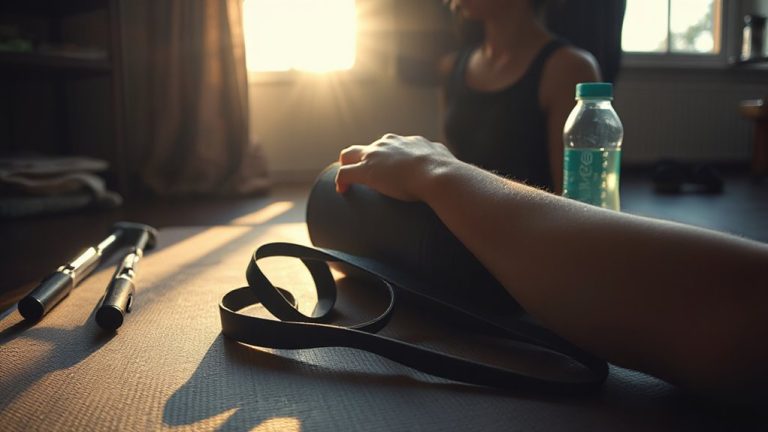
While you’re sidelined by Achilles tendinitis, staying active without worsening the injury might seem tricky, but cross-training makes it not only possible but beneficial. Engaging in low-impact activities helps maintain cardiovascular fitness while reducing strain on the tendon. Yoga flexibility routines enhance range of motion, decrease muscular tension, and promote circulation, supporting tissue repair. When combined with resistance bands strengthening exercises, you can specifically target the calf, ankle stabilizers, and lower leg muscles without compressive joint load. Resistance bands offer adjustable tension levels, making them ideal for progressive loading as recovery advances. Unlike heavier gym equipment, they’re portable and precise, allowing controlled movements that minimize risk. Used consistently, these tools support structural adaptation and prevent deconditioning. Cross-training isn’t just a placeholder for your regular routine-it’s a strategic recovery asset. With proper form and frequency, it speeds return to full activity. For optimal results, consider using the best recovery bands to enhance muscle relief and accelerate healing.
Cycling for Cardio Without Aggravating Achilles Pain
Cycling offers a reliable way to maintain cardiovascular conditioning during Achilles tendinitis recovery, letting you stay active without overloading the injured tendon. You can preserve aerobic fitness while minimizing strain, especially when pedaling with a smooth, circular motion that reduces peak loads on the Achilles. A proper bike fit is essential-your saddle height should allow slight knee bend at the bottom of the pedal stroke, preventing excessive ankle dorsiflexion that could irritate the tendon. Cleats or cycling shoes that position your foot neutrally help maintain alignment and efficiency. Focus on low resistance and higher cadence, ideally 80–90 RPM, to keep the pedal stroke fluid. Stationary bikes offer controlled conditions, but outdoor cycling works if terrain is flat. Regularly assess pain response post-ride; even minor discomfort may signal needed fit adjustments. When done correctly, cycling supports recovery without sacrificing cardio gains. For those seeking low-impact comfort and optimal support, a well-designed recumbent bike can further reduce strain on the lower legs while maintaining cardiovascular benefits.
Swimming for Achilles Recovery: Safe Full-Body Workouts
Swimming gives you a powerful way to stay in shape while letting your Achilles tendon heal, and it pairs especially well with cycling as part of a balanced recovery plan. The water resistance builds strength gradually without straining your tendon, making it ideal for maintaining fitness during rehab. You get a full-body workout that enhances endurance, muscle coordination, and circulation-all critical for recovery. Thanks to buoyancy benefits, your joints stay unloaded, drastically reducing impact stress on the injured area. This allows consistent training without risking setbacks. Freestyle and backstroke are particularly effective, promoting smooth, controlled motion. Using swim fins cautiously may amplify lower-leg activation without overloading the Achilles. Goggles, swim caps, and well-fitted suits improve efficiency and comfort, supporting longer, more effective sessions. Always warm up properly and avoid kicking excessively hard. Swimming isn’t just low-impact-it’s functionally restorative when used with purpose and progression.
Low-Impact Elliptical Training for Tendon Healing
You can keep your cardio sharp without stressing your healing Achilles by turning to the elliptical, a machine that mimics running’s motion while eliminating the jarring impact. It supports joint mobilization through smooth, controlled movement, encouraging circulation without grinding stress. When setting your routine, adjust elliptical resistance carefully-start low to avoid overloading the tendon, then gradually increase as strength improves. Unlike treadmills or bikes, ellipticals offer weight-supported motion, making them ideal during early recovery phases. A well-designed massage chair setup can further aid recovery by promoting muscle relaxation and reducing compensatory tension in the lower limbs. Below, key features and benefits are summarized for practical use.
| Feature | Benefit |
|---|---|
| Smooth stride | Promotes joint mobilization |
| Adjustable rails | Improves balance and form |
| Low impact | Protects healing tendon |
| Variable elliptical resistance | Customizable intensity |
| Full range motion | Supports tendon glide and flexibility |
This cross-training tool balances conditioning and recovery when used mindfully.
Designing a 7-Day Cross-Training Plan for Recovery
While your Achilles needs time and care to heal, staying consistent with structured cross-training can actually support recovery when done right. Your 7-day plan should balance mobility, strength, and circulation without overloading the tendon. Start with low-impact elliptical sessions every other day to maintain cardiovascular fitness while minimizing strain. Incorporate Pilates routines on days two and six-these emphasize core stability and controlled movements, reducing compensatory patterns that stress the Achilles. Include gentle yoga flows on days three and five to improve flexibility and proprioception, focusing on calf elongation and ankle mobility. Swimming on day four offers resistance-free conditioning, enhancing blood flow for tissue repair. Rest on day seven, but add light stretching. This rotation supports tendon remodeling without flare-ups. Choose supportive footwear and moisture-wicking apparel to maintain comfort. When executed with attention to form and recovery, this plan optimizes healing through intelligent, joint-sparing movement.
When to Safely Return to Running With Achilles Tendinitis
How do you know when it’s truly safe to start running again after Achilles tendinitis? It comes down to consistent pain monitoring and smart, gradual loading. If you’ve been pain-free during daily activities and cross-training for at least two weeks, you’re likely ready to test a return. Start with short walk-run intervals-like one minute of running followed by three minutes of walking-to assess response. Pay close attention: any ache during or after means you’re progressing too fast. Gradual loading isn’t just about distance; it’s about intensity, frequency, and tissue tolerance. Bouncing back too soon risks setbacks, while a methodical approach supports resilience. Think of it like conditioning gear-just as you’d break in new running shoes slowly, your tendon needs the same care. Smart progression beats speed any day.
Strengthen Supporting Muscles to Prevent Re-Injury
A strong foundation starts with more than just the injured tendon-it hinges on the entire kinetic chain. You can’t ignore core stability when rehabbing Achilles tendinitis; a weak core forces your lower limbs to compensate, increasing strain on the tendon. Strengthening glutes, calves, and hips improves alignment and shock absorption during movement. Balance training, like single-leg stands or wobble board drills, enhances proprioception, reducing missteps that could lead to re-injury. These exercises integrate seamlessly with cross-training, letting you maintain fitness without tendon overload. Effective gear-supportive footwear, resistance bands, and foam rollers-supports muscle development and recovery. But gear alone won’t suffice; consistent, progressive loading is key. Combine strength work with cross-training modalities like swimming or cycling, and you’ll build resilience across your entire system-preparing your body for safe, sustainable return to impact activities.
On a final note
Cross-training speeds Achilles tendinitis recovery by maintaining fitness while reducing tendon load. Cycling, swimming, and elliptical work deliver cardio benefits without impact, letting inflammation subside. These activities also strengthen calves, quads, and glutes-crucial for lower-leg stability. When paired with proper footwear and gradual progression, they lower re-injury risk. You’ll stay conditioned, heal smarter, and return to running on firmer, safer footing.