How Wearable Fascial Tension Sensors Guide Myofascial Release Interventions
You see real-time changes in fascial tension, letting you adjust myofascial release the moment stiffness or asymmetry appears. These sensors distinguish true fascial strain from muscle tightness, so you apply pressure only where needed. With live feedback, you avoid overworking tissue and improve timing and precision. Trainers use the data to personalize techniques, enhancing recovery. You’ll discover how this guidance sharpens both self-care and clinical routines.
Notable Insights
- Wearable fascial tension sensors detect real-time changes in fascial elasticity to identify areas needing myofascial release.
- They differentiate fascial strain from muscular tightness, enabling precise, targeted intervention strategies.
- Real-time tension mapping allows therapists to adjust manual therapy pressure for optimal tissue response.
- Sensors provide immediate feedback during stretching, guiding depth and alignment for effective fascial release.
- Continuous monitoring helps determine ideal timing for interventions, preventing overworking and enhancing recovery.
What Are Wearable Fascial Tension Sensors?
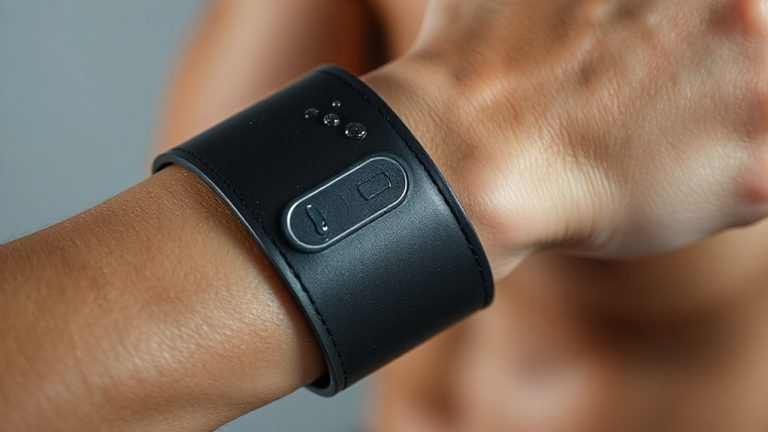
Think of fascia as the body’s internal web-this dense connective tissue wraps around muscles, organs, and bones, providing structure and support. Wearable fascial tension sensors are sleek, flexible devices designed to monitor changes in fascial elasticity during movement and recovery. They work by detecting subtle shifts in connective tissue resonance, offering data on tension patterns that traditional fitness gear often misses. Unlike standard wearables tracking heart rate or steps, these sensors focus on the mechanical behavior of fascia, giving you insights into how your body’s support system responds to strain. In practice, they’ve shown promise for athletes and rehab patients alike, helping pinpoint stiffness or asymmetry before injury strikes. While still emerging, their precision and non-invasive design make them a compelling addition to recovery tech. They’re not flashy, but their functional feedback can refine training, boost Fascial elasticity over time, and support long-term myofascial health.
How Wearable Fascial Sensors Enable Real-Time Myofascial Feedback
You’re already familiar with how wearable fascial tension sensors map the body’s connective tissue dynamics, but their real value emerges when that data becomes actionable in real time. You can monitor fascial hydration tracking directly through subtle shifts in tissue conductivity, giving insight into recovery status and injury risk. When you move, the sensors adjust, offering feedback on dynamic movement alignment so you can correct form before strain occurs. This isn’t just data display-it’s guidance. Trainers and therapists use this live feedback to tailor myofascial release timing and technique. The sensors help distinguish between normal tension and areas needing attention, all without invasive methods. Their integration into recovery routines enhances precision, making self-care more effective. While not infallible, the consistency of readings during movement patterns adds reliability. With regular use, you gain a clearer picture of how your fascia responds to load, rest, and release, improving long-term mobility and performance.
Precise Detection of High-Tension Fascial Areas
While fascial tension often goes undetected until discomfort arises, wearable sensors now make it possible to pinpoint high-tension areas with clinical-level precision. You’re able to identify restricted zones others might overlook, thanks to advanced tension mapping that visualizes stress distribution across your fascia in real time. These devices detect subtle changes in fascial elasticity, signaling when tissue becomes stiff or adhesive-often before pain begins. Unlike general assessments, the sensors differentiate between muscular tightness and true fascial strain, offering targeted insights. You’ll see exactly where intervention is needed, whether from overtraining, poor posture, or injury recovery. The data isn’t just accurate-it’s actionable. With consistent use, you build a clearer picture of your body’s patterns, making your recovery efforts more strategic. This level of detail elevates wearable fitness gear from passive tracking to active, intelligent support for long-term tissue health.
Get More From Stretches Using Live Tension Feedback
How often do your stretches feel like guesswork? With wearable fascial tension sensors, you don’t have to wonder if you’re pushing too hard or not far enough. These devices provide live tension feedback, letting you adjust in real time for safer, more effective sessions. By monitoring fascial resistance, they support dynamic alignment-ensuring your body moves through ideal postures during each stretch. That means less strain on joints and more targeted release where it’s needed. Stretch optimization isn’t just about depth; it’s about precision. Users consistently report improved flexibility and reduced soreness when guided by sensor data, compared to unassisted routines. The feedback loop helps correct subtle imbalances before they lead to overstretching. Unlike generic programs, this tech adapts to your body’s current state, offering a personalized approach that boosts recovery efficiency. You’re not just stretching-you’re training with data.
How Therapists Use Sensors During Hands-On Treatment
Fascial tension sensors aren’t just changing how people stretch on their own-they’re reshaping hands-on therapy, too. You place the wearable on your client, and real-time data shows fascial resistance, letting you adjust pressure before discomfort arises. This immediate feedback supports better client comfort, so sessions feel effective without crossing into pain. You’re no longer guessing-subtle changes in tension guide your hands, helping you match the ideal treatment rhythm. The sensor’s responsiveness means you can detect when tissue begins to release, avoiding overworking stubborn areas. Many therapists find this improves precision, reducing fatigue and increasing session consistency. It’s not about replacing touch; it’s enhancing intuition with data. When rhythm and comfort align, outcomes improve. The tech integrates smoothly into practice, requiring minimal setup and offering reliable readings across body regions. You stay focused on technique, while the sensor quietly confirms you’re on track.
Use Sensor Data to Monitor Healing and Mobility Gains
What if you could track recovery beyond how your client feels day to day? With wearable fascial tension sensors, you can. These devices capture real-time data trends in tissue stiffness and movement efficiency, letting you see progress objectively. Instead of relying solely on subjective feedback, you’ll identify subtle shifts in fascial elasticity after each myofascial release session. Over time, consistent data trends help establish recovery benchmarks-like reduced tension levels or improved joint range-so you know when a client hits key milestones. This isn’t just about feeling better; it’s about measuring functional gains in mobility and tissue resilience. You’ll spot plateaus quickly and adjust interventions accordingly. The sensors are lightweight, non-invasive, and integrate smoothly into clinical routines. While not a replacement for clinical judgment, they add a layer of precision that enhances decision-making. When recovery is measurable, outcomes become more predictable and treatments more effective.
Match Fascial Sensors to Clinical or Fitness Goals
You’re already seeing how sensor data can objectively track healing and mobility improvements over time, but now it’s about aligning that technology with specific goals-whether in rehabilitation or performance training. If you’re managing injury recovery, you’ll want sensors calibrated for low-tension thresholds to detect subtle changes in fascial hydration and tissue responsiveness. For athletes, higher sensitivity settings help capture dynamic loads during movement, guiding more aggressive myofascial release. Proper sensor calibration guarantees accuracy across different body regions, which is critical when targeting dense fascial nets like the thoracolumbar or plantar fascia. In clinical settings, consistent readings support evidence-based adjustments, while fitness enthusiasts benefit from real-time feedback during recovery sessions. Matching sensor specifications to your objectives-be it restoring range of motion or optimizing tissue resilience-turns raw data into actionable insight, making recovery not just observable, but predictable and efficient.
On a final note
You’re getting smarter about recovery with wearable fascial tension sensors-they detect tightness in real time, so you stretch more effectively. Therapists use them to guide hands-on work, while athletes track mobility gains. These devices bridge clinical precision and fitness practicality, offering data that’s actually useful. Though not essential, they enhance body awareness and optimize release techniques, making recovery more targeted and less guesswork. Worth considering if you’re serious about performance and healing.