The Impact of Sleep Quality on Recovery Timelines in Professional Athletes
You can’t out-train poor sleep-quality rest directly accelerates recovery by boosting growth hormone and repairing muscle tissue overnight. Without 7+ hours, inflammation rises, healing slows, and even compression gear or cryotherapy won’t compensate. Deep sleep lowers cortisol and fuels regeneration, while jet lag or noisy hotels disrupt REM cycles essential for performance. Smart naps and caffeine timing help, but consistency wins. Your recovery timeline improves drastically when sleep becomes non-negotiable-what comes next might change how you train.
Notable Insights
- High-quality sleep accelerates recovery by maximizing growth hormone release during deep sleep cycles.
- Poor sleep reduces tissue repair and prolongs healing, even with optimal training and nutrition.
- Disrupted sleep environments delay recovery by fragmenting REM and deep sleep phases.
- Chronic sleep deprivation increases injury risk and impairs nervous system recovery in athletes.
- Strategic napping and caffeine timing improve sleep quality and shorten recovery timelines.
Why Great Sleep Speeds Up Recovery
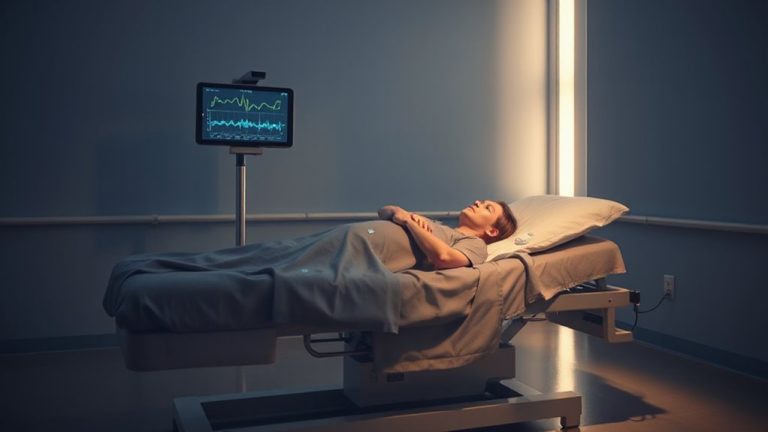
Recovery isn’t just about rest-it’s about repair, and sleep happens to be your body’s most powerful tool for both. During deep sleep, your body releases growth hormone, accelerates tissue regeneration, and balances cortisol levels, directly influencing recovery speed. You maximize this process by controlling your sleep environment-cool, dark, and quiet-using blackout curtains, white noise machines, or even temperature-regulating athletic recovery wear like compression garments designed to stay comfortable overnight. Pair this with precise nutritional timing: consuming protein and carbs within 30–60 minutes post-training primes muscle repair, but only if followed by quality sleep. Without it, even perfect nutrition falls short. High-end recovery gear supports thermoregulation and circulation, but its benefits plateau without consistent, uninterrupted sleep. You don’t just heal when you’re still-you rebuild smarter, deeper, and faster when your body’s systems align under ideal rest. That’s where true athletic recovery begins.
How Poor Sleep Delays Healing And Recovery
While your body tries to repair itself after intense training, skimping on sleep undermines the entire recovery process-no matter how advanced your gear or precise your nutrition. Sleep deprivation disrupts hormonal balance, reducing growth hormone release needed for tissue repair. Without sufficient rest, your nervous system struggles to reset, slowing reaction times and increasing injury risk. You might rely on recovery tools like compression devices or cryotherapy, but they can’t compensate for poor sleep. Over time, sleep loss accumulates, leading to chronic fatigue-a state where motivation drops and performance plateaus, no matter your training load. Recovery isn’t just physical; it’s neurological, metabolic, and hormonal. If you’re logging fewer than seven hours regularly, you’re likely delaying healing. Even smart nutrition and high-tech gear lose effectiveness when your sleep quality is low, making consistent, restorative rest non-negotiable for true athletic recovery.
How Deep Sleep Repairs Muscles And Fights Inflammation
Sleep’s deepest stage is where your body hits peak repair mode, and for good reason-this is when growth hormone surges, fueling muscle recovery and tissue regeneration. You’re not just resting; you’re actively rebuilding. During this phase, muscle regeneration accelerates as amino acids are rapidly incorporated into fibers, repairing microtears from intense training. At the same time, your nervous system calms, supporting inflammation control by modulating cytokine production and lowering cortisol. This dual action doesn’t just help recovery-it optimizes it. Without sufficient deep sleep, even the best recovery gear or compression wear becomes less effective, as biological repair lags. Think of deep sleep as the foundation: advanced clothing or recovery tools may help manage symptoms, but they can’t replicate your body’s internal repair cascade. Prioritize sleep quality, and you’re directly enhancing both muscle regeneration and inflammation control-the core drivers of athletic recovery.
Jet Lag, Late Games, And Hotel Rooms: Why Pro Schedules Sabotage Sleep
When you’re crossing time zones for back-to-back games or winding down after a late-night match in an unfamiliar hotel room, your sleep quality takes a hit no recovery supplement can fully fix. Circadian disruption throws off hormone regulation, slowing tissue repair. Late games and odd hours misalign your body’s internal clock, while environmental noise in hotels-like hall traffic or AC units-fragments sleep cycles. These factors combine to reduce REM and deep sleep, essential for cognitive and physical recovery.
| Factor | Impact on Sleep |
|---|---|
| Circadian disruption | Delays melatonin release, reducing sleep efficiency |
| Environmental noise | Increases awakenings, decreases sleep continuity |
Even elite recovery gear can’t override poor sleep environments. Consistent scheduling and noise control are critical. Your body needs predictable rest windows to perform. You can’t out-equip bad sleep hygiene.
Sleep Hacks For Athletes: Proven Ways To Recover Faster
You can’t fix disrupted sleep with fancy gear alone, but smart, science-backed strategies can make a real difference in recovery-especially when you’re stuck with erratic schedules. Smart napping-short, timed 20- to 30-minute rests-helps reset your nervous system without grogginess, boosting alertness and repair cycles. When travel or late games interfere, aim for naps before 3 p.m. to avoid nighttime sleep disruption. Pair this with precise caffeine timing: consume caffeine strategically in the morning or early afternoon, avoiding it within six hours of bedtime to prevent interference with deep sleep. While compression gear and recovery beds have value, their benefits plateau without proper sleep hygiene. These methods don’t replace consistent rest, but they stabilize sleep debt during intense competition cycles. Ultimately, small, controlled adjustments like smart napping and caffeine timing offer the most reliable edge in accelerating recovery when full rest isn’t an option.
On a final note
You need quality sleep to recover quickly, and it’s not just about hours-it’s about deep sleep cycles that repair muscle and reduce inflammation. Poor rest slows healing, especially with frequent travel disrupting circadian rhythms. Smart recovery means prioritizing sleep hygiene and using gear like cooling pillows or blackout masks. These tools, while not miracle fixes, support consistent, restorative rest-proven to enhance performance. You’ll heal faster and perform better when sleep becomes a non-negotiable part of training.