How Late Evening Weightlifting Affects REM Cycles and Next-Day Reaction Times
Late evening weightlifting spikes cortisol and adrenaline, delaying melatonin release and pushing back REM sleep onset-even if you sleep eight hours. This disrupts cognitive restoration, leaving you mentally foggy and slowing next-day reaction times. Elevated core temperature and nervous system arousal further impair sleep quality. For better recovery, finish lifting at least three hours before bed. You’ll support deeper sleep cycles and sharper mental performance tomorrow-there’s more to optimizing recovery than timing alone.
Notable Insights
- Late evening weightlifting elevates cortisol and adrenaline, delaying REM sleep onset and disrupting sleep architecture.
- Elevated core temperature from late workouts interferes with natural sleep cooldown, reducing sleep quality.
- Disrupted REM cycles impair cognitive restoration, leading to slower next-day reaction times.
- Hormonal imbalances from nighttime exercise reduce melatonin production, affecting sleep onset and depth.
- Finishing lifting at least three hours before bed supports better REM integrity and next-day mental performance.
Does Late Lifting Kill Your REM Sleep?
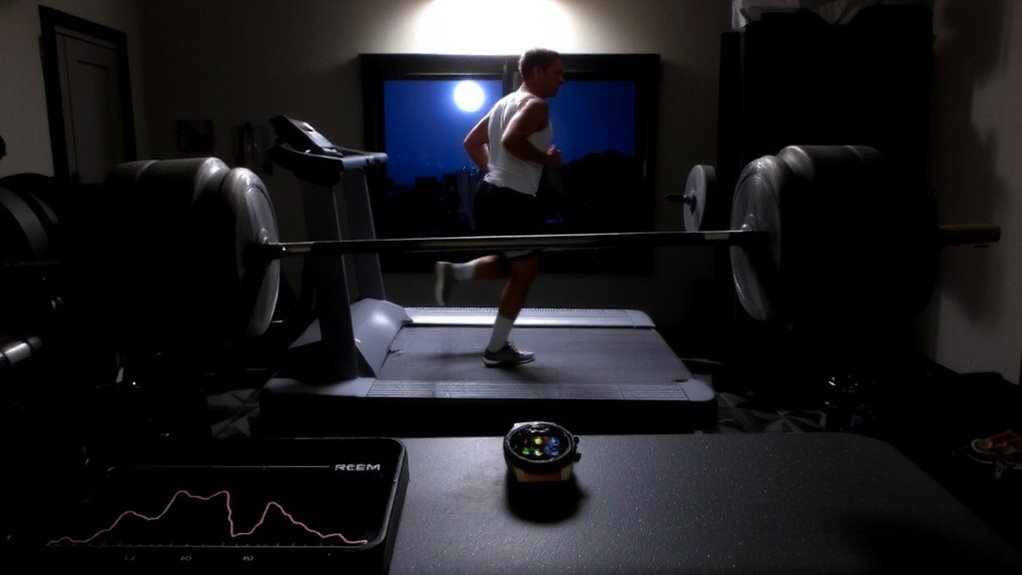
Could timing be the hidden factor undermining your recovery despite perfect form and top-tier fitness gear? When you lift late, your sleep architecture often pays the price. That intense session may boost growth hormone release, but it also triggers persistent hormonal fluctuations-especially cortisol-that can delay REM onset. Your body needs time to wind down, and without it, deep sleep phases shrink. Even if you clock eight hours, disrupted REM cycles mean less restorative rest. Studies show evening weightlifting shifts melatonin production, interfering with sleep onset and quality. You might feel recovered, but cognitive restoration lags. Sleep isn’t just downtime; it’s active repair shaped by timing. So while your gear supports physical performance, it can’t fix mistimed recovery. Optimizing workout timing helps preserve REM integrity, balancing hormonal rhythm and sleep structure for true recovery.
Why Late-Night Workouts Slow Morning Reaction Time
While your late-night lifting session might leave you feeling accomplished, it could be undermining your next-day sharpness more than you realize. Late workouts trigger cortisol spikes just when your body should be winding down, disrupting hormonal balance critical for cognitive recovery. This heightened stress response lingers, contributing to neural fatigue that hampers signal efficiency in the brain. You’re not imagining those sluggish morning reactions-your neurons are literally firing slower. Even if you clock enough sleep, the quality of mental restoration suffers, impairing focus and decision speed. Fitness recovery isn’t just about muscles; your nervous system needs downtime too. Without it, reaction time dips measurably by mid-morning. Recovery gear like compression or cooling devices may support physical repair, but they can’t fully offset the neural cost of mistimed exertion. Timing your training earlier aligns better with your body’s natural rhythm, preserving mental performance when it matters most.
How Late Exercise Keeps Your Body Too Wired to Sleep
Though your muscles may crave that post-dinner pump, exercising too close to bedtime leaves your body in a state of physiological arousal that’s hard to shake. You’re dealing with adrenaline spikes that sharpen alertness when you should be winding down, making it tougher to shift into restful sleep. Your core temperature also rises during weightlifting, and since falling asleep requires a natural cooldown, this delay disrupts your sleep onset. Even if you fall asleep, your body might not reach deep, restorative stages efficiently. Recovery isn’t just about how hard you train-it’s about timing. Without adequate cooldown and hormonal balance, muscle repair slows. That high-performance fitness gear you rely on won’t compensate for poor recovery habits. Your body needs time to normalize essential metrics before bed; otherwise, sleep quality drops, undermining both next-day focus and long-term fitness gains.
Best Time to Lift Weights Without Losing Sleep
Since your body needs time to wind down before sleep, lifting weights too late cuts into the recovery window when muscle repair and hormonal balance occur most effectively. You’re better off finishing workouts at least three hours before bed to avoid cortisol spikes that interfere with melatonin. Early evening sessions, around 5–7 p.m., align well with natural peaks in body temperature and strength, letting you push through muscle fatigue without wrecking sleep quality. Lifting earlier gives your nervous system time to calm, reducing the risk of delayed REM onset. While fitness gear like compression suits may help stabilize muscle fatigue, timing remains key. Late lifts might feel productive, but they often trigger stress responses that linger. You’ll perform better and recover faster when workouts end in time for your body to shift smoothly into rest. Prioritize consistency, not convenience-your sleep and next-day reaction times depend on it.
How to Recover Fast After an Evening Workout
Wrapping up an evening workout doesn’t mean your body clock resets-you still need to manage recovery if you’re aiming for solid sleep and sharp performance the next day. Taking a cold shower can help reduce inflammation and signal your nervous system to wind down, improving sleep onset and REM stability. While intense cooling might not suit everyone, a 5–10 minute cool-to-cold rinse shows measurable benefits in muscle recovery and circadian alignment. Pair that with proper protein timing-consuming 20–30 grams of fast-absorbing protein like whey within 30–45 minutes post-workout-to support muscle repair without disrupting sleep. Delaying protein intake weakens recovery efficiency, especially after late lifting. Compression gear can further aid circulation, but its impact is secondary to thermoregulation and nutrition. A massage gun used post-exercise can enhance recovery by increasing blood flow and reducing muscle tension, especially when targeting major muscle groups with the right best massage guns. Focus on basics first: cold showers regulate temperature, protein timing fuels repair, and both enhance next-day reaction times when consistency is maintained.
On a final note
You’ll recover better if you time lifting right-late sessions can overstimulate your nervous system, delaying sleep onset and trimming REM. That disrupted REM often blunts next-day reaction times, especially with poor cooldown habits. While recovery gear like percussive massagers or compression apparel helps, it can’t fully offset sleep loss. For peak recovery, lift earlier or allow three hours before bed, prioritize cooling down, and pair smart timing with quality rest gear to maintain performance and cognitive sharpness long-term.